Ch 07: Newton's Third Law
Knight Calc - Physics for Scientists and Engineers 5th Edition
Knight Calc5th EditionPhysics for Scientists and EngineersISBN: 9780137344796당신이 사용하는 게 아니라요?교과서 변경
7장, 문제 1c

A tennis racket swung over the server's head hits a tennis ball horizontally. Draw a free-body diagram for each object in the system. Use dashed lines to connect members of an action/reaction pair.

검증된 단계별 안내
1
Step 1: Identify the objects in the system. In this case, the objects are the tennis racket and the tennis ball. Each object will have its own free-body diagram.
Step 2: For the tennis racket, draw a free-body diagram. Represent the forces acting on it: (1) the gravitational force acting downward (\( F_g = m_r g \), where \( m_r \) is the mass of the racket), and (2) the upward normal force exerted by the server's hand. If the racket is in motion, include the force exerted by the ball on the racket (action/reaction pair).
Step 3: For the tennis ball, draw a free-body diagram. Represent the forces acting on it: (1) the gravitational force acting downward (\( F_g = m_b g \), where \( m_b \) is the mass of the ball), and (2) the horizontal force exerted by the racket on the ball during the hit (action/reaction pair).
Step 4: Use dashed lines to connect the action/reaction force pairs. For example, the force exerted by the racket on the ball and the force exerted by the ball on the racket are equal in magnitude and opposite in direction, as per Newton's Third Law. Connect these forces with a dashed line.
Step 5: Ensure that the diagrams are labeled clearly with all forces identified. For each force, indicate its direction and label it appropriately (e.g., \( F_g \) for gravitational force, \( F_{r \, on \, b} \) for the force of the racket on the ball, etc.). This will help in understanding the interaction between the objects in the system.

비슷한 문제에 대한 검증된 영상 답변:

이 영상 해법은 위 문제에 도움이 된다고 튜터들이 추천한 것입니다.
도움이 되었나요?

주요 개념

질문에 올바르게 답하기 위해 반드시 이해해야 하는 핵심 개념들은 다음과 같습니다.

Free-Body Diagram

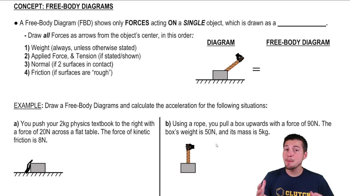
A free-body diagram is a graphical representation used to visualize the forces acting on an object. It shows the object as a dot and the forces as arrows pointing away from the object, indicating both the direction and magnitude of each force. This tool is essential for analyzing the dynamics of a system, as it helps identify all the forces involved, including gravitational, normal, frictional, and applied forces.
추천 영상:
가이드 코스
08:42
Free-Body Diagrams

Newton's Third Law of Motion

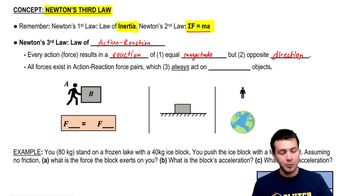
Newton's Third Law states that for every action, there is an equal and opposite reaction. This principle implies that forces always occur in pairs; when one object exerts a force on another, the second object exerts a force of equal magnitude and opposite direction back on the first. Understanding this law is crucial for identifying action/reaction pairs in the free-body diagrams of the tennis racket and ball.
추천 영상:
가이드 코스
08:01
Newton's Third Law & Action-Reaction Pairs

Horizontal Motion

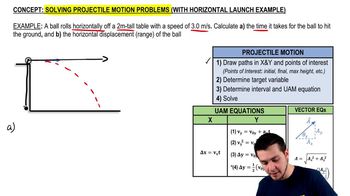
Horizontal motion refers to movement along a horizontal plane, where the primary forces acting on an object are typically gravity and any applied forces. In the context of the tennis racket hitting the ball, the ball's horizontal motion is influenced by the force exerted by the racket and air resistance. Analyzing horizontal motion is important for understanding the trajectory and behavior of the ball after impact.
추천 영상:
가이드 코스
08:37
Solving Horizontal Launch Problems