Ch 08: Dynamics II: Motion in a Plane
Knight Calc - Physics for Scientists and Engineers 5th Edition
Knight Calc5th EditionPhysics for Scientists and EngineersISBN: 9780137344796당신이 사용하는 게 아니라요?교과서 변경
8장, 문제 4a

A 4.0 x 10¹⁰ kg asteroid is heading directly toward the center of the earth at a steady 20 km/s. To save the planet, astronauts strap a giant rocket to the asteroid perpendicular to its direction of travel. The rocket generates 5.0 x 10⁹ N of thrust. The rocket is fired when the asteroid is 4.0 x 10⁶ km away from earth. You can ignore the earth's gravitational force on the asteroid and their rotation about the sun. If the mission fails, how many hours is it until the asteroid impacts the earth?

검증된 단계별 안내
1
Step 1: Calculate the time it would take for the asteroid to reach Earth if it continues traveling at its current velocity. Use the formula for time, \( t = \frac{d}{v} \), where \( d \) is the distance to Earth (\( 4.0 \times 10^6 \; \text{km} \)) and \( v \) is the velocity of the asteroid (\( 20 \; \text{km/s} \)). Convert the time from seconds to hours by dividing by 3600.
Step 2: Convert the given distance \( d \) from kilometers to meters to ensure consistent units. Since \( 1 \; \text{km} = 1000 \; \text{m} \), multiply \( 4.0 \times 10^6 \; \text{km} \) by 1000 to get the distance in meters.
Step 3: Substitute the converted distance (in meters) and the velocity (\( 20 \; \text{km/s} \), converted to \( 20000 \; \text{m/s} \)) into the formula \( t = \frac{d}{v} \) to calculate the time in seconds.
Step 4: Convert the time from seconds to hours by dividing the result by 3600 (since there are 3600 seconds in an hour). This will give the time until the asteroid impacts the Earth in hours.
Step 5: Interpret the result to understand how much time remains before the asteroid impacts Earth if no intervention occurs. This value represents the time available for any corrective actions to be taken.

비슷한 문제에 대한 검증된 영상 답변:

이 영상 해법은 위 문제에 도움이 된다고 튜터들이 추천한 것입니다.
영상 길이:
2m

주요 개념

질문에 올바르게 답하기 위해 반드시 이해해야 하는 핵심 개념들은 다음과 같습니다.

Kinematics

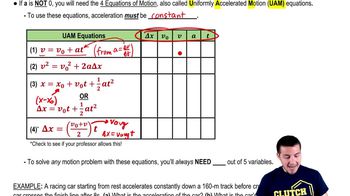
Kinematics is the branch of mechanics that deals with the motion of objects without considering the forces that cause the motion. In this scenario, understanding kinematics is essential to calculate the time it takes for the asteroid to travel a certain distance at a constant speed. The basic formula used is time = distance / speed, which allows us to determine how long it will take for the asteroid to reach Earth if no other forces act on it.
추천 영상:
가이드 코스
08:25
Kinematics Equations

Newton's Second Law of Motion

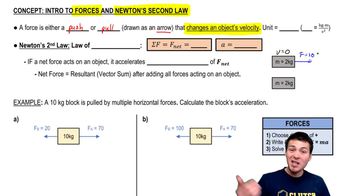
Newton's Second Law states that the acceleration of an object is directly proportional to the net force acting on it and inversely proportional to its mass, expressed as F = ma. Although the question specifies ignoring gravitational forces, this law is crucial for understanding how the thrust from the rocket will affect the asteroid's motion if the mission were to succeed. It helps in analyzing the changes in velocity and direction due to the applied force.
추천 영상:
가이드 코스
06:54
Intro to Forces & Newton's Second Law

Thrust and Impulse

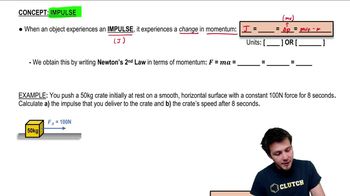
Thrust is the force exerted by a rocket engine to propel an object, while impulse is the change in momentum resulting from a force applied over time. In this scenario, the thrust generated by the rocket can alter the asteroid's trajectory, but if the mission fails, the initial conditions of motion remain unchanged. Understanding thrust and impulse is vital for evaluating the potential effectiveness of the astronauts' intervention and the resulting motion of the asteroid.
추천 영상:
가이드 코스
06:00
Impulse & Impulse-Momentum Theorem
관련 실천
교과서 질문

A 1500 kg car takes a 50-m-radius unbanked curve at 15 m/s. What is the size of the friction force on the car?

1655
views

교과서 질문

As a science fair project, you want to launch an 800 g model rocket straight up and hit a horizontally moving target as it passes 30 m above the launch point. The rocket engine provides a constant thrust of 15.0 N. The target is approaching at a speed of 15 m/s. At what horizontal distance between the target and the rocket should you launch?

1730
views
교과서 질문

A 500 g model rocket is on a cart that is rolling to the right at a speed of. The rocket engine, when it is fired, exerts an 8.0 N vertical thrust on the rocket. Your goal is to have the rocket pass through a small horizontal hoop that is 20 m above the ground. At what horizontal distance left of the hoop should you launch?

2250
views
교과서 질문

In the Bohr model of the hydrogen atom, an electron (mass m = 9.1 x 10⁻³¹ kg) orbits a proton at a distance of 5.3 x 10⁻¹¹ m. The proton pulls on the electron with an electric force of 8.2 x 10⁻⁸ N. How many revolutions per second does the electron make?

2435
views
1
rank
교과서 질문

A 4.0 x 10¹⁰ kg asteroid is heading directly toward the center of the earth at a steady 20 km/s. To save the planet, astronauts strap a giant rocket to the asteroid perpendicular to its direction of travel. The rocket generates 5.0 x 10⁹ N of thrust. The rocket is fired when the asteroid is 4.0 x 10⁶ km away from earth. You can ignore the earth's gravitational force on the asteroid and their rotation about the sun.The radius of the earth is 6400 km. By what minimum angle must the asteroid be deflected to just miss the earth?

1919
views
1
rank