
Ch 08: Dynamics II: Motion in a Plane
Knight Calc - Physics for Scientists and Engineers 5th Edition
Knight Calc5th EditionPhysics for Scientists and EngineersISBN: 9780137344796당신이 사용하는 게 아니라요?교과서 변경
8장, 문제 68a

In the absence of air resistance, a projectile that lands at the elevation from which it was launched achieves maximum range when launched at a 45° angle. Suppose a projectile of mass m is launched with speed into a headwind that exerts a constant, horizontal retarding force Fwind=Fwindı^.\(\vec{F}\)_{\(\text{wind}\)} = -F_{\(\text{wind}\)} \(\hat{\imath}\).. Find an expression for the angle at which the range is maximum.

검증된 단계별 안내
1
Start by analyzing the forces acting on the projectile. The headwind exerts a constant horizontal retarding force \( F_{\text{wind}} = -F_{\text{wind}} \hat{i} \), which affects the horizontal motion of the projectile. The vertical motion is influenced only by gravity \( g \).
Write the equations of motion for the horizontal and vertical directions. For the horizontal motion, the acceleration is \( a_x = -\frac{F_{\text{wind}}}{m} \), and the velocity in the horizontal direction is \( v_x(t) = v_0 \cos(\theta) - \frac{F_{\text{wind}}}{m}t \). For the vertical motion, the acceleration is \( a_y = -g \), and the velocity in the vertical direction is \( v_y(t) = v_0 \sin(\theta) - g t \).
Determine the time of flight \( T \) by finding when the projectile returns to its initial elevation. Use the vertical displacement equation \( y(t) = v_0 \sin(\theta)t - \frac{1}{2}g t^2 \). Setting \( y(T) = 0 \), solve for \( T \): \( T = \frac{2v_0 \sin(\theta)}{g} \).
Find the horizontal range \( R \) by integrating the horizontal velocity over the time of flight. The horizontal displacement is \( x(T) = \int_0^T \left(v_0 \cos(\theta) - \frac{F_{\text{wind}}}{m}t\right) dt \). Solve this integral to get \( R = v_0 \cos(\theta)T - \frac{F_{\text{wind}}}{2m}T^2 \). Substitute \( T = \frac{2v_0 \sin(\theta)}{g} \) into this expression.
To maximize the range \( R \), take the derivative of \( R \) with respect to \( \theta \) and set it equal to zero. Solve \( \frac{dR}{d\theta} = 0 \) to find the angle \( \theta \) that maximizes the range. This will involve balancing the effects of the headwind and gravity on the projectile's motion.

비슷한 문제에 대한 검증된 영상 답변:

이 영상 해법은 위 문제에 도움이 된다고 튜터들이 추천한 것입니다.
영상 길이:
16m
도움이 되었나요?

주요 개념

질문에 올바르게 답하기 위해 반드시 이해해야 하는 핵심 개념들은 다음과 같습니다.

Projectile Motion

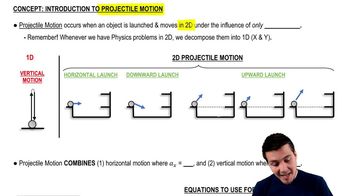
Projectile motion refers to the motion of an object that is launched into the air and is subject to gravitational force. The trajectory of a projectile is typically parabolic, and its range is influenced by the launch angle, initial speed, and the effects of air resistance. In ideal conditions without air resistance, the optimal launch angle for maximum range is 45 degrees.
추천 영상:
가이드 코스
04:44
Introduction to Projectile Motion

Effect of Air Resistance

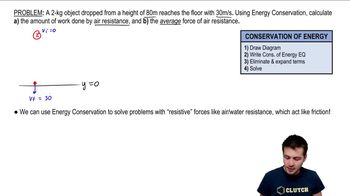
Air resistance, or drag, is a force that opposes the motion of an object through the air. It affects the trajectory and range of projectiles by reducing their horizontal velocity and altering their optimal launch angle. In the presence of a headwind, the effective launch angle for achieving maximum range will differ from the ideal 45 degrees due to the additional retarding force acting on the projectile.
추천 영상:
가이드 코스
05:06
Energy Conservation with Air Resistance

Optimal Launch Angle

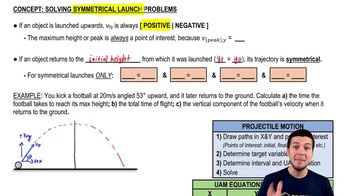
The optimal launch angle is the angle at which a projectile should be launched to achieve the maximum horizontal distance or range. This angle can change based on external factors such as air resistance and wind. In the case of a projectile launched into a headwind, the optimal angle will need to be recalculated to account for the retarding force, which typically results in a launch angle less than 45 degrees.
추천 영상:
가이드 코스
12:39
Solving Symmetric Launch Problems
관련 실천
교과서 질문

A 500 g steel block rotates on a steel table while attached to a 1.2-m-long hollow tube as shown in FIGURE CP8.70. Compressed air fed through the tube and ejected from a nozzle on the back of the block exerts a thrust force of 4.0 N perpendicular to the tube. The maximum tension the tube can withstand without breaking is 50 N. If the block starts from rest, how many revolutions does it make before the tube breaks?

2040
views
1
rank
교과서 질문

2.0 kg ball swings in a vertical circle on the end of an 80-cm-long string. The tension in the string is 20 N when its angle from the highest point on the circle is θ = 30°. What is the ball's speed when θ = 30°?

2452
views
1
rank
교과서 질문

The 10 mg bead in FIGURE CP8.69 is free to slide on a frictionless wire loop. The loop rotates about a vertical axis with angular velocity ω. If ω is less than some critical value ω꜀, the bead sits at the bottom of the spinning loop. When ω > ω꜀, the bead moves out to some angle θ. What is ω꜀ in rpm for the loop shown in the figure?

2536
views
교과서 질문

In the absence of air resistance, a projectile that lands at the elevation from which it was launched achieves maximum range when launched at a 45° angle. Suppose a projectile of mass m is launched with speed into a headwind that exerts a constant, horizontal retarding force Fwind=Fwindı^.\(\vec{F}\)_{\(\text{wind}\)} = -F_{\(\text{wind}\)} \(\hat{\imath}\). By what percentage is the maximum range of a 0.50 kg ball reduced if Fwind=0.60 NF_{\(\text{wind}\)}=0.60\(\text{ N}\)?

2355
views
교과서 질문

Scientists design a new particle accelerator in which protons (mass 1.7 X 10⁻²⁷ kg) follow a circular trajectory given by r=ccos(kt2)i+csin(kt2)j\(\mathbf{r}\) = c \(\cos\)(kt^2) \(\mathbf{i}\) + c \(\sin\)(kt^2) \(\mathbf{j}\) where c = 5.0 m and k = 8.0 x 10⁴ rad/s2 are constants and t is the elapsed time. What is the radius of the circle?

2244
views
교과서 질문

For safety, elevators have a rotational governor, a device that is attached to and rotates with one of the elevator's pulleys. The governor, shown in FIGURE P8.63, is a disk with two hollow channels holding springs with metal blocks of mass m attached to their free ends. The faster the governor spins, the more the springs stretch. At a critical angular velocity ωc, the metal blocks contact the housing, which completes a circuit and activates an emergency brake. The spring force on a mass, which we will explore more thoroughly in Chapter 9, is FSp = k(r - L), where k is the spring constant measured in N/m, and L is the relaxed (unstretched) length of the spring. Suppose a rotational governor has L = 0.80R and the emergency brake activates when the metal blocks reach r = R. What is the critical angular velocity in rpm if R = 15cm, k = 20 N/m, and m = 25g? Ignore gravity.

249
views