Ch 09: Work and Kinetic Energy
Knight Calc - Physics for Scientists and Engineers 5th Edition
Knight Calc5th EditionPhysics for Scientists and EngineersISBN: 9780137344796당신이 사용하는 게 아니라요?교과서 변경
9장, 문제 41

A 70 kg human sprinter can accelerate from rest to 10 m/s in 3.0 s. During the same time interval, a 30 kg greyhound can go from rest to 20 m/s. What is the average power output of each? Average power over a time interval ∆t is ∆E/∆t.

검증된 단계별 안내
1
Step 1: Start by recalling the formula for average power, which is given as \( P_{avg} = \frac{\Delta E}{\Delta t} \), where \( \Delta E \) is the change in energy and \( \Delta t \) is the time interval.
Step 2: The change in energy \( \Delta E \) is the change in kinetic energy, which can be calculated using the formula \( KE = \frac{1}{2} m v^2 \), where \( m \) is the mass and \( v \) is the velocity. For each case, calculate the final kinetic energy since the initial kinetic energy is zero (starting from rest).
Step 3: For the human sprinter, substitute \( m = 70 \ \text{kg} \) and \( v = 10 \ \text{m/s} \) into the kinetic energy formula: \( KE_{human} = \frac{1}{2} (70) (10)^2 \).
Step 4: For the greyhound, substitute \( m = 30 \ \text{kg} \) and \( v = 20 \ \text{m/s} \) into the kinetic energy formula: \( KE_{greyhound} = \frac{1}{2} (30) (20)^2 \).
Step 5: Divide the calculated kinetic energy for each case by the time interval \( \Delta t = 3.0 \ \text{s} \) to find the average power output: \( P_{avg, human} = \frac{KE_{human}}{3.0} \) and \( P_{avg, greyhound} = \frac{KE_{greyhound}}{3.0} \).

비슷한 문제에 대한 검증된 영상 답변:

이 영상 해법은 위 문제에 도움이 된다고 튜터들이 추천한 것입니다.
영상 길이:
4m
도움이 되었나요?

주요 개념

질문에 올바르게 답하기 위해 반드시 이해해야 하는 핵심 개념들은 다음과 같습니다.

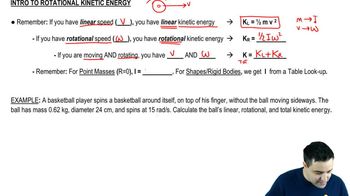
Kinetic Energy

Kinetic energy is the energy an object possesses due to its motion, calculated using the formula KE = 1/2 mv², where m is mass and v is velocity. In this scenario, both the sprinter and the greyhound are accelerating, which means their kinetic energy will change as they reach their final speeds. Understanding kinetic energy is essential for calculating the work done and the power output.
추천 영상:
가이드 코스
06:07
Intro to Rotational Kinetic Energy

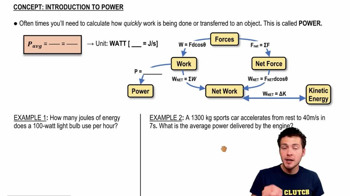
Power

Power is defined as the rate at which work is done or energy is transferred over time, expressed mathematically as P = ∆E/∆t. In this context, average power output can be calculated by determining the change in kinetic energy for each athlete and dividing it by the time interval of their acceleration. This concept is crucial for comparing the performance of the sprinter and the greyhound.
추천 영상:

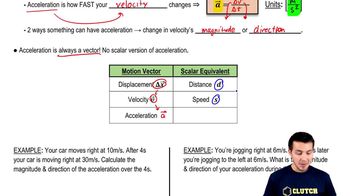
Acceleration

Acceleration is the rate of change of velocity of an object over time, calculated as a = (v_f - v_i)/∆t, where v_f is final velocity, v_i is initial velocity, and ∆t is the time interval. Both the sprinter and the greyhound experience acceleration as they increase their speeds from rest. Understanding acceleration helps in determining the forces involved and the energy changes during their motion.
추천 영상:
가이드 코스
05:47
Intro to Acceleration