Ch 09: Work and Kinetic Energy
Knight Calc - Physics for Scientists and Engineers 5th Edition
Knight Calc5th EditionPhysics for Scientists and EngineersISBN: 9780137344796당신이 사용하는 게 아니라요?교과서 변경
9장, 문제 6

A pitcher accelerates a 150 g baseball from rest to 35 m/s. How much work does the pitcher do on the ball?

검증된 단계별 안내
1
Step 1: Identify the given values in the problem. The mass of the baseball is 150 g (convert to kilograms: 0.150 kg), the initial velocity (v₀) is 0 m/s, and the final velocity (v) is 35 m/s. The goal is to calculate the work done on the ball.
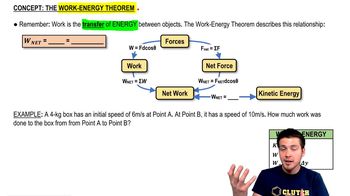
Step 2: Recall the work-energy principle, which states that the work done on an object is equal to its change in kinetic energy. The formula for kinetic energy is: K1 = 12mv2. The change in kinetic energy is given by: W = K2 - K1.
Step 3: Substitute the values into the kinetic energy formula. For the initial kinetic energy, K1 = 12mv2, where v0 is 0 m/s. This makes K1 = 0. For the final kinetic energy, use K2 = 12mv2, where v is 35 m/s.
Step 4: Calculate the change in kinetic energy using the formula: W = K2 - K1. Since K1 = 0, the work done is equal to K2, which is 12mv2. Substitute the values for mass and velocity into this formula.
Step 5: Perform the calculation to find the work done. Ensure the units are consistent (mass in kilograms, velocity in meters per second), and express the result in joules (J), the standard unit of work and energy.

비슷한 문제에 대한 검증된 영상 답변:

이 영상 해법은 위 문제에 도움이 된다고 튜터들이 추천한 것입니다.
영상 길이:
2m
도움이 되었나요?

주요 개념

질문에 올바르게 답하기 위해 반드시 이해해야 하는 핵심 개념들은 다음과 같습니다.

Work-Energy Principle

The Work-Energy Principle states that the work done on an object is equal to the change in its kinetic energy. In this scenario, the pitcher does work on the baseball to accelerate it from rest to a certain speed, which results in an increase in the ball's kinetic energy.
추천 영상:
가이드 코스
04:10
The Work-Energy Theorem

Kinetic Energy

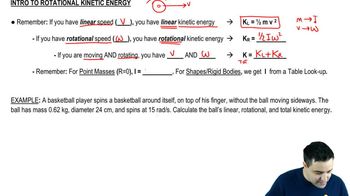
Kinetic energy is the energy an object possesses due to its motion, calculated using the formula KE = 0.5 * m * v^2, where m is the mass and v is the velocity. For the baseball, its kinetic energy will be determined by its mass and the final speed it reaches after being pitched.
추천 영상:
가이드 코스
06:07
Intro to Rotational Kinetic Energy

Mass and Units

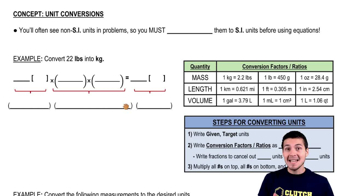
Mass is a measure of the amount of matter in an object, typically measured in kilograms (kg) or grams (g). In this problem, the baseball's mass is given as 150 g, which must be converted to kilograms (0.15 kg) to use in calculations involving work and kinetic energy, as standard physics equations require SI units.
추천 영상:
가이드 코스
07:46
Unit Conversions