Ch 09: Work and Kinetic Energy
Knight Calc - Physics for Scientists and Engineers 5th Edition
Knight Calc5th EditionPhysics for Scientists and EngineersISBN: 9780137344796당신이 사용하는 게 아니라요?교과서 변경
9장, 문제 34

Justin, with a mass of 30 kg, is going down an 8.0-m-high water slide. He starts at rest, and his speed at the bottom is 11 m/s. How much thermal energy is created by friction during his descent?

검증된 단계별 안내
1
Step 1: Identify the energy transformations involved. Justin starts at rest, so his initial energy is purely gravitational potential energy. At the bottom of the slide, he has kinetic energy, and some energy is lost as thermal energy due to friction.
Step 2: Calculate Justin's initial gravitational potential energy using the formula: Eginitial=mgh, where m is his mass (30 kg), g is the acceleration due to gravity (9.8 m/s²), and h is the height of the slide (8.0 m).
Step 3: Calculate Justin's kinetic energy at the bottom of the slide using the formula: Ekfinal=12mv2, where m is his mass (30 kg) and v is his speed at the bottom (11 m/s).
Step 4: Determine the total energy lost to friction by subtracting the final kinetic energy from the initial gravitational potential energy. Use the formula: Ethermal=Eginitial-Ekfinal.
Step 5: Verify the units of your calculations to ensure consistency (e.g., joules for energy) and interpret the result as the amount of thermal energy generated by friction during Justin's descent.

비슷한 문제에 대한 검증된 영상 답변:

이 영상 해법은 위 문제에 도움이 된다고 튜터들이 추천한 것입니다.
영상 길이:
9m

주요 개념

질문에 올바르게 답하기 위해 반드시 이해해야 하는 핵심 개념들은 다음과 같습니다.

Conservation of Energy

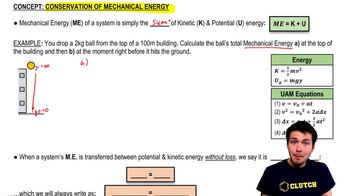
The principle of conservation of energy states that energy cannot be created or destroyed, only transformed from one form to another. In this scenario, Justin's potential energy at the top of the slide is converted into kinetic energy as he descends. Any difference between the initial potential energy and the final kinetic energy indicates energy lost to friction, which manifests as thermal energy.
추천 영상:
가이드 코스
06:24
Conservation Of Mechanical Energy

Potential Energy

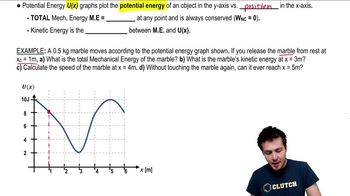
Potential energy is the energy stored in an object due to its position in a gravitational field. For Justin, this is calculated using the formula PE = mgh, where m is mass, g is the acceleration due to gravity, and h is height. At the top of the slide, his potential energy is at its maximum, which decreases as he descends, converting into kinetic energy and thermal energy due to friction.
추천 영상:
가이드 코스
07:24
Potential Energy Graphs

Kinetic Energy

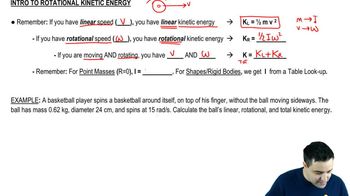
Kinetic energy is the energy of an object in motion, defined by the formula KE = 0.5mv², where m is mass and v is velocity. At the bottom of the slide, Justin's kinetic energy reflects his speed. The difference between the initial potential energy and the final kinetic energy helps quantify the thermal energy generated by friction during his descent.
추천 영상:
가이드 코스
06:07
Intro to Rotational Kinetic Energy