Ch 11: Impulse and Momentum
Knight Calc - Physics for Scientists and Engineers 5th Edition
Knight Calc5th EditionPhysics for Scientists and EngineersISBN: 9780137344796당신이 사용하는 게 아니라요?교과서 변경
11장, 문제 73

A 2100 kg truck is traveling east through an intersection at 2.0 m/s when it is hit simultaneously from the side and the rear. (Some people have all the luck!) One car is a 1200 kg compact traveling north at 5.0 m/s. The other is a 1500 kg midsize traveling east at 10 m/s. The three vehicles become entangled and slide as one body. What are their speed and direction just after the collision?

검증된 단계별 안내
1
Step 1: Recognize that this is a perfectly inelastic collision problem where the three vehicles stick together after the collision. The principle of conservation of momentum applies separately in the x-direction (east-west) and the y-direction (north-south).
Step 2: Write the momentum conservation equation for the x-direction. The total momentum in the x-direction before the collision is the sum of the momenta of the truck and the midsize car (since the compact car has no velocity in the x-direction). Use the formula for momentum: \( p = m \cdot v \), where \( m \) is mass and \( v \) is velocity.
Step 3: Write the momentum conservation equation for the y-direction. The total momentum in the y-direction before the collision is the momentum of the compact car (since the truck and midsize car have no velocity in the y-direction).
Step 4: Calculate the total mass of the entangled vehicles after the collision. The total mass is the sum of the masses of the truck, compact car, and midsize car. Use this total mass to find the final velocity components \( v_x \) (in the x-direction) and \( v_y \) (in the y-direction) by dividing the total momentum in each direction by the total mass.
Step 5: Determine the magnitude and direction of the final velocity. The magnitude of the velocity is given by \( v = \sqrt{v_x^2 + v_y^2} \), and the direction (angle \( \theta \)) is given by \( \theta = \tan^{-1}(v_y / v_x) \).

비슷한 문제에 대한 검증된 영상 답변:

이 영상 해법은 위 문제에 도움이 된다고 튜터들이 추천한 것입니다.
영상 길이:
18m
도움이 되었나요?

주요 개념

질문에 올바르게 답하기 위해 반드시 이해해야 하는 핵심 개념들은 다음과 같습니다.

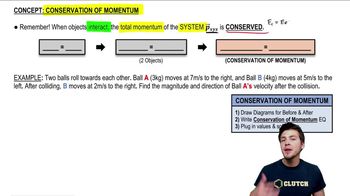
Conservation of Momentum

The principle of conservation of momentum states that the total momentum of a closed system remains constant if no external forces act on it. In collisions, the momentum before the collision must equal the momentum after the collision. This concept is crucial for solving problems involving collisions, as it allows us to calculate the final velocities of the objects involved.
추천 영상:
가이드 코스
05:58
Conservation Of Momentum

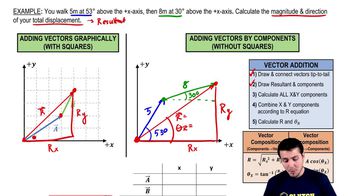
Vector Addition

In physics, velocity is a vector quantity, meaning it has both magnitude and direction. When multiple objects collide, their velocities must be treated as vectors, requiring vector addition to determine the resultant velocity of the combined mass. This involves breaking down the velocities into their components and summing them accordingly to find the overall speed and direction after the collision.
추천 영상:
가이드 코스
07:30
Vector Addition By Components

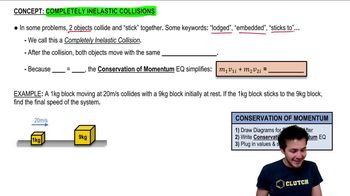
Inelastic Collision

An inelastic collision is a type of collision where the colliding objects stick together after impact, resulting in a loss of kinetic energy. In this scenario, the three vehicles become entangled and move as a single body, which is characteristic of inelastic collisions. Understanding this concept is essential for analyzing the final speed and direction of the combined mass post-collision.
추천 영상:
가이드 코스
04:18
Completely Inelastic Collisions
관련 실천
교과서 질문

In Problems 76,77,78,76, 77, 78, and 7979 you are given the equation(s) used to solve a problem. For each of these, you are to write a realistic problem for which this is the correct equation(s).

12(0.30 kg)(0 m/s)2+12(3.0 N/m)(Δx2)2=12(0.30 kg)(v1x)2+12(3.0 N/m)(0 m)2\(\frac{1}{2}\) (0.30 \(\text{ kg}\)) (0 \(\text{ m/s}\))^2 + \(\frac{1}{2}\) (3.0 \(\text{ N/m}\)) (\(\Delta\) x_2)^2 = \(\frac{1}{2}\) (0.30 \(\text{ kg}\)) (v_{1x})^2 + \(\frac{1}{2}\) (3.0 \(\text{ N/m}\)) (0 \(\text{ m}\))^2

793
views
교과서 질문

In Problems 76,77,78,76, 77, 78, and 7979 you are given the equation(s) used to solve a problem. For each of these, you are to finish the solution of the problem, including a pictorial representation.

12(0.30 kg)(0 m/s)2+12(3.0 N/m)(Δx2)2=12(0.30 kg)(v1x)2+12(3.0 N/m)(0 m)2\(\frac{1}{2}\) (0.30 \(\text{ kg}\)) (0 \(\text{ m/s}\))^2 + \(\frac{1}{2}\) (3.0 \(\text{ N/m}\)) (\(\Delta\) x_2)^2 = \(\frac{1}{2}\) (0.30 \(\text{ kg}\)) (v_{1x})^2 + \(\frac{1}{2}\) (3.0 \(\text{ N/m}\)) (0 \(\text{ m}\))^2

557
views
교과서 질문

A 45 g projectile explodes into three pieces: a 20 g piece with velocity 25 î m/s, a 15 g piece with velocity −10 î + 10ĵ m/s, and a 10 g piece with velocity −15 î − 20ĵ m/s. What was the projectile's velocity just before the explosion?

2383
views
교과서 질문

A spaceship of mass 2.0×10⁶ kg is cruising at a speed of 5.0×10⁶ m/s when the antimatter reactor fails, blowing the ship into three pieces. One section, having a mass of 5.0×10⁵ kg, is blown straight backward with a speed of 2.0×10⁶ m/s . A second piece, with mass 8.0×10⁵ kg, continues forward at 1.0×10⁶ m/s. What are the direction and speed of the third piece?

519
views
교과서 질문

A white ball traveling at 2.0m/s hits an equal-mass red ball at rest. The white ball is deflected by 25° and slowed to 1.5m/s. What percentage of the initial mechanical energy is lost in the collision?

2201
views
교과서 질문

A neutron is an electrically neutral subatomic particle with a mass just slightly greater than that of a proton. A free neutron is radioactive and decays after a few minutes into other subatomic particles. In one experiment, a neutron at rest was observed to decay into a proton (mass 1.67×10⁻²⁷ kg) and an electron (mass 9.11×10⁻³¹ kg) . The proton and electron were shot out back-to-back. The proton speed was measured to be 1.0 ×10⁵ m/s, and the electron speed was 3.0×10⁷ m/s. No other decay products were detected. How much momentum did this neutrino 'carry away' with it?

2150
views