Ch 11: Impulse and Momentum
Knight Calc - Physics for Scientists and Engineers 5th Edition
Knight Calc5th EditionPhysics for Scientists and EngineersISBN: 9780137344796당신이 사용하는 게 아니라요?교과서 변경
11장, 문제 11b

A force in the +x-direction increases linearly from 0 N to 9000 N in 5.0 s, then suddenly ends. What impulse does this force provide?

검증된 단계별 안내
1
Step 1: Recall the definition of impulse. Impulse is the product of force and the time interval during which the force acts. Mathematically, impulse is given by \( J = \int F(t) \, dt \), where \( F(t) \) is the force as a function of time.
Step 2: Recognize that the force increases linearly from 0 N to 9000 N over 5.0 s. A linear force can be expressed as \( F(t) = kt \), where \( k \) is the slope of the force-time graph. Determine \( k \) using the formula \( k = \frac{F_{\text{max}}}{t_{\text{max}}} \), where \( F_{\text{max}} = 9000 \, \text{N} \) and \( t_{\text{max}} = 5.0 \, \text{s} \).
Step 3: Substitute \( F(t) = kt \) into the impulse formula \( J = \int F(t) \, dt \). The integral becomes \( J = \int_{0}^{5.0} kt \, dt \). Evaluate the integral by substituting \( k \) and solving \( \int_{0}^{5.0} kt \, dt = k \int_{0}^{5.0} t \, dt \).
Step 4: Compute the integral \( \int_{0}^{5.0} t \, dt \), which is \( \frac{1}{2} t^2 \) evaluated from \( t = 0 \) to \( t = 5.0 \). Substitute the limits of integration to find the result of the integral.
Step 5: Multiply the result of the integral by \( k \) to find the total impulse \( J \). The impulse is the area under the force-time graph, which corresponds to the triangular region formed by the linear increase of force.

비슷한 문제에 대한 검증된 영상 답변:

이 영상 해법은 위 문제에 도움이 된다고 튜터들이 추천한 것입니다.
영상 길이:
2m

주요 개념

질문에 올바르게 답하기 위해 반드시 이해해야 하는 핵심 개념들은 다음과 같습니다.

Impulse

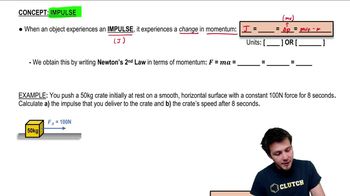
Impulse is defined as the change in momentum of an object when a force is applied over a period of time. It is mathematically represented as the product of the average force and the time duration during which the force acts. In this scenario, the impulse can be calculated by integrating the force over the time interval, which gives the total effect of the force on the object's momentum.
추천 영상:
가이드 코스
06:00
Impulse & Impulse-Momentum Theorem

Force-Time Graph

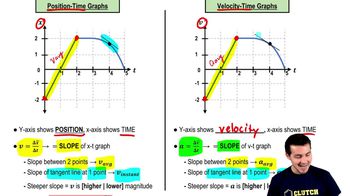
A force-time graph visually represents how a force varies with time. In this case, the force increases linearly from 0 N to 9000 N over 5 seconds, forming a triangular shape on the graph. The area under the force-time graph corresponds to the impulse delivered to the object, which can be calculated using the formula for the area of a triangle: 1/2 * base * height.
추천 영상:
가이드 코스
05:59
Velocity-Time Graphs & Acceleration

Linear Increase

A linear increase refers to a steady, uniform change in a quantity over time, represented by a straight line on a graph. In this problem, the force increases linearly, meaning it rises at a constant rate from 0 N to 9000 N over 5 seconds. This characteristic simplifies the calculation of impulse, as the average force can be easily determined by taking the midpoint of the initial and final values.
추천 영상:
가이드 코스
07:31
Linear Thermal Expansion