
Ch 11: Impulse and Momentum
Knight Calc - Physics for Scientists and Engineers 5th Edition
Knight Calc5th EditionPhysics for Scientists and EngineersISBN: 9780137344796당신이 사용하는 게 아니라요?교과서 변경
11장, 문제 61

A 500 g particle has velocity vx = −5.0 m/s at t = −2 s. Force Fx = (4−t2) N, where t is in s, is exerted on the particle between t = −2 s and t = 2 s. This force increases from 0 N at t = −2 s to 4 N at t = 0 s and then back to 0 N at t = 2 s. What is the particle's velocity at t = 2s?

검증된 단계별 안내
1
Step 1: Identify the relationship between force and acceleration using Newton's second law. The formula is: F=ma, where F is the force, m is the mass, and a is the acceleration. Rearrange to find acceleration: a=Fm.
Step 2: Express the acceleration as a function of time. The force is given as F=4-t2, and the mass of the particle is 0.5 kg. Substitute these values into the formula for acceleration: a=4-t20.5.
Step 3: Use the relationship between acceleration and velocity. Acceleration is the derivative of velocity with respect to time: a=dvdt. Rearrange to express velocity as an integral of acceleration: v=v0+t=-2t=2adt, where v0 is the initial velocity.
Step 4: Substitute the expression for acceleration into the integral. Replace a with 4-t20.5 in the integral: v=v0+t=-2t=24-t20.5dt.
Step 5: Solve the integral to find the velocity at t=2. Evaluate the definite integral of the acceleration function over the interval [-2,2], and add the result to the initial velocity v0=-5 m/s to find the final velocity.

비슷한 문제에 대한 검증된 영상 답변:

이 영상 해법은 위 문제에 도움이 된다고 튜터들이 추천한 것입니다.
영상 길이:
4m
도움이 되었나요?

주요 개념

질문에 올바르게 답하기 위해 반드시 이해해야 하는 핵심 개념들은 다음과 같습니다.

Newton's Second Law of Motion

Newton's Second Law states that the acceleration of an object is directly proportional to the net force acting on it and inversely proportional to its mass. This relationship is expressed mathematically as F = ma, where F is the net force, m is the mass, and a is the acceleration. Understanding this law is crucial for analyzing how the force applied to the particle affects its motion over time.
추천 영상:
가이드 코스
06:54
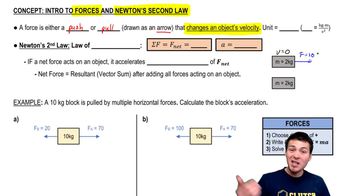
Intro to Forces & Newton's Second Law

Impulse and Momentum

Impulse is defined as the change in momentum of an object when a force is applied over a period of time. It is calculated as the product of the average force and the time duration during which the force acts. The relationship between impulse and momentum is given by the equation Impulse = Δp = F_avg * Δt, where Δp is the change in momentum. This concept is essential for determining how the force affects the particle's velocity from t = -2 s to t = 2 s.
추천 영상:
가이드 코스
06:00
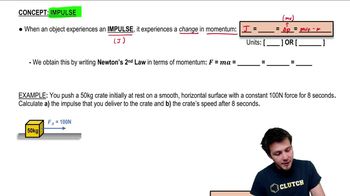
Impulse & Impulse-Momentum Theorem

Kinematics

Kinematics is the branch of mechanics that describes the motion of objects without considering the forces that cause the motion. It involves concepts such as displacement, velocity, and acceleration. In this problem, kinematic equations can be used to relate the initial velocity, the change in velocity due to the applied force, and the final velocity of the particle at t = 2 s.
추천 영상:
가이드 코스
08:25
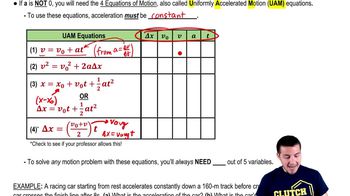
Kinematics Equations
관련 실천
교과서 질문

Two 500 g blocks of wood are 2.0 m apart on a frictionless table. A 10 g bullet is fired at 400 m/s toward the blocks. It passes all the way through the first block, then embeds itself in the second block. The speed of the first block immediately afterward is 6.0 m/s . What is the speed of the second block after the bullet stops in it?

1875
views
교과서 질문

A 100 g ball moving to the right at 4.0 m/s collides head-on with a 200g ball that is moving to the left at 3.0 m/s. If the collision is perfectly elastic, what are the speed and direction of each ball after the collision?

2271
views
교과서 질문

The stoplight had just changed and a 2000 kg Cadillac had entered the intersection, heading north at 3.0 m/s , when it was struck by a 1000 kg eastbound Volkswagen. The cars stuck together and slid to a halt, leaving skid marks angled 35° north of east. How fast was the Volkswagen going just before the impact?

2229
views
교과서 질문

A 1500 kg weather rocket accelerates upward at 10 m/s². It explodes 2.0 s after liftoff and breaks into two fragments, one twice as massive as the other. Photos reveal that the lighter fragment traveled straight up and reached a maximum height of 530 m. What were the speed and direction of the heavier fragment just after the explosion?

2166
views
교과서 질문

A 30 ton rail car and a 90 ton rail car, initially at rest, are connected together with a giant but massless compressed spring between them. When released, the 30 ton car is pushed away at a speed of 4.0 m/s relative to the 90 ton car. What is the speed of the 30 ton car relative to the ground?

2242
views
1
comments
교과서 질문

One end of a massless, 30-cm-long spring with spring constant 15 N/m is attached to a 250 g stationary air-track glider; the other end is attached to the track. A 500 g glider hits and sticks to the 250 g glider, compressing the spring to a minimum length of 22 cm. What was the speed of the 500 g glider just before impact?

1644
views
1
rank