A 2.0 kg object is moving to the right with a speed of when it experiences the force shown in FIGURE EX11.9. What are the object's speed and direction after the force ends?
Ch 11: Impulse and Momentum
11장, 문제 6
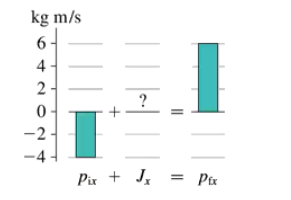
FIGURE EX11.6 is an incomplete momentum bar chart for a collision that lasts 10 ms. What are the magnitude and direction of the average collision force exerted on the object?

검증된 단계별 안내1
Step 1: Analyze the momentum bar chart. The initial momentum (P_ix) is represented by the shaded bar on the left, which corresponds to +6 kg·m/s. The final momentum (P_fx) is represented by the shaded bar on the right, which corresponds to -3 kg·m/s.
Step 2: Calculate the change in momentum (ΔP). The change in momentum is given by ΔP = P_fx - P_ix. Substitute the values: ΔP = (-3 kg·m/s) - (+6 kg·m/s).
Step 3: Use the impulse-momentum theorem to relate the change in momentum to the average collision force. The impulse-momentum theorem states that J_x = F_avg × Δt, where J_x is the impulse, F_avg is the average force, and Δt is the time duration of the collision.
Step 4: Substitute the value of ΔP for J_x, as impulse is equal to the change in momentum. Also, substitute the given time duration of the collision, Δt = 10 ms = 0.01 s, into the equation.
Step 5: Rearrange the equation to solve for F_avg. F_avg = ΔP / Δt. Substitute the values of ΔP and Δt to find the magnitude and direction of the average collision force.

비슷한 문제에 대한 검증된 영상 답변:
이 영상 해법은 위 문제에 도움이 된다고 튜터들이 추천한 것입니다.
영상 길이:
4m도움이 되었나요?
주요 개념
질문에 올바르게 답하기 위해 반드시 이해해야 하는 핵심 개념들은 다음과 같습니다.
Momentum
Momentum is a vector quantity defined as the product of an object's mass and its velocity. It is represented by the symbol 'p' and is crucial in understanding collisions, as it is conserved in isolated systems. The momentum before and after a collision can be analyzed to determine the effects of the collision on the objects involved.
추천 영상:
가이드 코스
Intro to Momentum
Impulse
Impulse is defined as the change in momentum of an object when a force is applied over a period of time. It is calculated as the product of the average force and the time duration of the force application. In the context of collisions, impulse helps quantify the effect of the collision force on the momentum of the objects involved.
추천 영상:
가이드 코스
Impulse & Impulse-Momentum Theorem
Average Force
Average force is the total impulse experienced by an object divided by the time duration over which the force acts. It provides a measure of how much force is exerted on an object during a collision. Understanding average force is essential for analyzing the dynamics of collisions and determining the resulting motion of the objects involved.
추천 영상:
가이드 코스
Solving Constant and Average Velocity Problems
관련 실천
교과서 질문
2252
views
교과서 질문
What is the impulse on a 3.0 kg particle that experiences the force shown in FIGURE EX11.4?
2454
views
1
comments
교과서 질문
Far in space, where gravity is negligible, a 425 kg rocket traveling at 75 m/s in the +x-direction fires its engines. FIGURE EX11.10 shows the thrust force as a function of time. The mass lost by the rocket during these 30 s is negligible. At what time does the rocket reach its maximum speed? What is the maximum speed?
1992
views
교과서 질문
In FIGURE EX11.5, what value of Fmax gives an impulse of 6.0 N s?
2454
views
교과서 질문
What impulse does the force shown in FIGURE EX11.3 exert on a 250 g particle?
2139
views
교과서 질문
A 2.0 kg object is moving to the right with a speed of 1.0 m/s when it experiences the force shown in FIGURE EX11.8. What are the object's speed and direction after the force ends?
2227
views