Ch 11: Impulse and Momentum
Knight Calc - Physics for Scientists and Engineers 5th Edition
Knight Calc5th EditionPhysics for Scientists and EngineersISBN: 9780137344796당신이 사용하는 게 아니라요?교과서 변경
11장, 문제 66

Consider a partially elastic collision in which ball A of mass m with initial velocity (vix)A collides with stationary ball B, also of mass m, and in which 1/4 of the mechanical energy is dissipated as thermal energy. Find expressions for the final velocities of each ball. Hint: Mathematically there are two solutions; however, one of them is physically impossible.

검증된 단계별 안내
1
Step 1: Begin by applying the principle of conservation of momentum. Since the collision occurs in one dimension, the total momentum before and after the collision must be equal. Write the equation: mAvixA = mAvfxA + mBvfxB, where vfx represents the final velocities of balls A and B.
Step 2: Use the principle of conservation of energy, but account for the fact that 1/4 of the mechanical energy is dissipated as thermal energy. Write the equation for the initial kinetic energy and the remaining kinetic energy after the collision: (3/4) of the initial kinetic energy is conserved. Express this as: (3/4)mAvixA^2 = mAvfxA^2 + mBvfxB^2.
Step 3: Solve the system of equations formed by the conservation of momentum and the modified conservation of energy. Substitute the expression for vfxB from the momentum equation into the energy equation to eliminate one variable. This will allow you to solve for vfxA.
Step 4: After solving for vfxA, substitute this value back into the momentum equation to find vfxB. Ensure that both solutions satisfy the physical constraints of the problem, such as the direction of motion and the dissipation of energy.
Step 5: Identify the physically impossible solution by checking whether it violates any physical principles, such as conservation laws or the dissipation of energy. Discard the invalid solution and retain the valid one as the final expressions for the velocities of balls A and B.

비슷한 문제에 대한 검증된 영상 답변:

이 영상 해법은 위 문제에 도움이 된다고 튜터들이 추천한 것입니다.
영상 길이:
16m
도움이 되었나요?

주요 개념

질문에 올바르게 답하기 위해 반드시 이해해야 하는 핵심 개념들은 다음과 같습니다.

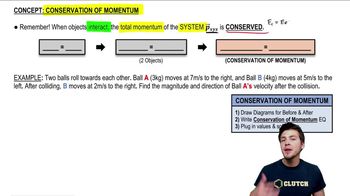
Conservation of Momentum

In a collision, the total momentum of a closed system remains constant if no external forces act on it. This principle allows us to relate the initial and final velocities of colliding objects. For two colliding balls, the equation m(vix)A + m(0) = m(vfx)A + m(vfx)B can be used, where vfx represents the final velocities of balls A and B.
추천 영상:
가이드 코스
05:58
Conservation Of Momentum

Kinetic Energy and Elasticity

Kinetic energy is the energy of motion, given by the formula KE = 1/2 mv^2. In elastic collisions, kinetic energy is conserved, while in partially elastic collisions, some energy is transformed into other forms, such as thermal energy. In this scenario, 1/4 of the mechanical energy is lost, which affects the final velocities of the balls.
추천 영상:
가이드 코스
06:07
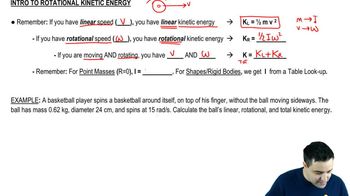
Intro to Rotational Kinetic Energy

Physical Feasibility of Solutions

When solving for final velocities in collision problems, it is essential to evaluate the physical feasibility of the solutions. One solution may yield negative velocities or violate conservation laws, indicating it is not physically possible. Thus, only the solution that adheres to the principles of physics and the context of the problem should be accepted.
추천 영상:
가이드 코스
03:09
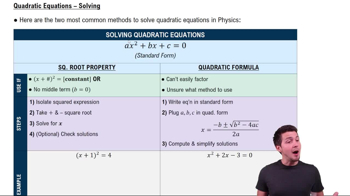
Quadratic Equations - Solving
관련 실천
교과서 질문

A 100 g ball moving to the right at 4.0 m/s collides head-on with a 200g ball that is moving to the left at 3.0 m/s. If the collision is perfectly elastic, what are the speed and direction of each ball after the collision?

2271
views

교과서 질문

A 30 ton rail car and a 90 ton rail car, initially at rest, are connected together with a giant but massless compressed spring between them. When released, the 30 ton car is pushed away at a speed of 4.0 m/s relative to the 90 ton car. What is the speed of the 30 ton car relative to the ground?

2242
views
1
comments
교과서 질문

A 45 g projectile explodes into three pieces: a 20 g piece with velocity 25 î m/s, a 15 g piece with velocity −10 î + 10ĵ m/s, and a 10 g piece with velocity −15 î − 20ĵ m/s. What was the projectile's velocity just before the explosion?

2383
views
교과서 질문

The nucleus of the polonium isotope ²¹⁴Po (mass 214 u) is radioactive and decays by emitting an alpha particle (a helium nucleus with mass 4 u). Laboratory experiments measure the speed of the alpha particle to be 1.92×10⁷ m/s . Assuming the polonium nucleus was initially at rest, what is the recoil speed of the nucleus that remains after the decay?

1765
views
교과서 질문

One end of a massless, 30-cm-long spring with spring constant 15 N/m is attached to a 250 g stationary air-track glider; the other end is attached to the track. A 500 g glider hits and sticks to the 250 g glider, compressing the spring to a minimum length of 22 cm. What was the speed of the 500 g glider just before impact?

1644
views
1
rank
교과서 질문

A neutron is an electrically neutral subatomic particle with a mass just slightly greater than that of a proton. A free neutron is radioactive and decays after a few minutes into other subatomic particles. In one experiment, a neutron at rest was observed to decay into a proton (mass 1.67×10⁻²⁷ kg) and an electron (mass 9.11×10⁻³¹ kg) . The proton and electron were shot out back-to-back. The proton speed was measured to be 1.0 ×10⁵ m/s, and the electron speed was 3.0×10⁷ m/s. No other decay products were detected. How much momentum did this neutrino 'carry away' with it?

2150
views