
Ch 11: Impulse and Momentum
Knight Calc - Physics for Scientists and Engineers 5th Edition
Knight Calc5th EditionPhysics for Scientists and EngineersISBN: 9780137344796당신이 사용하는 게 아니라요?교과서 변경
11장, 문제 45b

Most geologists believe that the dinosaurs became extinct 65 million years ago when a large comet or asteroid struck the earth, throwing up so much dust that the sun was blocked out for a period of many months. Suppose an asteroid with a diameter of 2.0 km and a mass of 1.0×10¹³ kg hits the earth (6.0×10²⁴ kg) with an impact speed of 4.0×10⁴ m/s. What percentage is this of the earth's speed around the sun? The earth orbits the sun at a distance of 1.5×10¹¹ m .

검증된 단계별 안내
1
Step 1: Calculate the momentum of the asteroid using the formula for linear momentum: \( p = mv \), where \( m \) is the mass of the asteroid (\( 1.0 \times 10^{13} \; \text{kg} \)) and \( v \) is its impact speed (\( 4.0 \times 10^4 \; \text{m/s} \)).
Step 2: Determine the orbital speed of the Earth around the Sun using the formula for circular orbital velocity: \( v = \sqrt{\frac{GM}{r}} \), where \( G \) is the gravitational constant (\( 6.674 \times 10^{-11} \; \text{N·m}^2/\text{kg}^2 \)), \( M \) is the mass of the Sun (\( 1.989 \times 10^{30} \; \text{kg} \)), and \( r \) is the orbital radius of the Earth (\( 1.5 \times 10^{11} \; \text{m} \)).
Step 3: Once the Earth's orbital speed is calculated, compare the asteroid's impact speed to the Earth's orbital speed by finding the ratio: \( \text{Percentage} = \left( \frac{v_{\text{asteroid}}}{v_{\text{Earth}}} \right) \times 100 \).
Step 4: Substitute the known values into the ratio formula: \( v_{\text{asteroid}} = 4.0 \times 10^4 \; \text{m/s} \) and \( v_{\text{Earth}} \) (calculated in Step 2).
Step 5: Simplify the expression to find the percentage of the asteroid's speed relative to the Earth's orbital speed. This will give the final answer.

비슷한 문제에 대한 검증된 영상 답변:

이 영상 해법은 위 문제에 도움이 된다고 튜터들이 추천한 것입니다.
영상 길이:
6m
도움이 되었나요?

주요 개념

질문에 올바르게 답하기 위해 반드시 이해해야 하는 핵심 개념들은 다음과 같습니다.

Impact Velocity

Impact velocity refers to the speed at which an object strikes another object. In this context, the asteroid's impact speed of 4.0×10⁴ m/s is crucial for understanding the energy released during the collision. This energy can be calculated using kinetic energy formulas, which are essential for assessing the potential effects of such an impact on Earth.
추천 영상:
가이드 코스
7:27
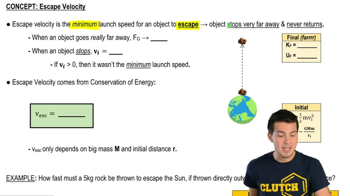
Escape Velocity

Orbital Speed of Earth

The orbital speed of Earth around the sun is approximately 29,800 m/s. This speed is determined by the gravitational forces acting between the Earth and the sun, and it is essential for understanding how the asteroid's impact speed compares to the Earth's motion. Calculating the percentage of the asteroid's speed relative to Earth's orbital speed provides insight into the relative scale of the impact.
추천 영상:
가이드 코스
6:03
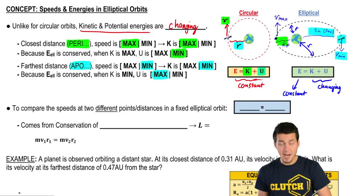
Speed and Energy of Elliptical Orbits

Kinetic Energy

Kinetic energy is the energy possessed by an object due to its motion, calculated using the formula KE = 0.5 * m * v², where m is mass and v is velocity. In the case of the asteroid, its significant mass and high impact velocity would result in a tremendous amount of kinetic energy, which is critical for evaluating the potential consequences of the impact, such as environmental changes and mass extinctions.
추천 영상:
가이드 코스
06:07
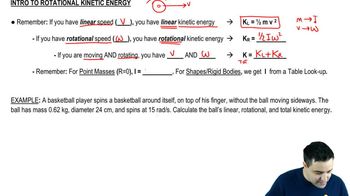
Intro to Rotational Kinetic Energy
관련 실천
교과서 질문

A bullet of mass m is fired into a block of mass M that is at rest. The block, with the bullet embedded, slides distance d across a horizontal surface. The coefficient of kinetic friction is μk .Find an expression for the bullet's speed vbullet.

2264
views
교과서 질문

A 60 g tennis ball with an initial speed of 32 m/s hits a wall and rebounds with the same speed. FIGURE P11.40 shows the force of the wall on the ball during the collision. What is the value of Fmax , the maximum value of the contact force during the collision?

428
views
교과서 질문

A tennis player swings her 1000g racket with a speed of 10 m/s. She hits a 60g tennis ball that was approaching her at a speed of 20 m/s. The ball rebounds at 40 m/s. If the tennis ball and racket are in contact for 10 ms, what is the average force that the racket exerts on the ball? How does this compare to the gravitational force on the ball?

1914
views
교과서 질문

What is the speed of a 10g bullet that, when fired into a 10kg stationary wood block, causes the block to slide 5.0 cm across a wood table?

1785
views
교과서 질문

A particle of mass m is at rest at t = 0. Its momentum for t > 0 is given by px = 6t² kg m/s, where t is in s. Find an expression for Fx(t), the force exerted on the particle as a function of time.

1861
views
교과서 질문

BIO Squids rely on jet propulsion to move around. A 1.50 kg squid (including the mass of water inside the squid) drifting at 0.40m/s suddenly ejects 0.100 kg of water to get itself moving at 2.50m/s . If drag is ignored over the small interval of time needed to expel the water (the impulse approximation), what is the water’s ejection speed relative to the squid?

1611
views