
교과서 질문
A 70.00 kg football player is gliding across very smooth ice at 2.00 m/s. He throws a 0.450 kg football straight forward. What is the player's speed afterward if the ball is thrown at 15.0 m/s relative to the ground?
2289
views

 검증된 단계별 안내
 05:17
05:17
 07:30
07:30 08:56
08:56A 70.00 kg football player is gliding across very smooth ice at 2.00 m/s. He throws a 0.450 kg football straight forward. What is the player's speed afterward if the ball is thrown at 15.0 m/s relative to the ground?
A 50 g ball of clay traveling at speed v0 hits and sticks to a 1.0 kg brick sitting at rest on a frictionless surface. What is the speed of the brick after the collision?
Dan is gliding on his skateboard at 4.0 m/s. He suddenly jumps backward off the skateboard, kicking the skateboard forward at 8.0 m/s. How fast is Dan going as his feet hit the ground? Dan's mass is 50 kg and the skateboard's mass is 5.0 kg.
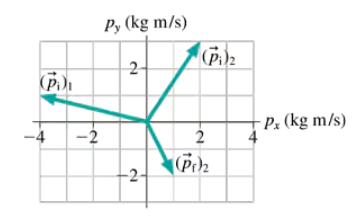
An object at rest explodes into three fragments. FIGURE EX11.32 shows the momentum vectors of two of the fragments. What is the momentum of the third fragment? Write your answer using unit vectors.
A 20 g ball of clay traveling east at 3.0 m/s collides with a 30 g ball of clay traveling north at 2.0 m/s. What are the speed and the direction of the resulting 50 g ball of clay? Give your answer as an angle north of east.
At the center of a 50-m-diameter circular ice rink, a 75 kg skater traveling north at 2.5 m/s collides with and holds on to a 60 kg skater who had been heading west at 3.5 m/s. Where will they reach it? Give your answer as an angle north of west.