Ch 12: Rotation of a Rigid Body
Knight Calc - Physics for Scientists and Engineers 5th Edition
Knight Calc5th EditionPhysics for Scientists and EngineersISBN: 9780137344796당신이 사용하는 게 아니라요?교과서 변경
12장, 문제 88c

A rod of length L and mass M has a nonuniform mass distribution. The linear mass density (mass per length) is λ = cx2 , where x is measured from the center of the rod and c is a constant. Find an expression in terms of L and M for the moment of inertia of the rod for rotation about an axis through the center.

검증된 단계별 안내
1
Understand the problem: The moment of inertia (I) is a measure of an object's resistance to rotational motion about a given axis. For a nonuniform rod, we need to integrate over the mass distribution to calculate I. The linear mass density λ = cx² varies with position x, where x is measured from the center of the rod.
Express the mass element (dm): The mass of a small segment of the rod, dm, can be written as dm = λ dx. Substituting λ = cx², we get dm = c x² dx.
Set up the moment of inertia integral: The moment of inertia for a small mass element is dI = x² dm. Substituting dm = c x² dx, we get dI = c x⁴ dx. To find the total moment of inertia, integrate this expression over the length of the rod, from -L/2 to L/2: I = ∫(from -L/2 to L/2) c x⁴ dx.
Relate the constant c to the total mass M: The total mass of the rod is M = ∫(from -L/2 to L/2) λ dx = ∫(from -L/2 to L/2) c x² dx. Solve this integral to find c in terms of M and L. This will allow us to express the moment of inertia in terms of M and L.
Solve the integral for I: Substitute the value of c obtained in the previous step into the integral for I. Evaluate the integral ∫(from -L/2 to L/2) c x⁴ dx to find the final expression for the moment of inertia in terms of M and L.

비슷한 문제에 대한 검증된 영상 답변:

이 영상 해법은 위 문제에 도움이 된다고 튜터들이 추천한 것입니다.
영상 길이:
11m

주요 개념

질문에 올바르게 답하기 위해 반드시 이해해야 하는 핵심 개념들은 다음과 같습니다.

Moment of Inertia

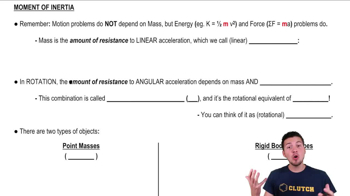
The moment of inertia is a measure of an object's resistance to rotational motion about a specific axis. It depends on the mass distribution relative to that axis. For a continuous mass distribution, it is calculated by integrating the product of mass elements and the square of their distance from the axis of rotation.
추천 영상:
가이드 코스
11:47
Intro to Moment of Inertia

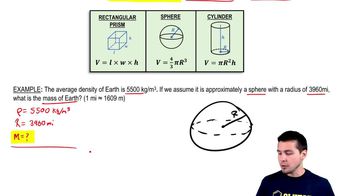
Linear Mass Density

Linear mass density (λ) is defined as the mass per unit length of an object. In this case, it varies with position along the rod, given by λ = cx², where c is a constant and x is the distance from the center. This nonuniform distribution affects how mass is distributed relative to the axis of rotation, influencing the moment of inertia.
추천 영상:
가이드 코스
04:33
Problems with Mass, Volume, & Density

Integration in Physics

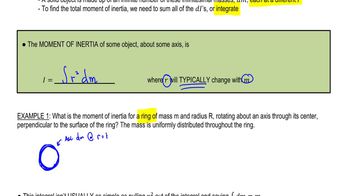
Integration is a mathematical technique used to calculate quantities that accumulate over a continuous range. In the context of finding the moment of inertia for a nonuniform mass distribution, integration allows us to sum the contributions of infinitesimal mass elements across the length of the rod, taking into account their varying distances from the axis of rotation.
추천 영상:
가이드 코스
11:43
Finding Moment Of Inertia By Integrating
관련 실천
교과서 질문

The two blocks in FIGURE CP12.86 are connected by a massless rope that passes over a pulley. The pulley is 12 cm in diameter and has a mass of 2.0 kg. As the pulley turns, friction at the axle exerts a torque of magnitude 0.50 N m. If the blocks are released from rest, how long does it take the 4.0 kg block to reach the floor?

1930
views
3
rank
교과서 질문

A rod of length L and mass M has a nonuniform mass distribution. The linear mass density (mass per length) is λ = cx2, where x is measured from the center of the rod and c is a constant. Find an expression for c in terms of L and M.

1794
views
교과서 질문

The bunchberry flower has the fastest-moving parts ever observed in a plant. Initially, the stamens are held by the petals in a bent position, storing elastic energy like a coiled spring. When the petals release, the tips of the stamen act like medieval catapults, flipping through a 60° angle in just 0.30 ms to launch pollen from anther sacs at their ends. The human eye just sees a burst of pollen; only high-speed photography reveals the details. As FIGURE CP12.91 shows, we can model the stamen tip as a 1.0-mm-long, 10 μg rigid rod with a 10 μg anther sac at the end. Although oversimplifying, we'll assume a constant angular acceleration. What is the speed of the anther sac as it releases its pollen?

1830
views
교과서 질문

Objects that rotate in air or water experience a torque due to drag. With quadratic drag, a drag torque that's negligible at low rpm quickly becomes significant as the rpm increases. Consider a square bar with cross section a x a and length L. It is rotating on an axle through its center at angular velocity ω in a fluid of density ρ. Assume that the drag coefficient C𝒹 is constant along the length of the bar. Find an expression for the magnitude of the drag torque on the bar. Hint: Begin by considering the drag force on a small piece of the bar of length dr at distance r from the axle.

2388
views