
Ch 12: Rotation of a Rigid Body
Knight Calc - Physics for Scientists and Engineers 5th Edition
Knight Calc5th EditionPhysics for Scientists and EngineersISBN: 9780137344796당신이 사용하는 게 아니라요?교과서 변경
12장, 문제 77b

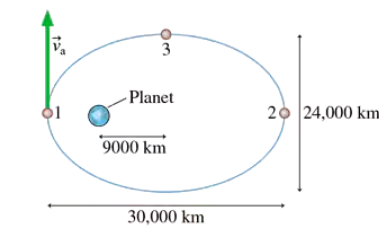
A satellite follows the elliptical orbit shown in FIGURE P12.77. The only force on the satellite is the gravitational attraction of the planet. The satellite's speed at point 1 is 8000 m/s. What is the satellite's speed at point 2?

검증된 단계별 안내
1
Step 1: Recognize that the problem involves conservation of mechanical energy. Since the only force acting on the satellite is gravity, the total mechanical energy (kinetic + potential) of the satellite remains constant throughout its orbit.
Step 2: Write the expression for the total mechanical energy at point 1 and point 2. The total energy is given by: \( E = K + U \), where \( K \) is the kinetic energy \( \frac{1}{2}mv^2 \) and \( U \) is the gravitational potential energy \( -\frac{GMm}{r} \). Here, \( m \) is the satellite's mass, \( v \) is its speed, \( G \) is the gravitational constant, \( M \) is the planet's mass, and \( r \) is the distance from the center of the planet.
Step 3: Set the total energy at point 1 equal to the total energy at point 2: \( \frac{1}{2}mv_1^2 - \frac{GMm}{r_1} = \frac{1}{2}mv_2^2 - \frac{GMm}{r_2} \). Here, \( v_1 \) and \( r_1 \) are the speed and distance at point 1, and \( v_2 \) and \( r_2 \) are the speed and distance at point 2.
Step 4: Simplify the equation by canceling \( m \) (since it appears in every term) and solving for \( v_2 \): \( v_2 = \sqrt{v_1^2 + 2GM \left( \frac{1}{r_1} - \frac{1}{r_2} \right)} \). This equation relates the satellite's speed at point 2 to its speed at point 1 and the distances \( r_1 \) and \( r_2 \).
Step 5: Substitute the given values into the equation. Use \( v_1 = 8000 \, \text{m/s} \), \( r_1 \) (distance at point 1), and \( r_2 \) (distance at point 2) as provided in the problem or figure. Also, use the known values for \( G \) and \( M \) (gravitational constant and planet's mass). Perform the calculations to find \( v_2 \).

비슷한 문제에 대한 검증된 영상 답변:

이 영상 해법은 위 문제에 도움이 된다고 튜터들이 추천한 것입니다.
영상 길이:
7m

주요 개념

질문에 올바르게 답하기 위해 반드시 이해해야 하는 핵심 개념들은 다음과 같습니다.

Gravitational Force

Gravitational force is the attractive force between two masses, described by Newton's law of universal gravitation. It dictates that the force is proportional to the product of the masses and inversely proportional to the square of the distance between their centers. In the context of a satellite, this force is what keeps it in orbit around a planet.
추천 영상:
가이드 코스
05:41
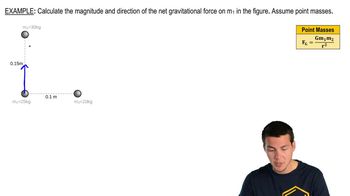
Gravitational Forces in 2D

Conservation of Energy

The principle of conservation of energy states that the total energy in a closed system remains constant. For a satellite in orbit, its mechanical energy, which is the sum of kinetic and potential energy, is conserved. As the satellite moves through different points in its elliptical orbit, its speed changes, but the total energy remains the same.
추천 영상:
가이드 코스
06:24
Conservation Of Mechanical Energy

Elliptical Orbits

Elliptical orbits are paths followed by objects in space under the influence of gravity, characterized by their oval shape. According to Kepler's laws of planetary motion, a satellite moves faster when it is closer to the planet (periapsis) and slower when it is farther away (apoapsis). This variation in speed is crucial for calculating the satellite's speed at different points in its orbit.
추천 영상:
가이드 코스
6:03
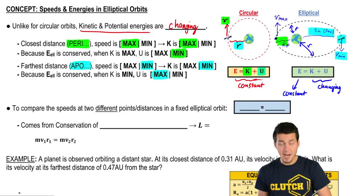
Speed and Energy of Elliptical Orbits
관련 실천
교과서 질문

A long, thin rod of mass M and length L is standing straight up on a table. Its lower end rotates on a frictionless pivot. A very slight push causes the rod to fall over. As it hits the table, what are the speed of the tip of the rod?

1295
views
교과서 질문

A 10 g bullet traveling at 400 m/s strikes a 10 kg, 1.0-m-wide door at the edge opposite the hinge. The bullet embeds itself in the door, causing the door to swing open. What is the angular velocity of the door just after impact?

1429
views
교과서 질문

The sphere of mass M and radius R in FIGURE P12.75 is rigidly attached to a thin rod of radius r that passes through the sphere at distance (1/2)R from the center. A string wrapped around the rod pulls with tension T. Find an expression for the sphere's angular acceleration. The rod's moment of inertia is negligible.

2019
views
교과서 질문

A merry-go-round is a common piece of playground equipment. A 3.0-m-diameter merry-go-round with a mass of 250 kg is spinning at 20 rpm. John runs tangent to the merry-go-round at 5.0 m/s, in the same direction that it is turning, and jumps onto the outer edge. John's mass is 30 kg. What is the merry-go-round's angular velocity, in rpm, after John jumps on?

2709
views
교과서 질문

FIGURE P12.82 shows a cube of mass m sliding without friction at speed v0. It undergoes a perfectly elastic collision with the bottom tip of a rod of length d and mass M = 2m. The rod is pivoted about a frictionless axle through its center, and initially it hangs straight down and is at rest. What is the cube's velocity—both speed and direction—after the collision?

1432
views
교과서 질문

A satellite follows the elliptical orbit shown in FIGURE P12.77. The only force on the satellite is the gravitational attraction of the planet. The satellite's speed at point 1 is 8000 m/s. Does the satellite experience any torque about the center of the planet? Explain.

1985
views