


Ch 12: Rotation of a Rigid Body
Knight Calc - Physics for Scientists and Engineers 5th Edition
Knight Calc5th EditionPhysics for Scientists and EngineersISBN: 9780137344796당신이 사용하는 게 아니라요?교과서 변경
12장, 문제 68

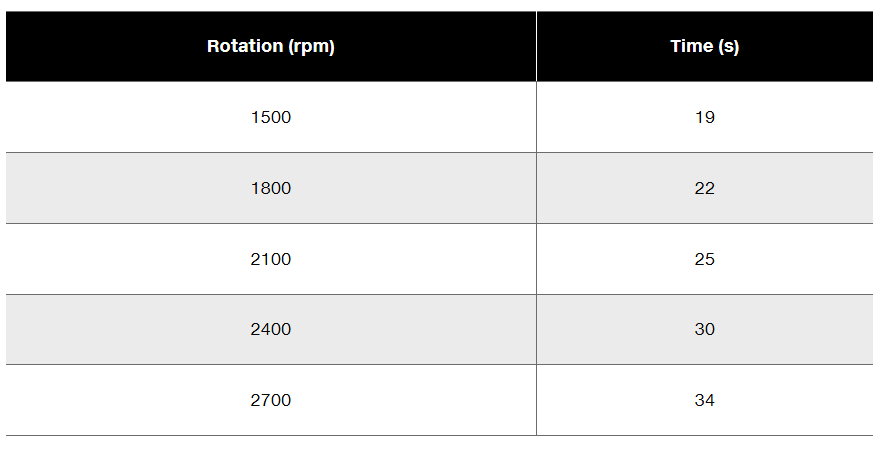
Your engineering team has been assigned the task of measuring the properties of a new jet-engine turbine. You've previously determined that the turbine's moment of inertia is 2.6 kg m2. The next job is to measure the frictional torque of the bearings. Your plan is to run the turbine up to a predetermined rotation speed, cut the power, and time how long it takes the turbine to reduce its rotation speed by 50%. Your data are given in the table. Draw an appropriate graph of the data and, from the slope of the best-fit line, determine the frictional torque.

검증된 단계별 안내
1
Step 1: Understand the problem. The goal is to determine the frictional torque of the turbine bearings. The moment of inertia (I) is given as 2.6 kg·m², and the rotational speed decreases over time due to friction. The relationship between torque (τ), angular acceleration (α), and moment of inertia is given by the equation: τ=Iα.
Step 2: Analyze the data. The data table provides the rotational speed (ω) at different times. To find the angular acceleration (α), calculate the rate of change of angular velocity with respect to time. Use the formula: α=ΔωΔt, where Δω is the change in angular velocity and Δt is the change in time.
Step 3: Plot the data. Create a graph of angular velocity (ω) versus time (t). The slope of the best-fit line on this graph represents the angular acceleration (α). Ensure the graph is properly labeled with units on both axes.
Step 4: Determine the slope of the best-fit line. Use the data points to calculate the slope of the line, which corresponds to the angular acceleration (α). The slope can be calculated using the formula: α=ω2ω1t2t1, where ω1 and ω2 are angular velocities at times t1 and t2, respectively.
Step 5: Calculate the frictional torque. Once the angular acceleration (α) is determined from the slope, use the equation τ=Iα to calculate the frictional torque. Substitute the given moment of inertia (I = 2.6 kg·m²) and the calculated angular acceleration (α) into the equation to find the torque.

비슷한 문제에 대한 검증된 영상 답변:

이 영상 해법은 위 문제에 도움이 된다고 튜터들이 추천한 것입니다.
영상 길이:
12m

주요 개념

질문에 올바르게 답하기 위해 반드시 이해해야 하는 핵심 개념들은 다음과 같습니다.

Moment of Inertia

Moment of inertia is a measure of an object's resistance to changes in its rotational motion. It depends on the mass distribution of the object relative to the axis of rotation. In this case, the turbine's moment of inertia is given as 2.6 kg m², indicating how difficult it is to change its rotational speed. A higher moment of inertia means more torque is required to achieve the same angular acceleration.
추천 영상:
가이드 코스
11:47
Intro to Moment of Inertia

Frictional Torque

Frictional torque is the torque that opposes the motion of a rotating object due to friction in its bearings or other components. It can be calculated by analyzing the deceleration of the object when external power is removed. In this scenario, measuring how long it takes for the turbine to slow down by 50% allows for the determination of the frictional torque acting on it, which is crucial for understanding the efficiency and performance of the turbine.
추천 영상:
가이드 코스
08:55
Net Torque & Sign of Torque

Graphing and Linear Regression

Graphing the data collected from the turbine's deceleration allows for visual analysis of the relationship between time and angular velocity. By plotting the data points and applying linear regression, one can find the best-fit line that represents the trend. The slope of this line is directly related to the frictional torque, providing a quantitative measure of how quickly the turbine slows down, which is essential for evaluating its performance.
추천 영상:
가이드 코스
01:05
Graphing Linear Equations
관련 실천
교과서 질문

A solid spherical marble shot up a frictionless 15° slope rolls 2.50 m to its highest point. If the marble is shot with the same speed up a slightly rough 15° slope, it rolls only 2.30 m. What is the coefficient of rolling friction on the second slope?

1640
views
교과서 질문

A 30-cm-diameter, 1.2 kg solid turntable rotates on a 1.2-cm-diameter, 450 g shaft at a constant 33 rpm. When you hit the stop switch, a brake pad presses against the shaft and brings the turntable to a halt in 15 seconds. How much friction force does the brake pad apply to the shaft?

1789
views
교과서 질문

The 2.0 kg, 30-cm-diameter disk in FIGURE P12.65 is spinning at 300 rpm. How much friction force must the brake apply to the rim to bring the disk to a halt in 3.0 s?

1629
views
1
rank
교과서 질문

The 5.0 kg, 60-cm-diameter disk in FIGURE P12.71 rotates on an axle passing through one edge. The axle is parallel to the floor. The cylinder is held with the center of mass at the same height as the axle, then released. What is the cylinder's angular velocity when it is directly below the axle?

437
views
교과서 질문

A 750 g disk and a 760 g ring, both 15 cm in diameter, are rolling along a horizontal surface at 1.5 m/s when they encounter a 15° slope. How far up the slope does each travel before rolling back down?

2376
views
교과서 질문

Flywheels are large, massive wheels used to store energy. They can be spun up slowly, then the wheel's energy can be released quickly to accomplish a task that demands high power. An industrial flywheel has a 1.5 m diameter and a mass of 250 kg. Its maximum angular velocity is 1200 rpm. How much energy is stored in the flywheel?

2047
views