Ch 13: Newton's Theory of Gravity
Knight Calc - Physics for Scientists and Engineers 5th Edition
Knight Calc5th EditionPhysics for Scientists and EngineersISBN: 9780137344796당신이 사용하는 게 아니라요?교과서 변경
13장, 문제 68a

A satellite in a circular orbit of radius r has period T. A satellite in a nearby orbit with radius r + Δr, where Δr ≪ r, has the very slightly different period T + ΔT. Show that ΔT/T = (3/2) (Δr/r)

검증된 단계별 안내
1
Start by recalling Kepler's Third Law, which states that the square of the orbital period (T) of a satellite is proportional to the cube of the radius (r) of its orbit. Mathematically, this is expressed as: T^2 \(\propto\) r^3 or equivalently T^2 = k r^3, where k is a constant of proportionality.
Differentiate both sides of the equation T^2 = k r^3 with respect to r to find the relationship between changes in T and r. Using the chain rule, we get: 2T \(\frac{dT}{dr}\) = 3k r^2.
Rearrange the differentiated equation to isolate \(\frac{dT}{T}\): \(\frac{dT}{T}\) = \(\frac{3}{2}\) \(\frac{dr}{r}\). Here, \(\frac{dT}{T}\) represents the fractional change in the period, and \(\frac{dr}{r}\) represents the fractional change in the radius.
Recognize that for small changes in the radius and period, \(\Delta\) r and \(\Delta\) T can be used in place of dr and dT, respectively. Thus, the equation becomes: \(\frac{\Delta T}{T}\) = \(\frac{3}{2}\) \(\frac{\Delta r}{r}\).
Conclude that the fractional change in the orbital period is proportional to the fractional change in the orbital radius, with a proportionality constant of \(\frac{3}{2}\). This completes the derivation: \(\frac{\Delta T}{T}\) = \(\frac{3}{2}\) \(\frac{\Delta r}{r}\).

비슷한 문제에 대한 검증된 영상 답변:

이 영상 해법은 위 문제에 도움이 된다고 튜터들이 추천한 것입니다.
영상 길이:
9m

주요 개념

질문에 올바르게 답하기 위해 반드시 이해해야 하는 핵심 개념들은 다음과 같습니다.

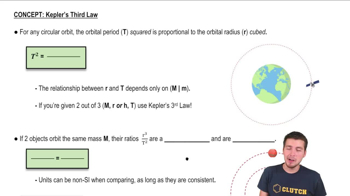
Kepler's Third Law

Kepler's Third Law states that the square of the orbital period of a planet is directly proportional to the cube of the semi-major axis of its orbit. For circular orbits, this can be expressed as T² ∝ r³, which implies that as the radius increases, the period increases, but at a specific rate determined by the gravitational force acting on the satellite.
추천 영상:
가이드 코스
08:32
Kepler's Third Law

Differential Calculus

Differential calculus is a branch of mathematics that deals with the rates at which quantities change. In this context, it helps us understand how small changes in the radius (Δr) affect the orbital period (ΔT) of the satellite. By applying calculus, we can derive relationships between these small changes and express them in terms of ratios.
추천 영상:
가이드 코스
04:53
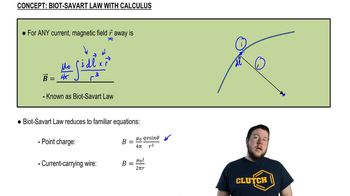
Biot-Savart Law with Calculus

Orbital Mechanics

Orbital mechanics is the study of the motion of objects in space under the influence of gravitational forces. It encompasses the principles governing satellite motion, including the relationship between radius, velocity, and period. Understanding these principles is crucial for analyzing how changes in orbital radius affect the period of a satellite's orbit.
추천 영상:
가이드 코스
04:45
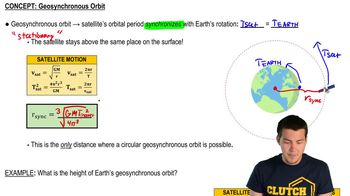
Geosynchronous Orbits
관련 실천
교과서 질문

Two Jupiter-size planets are released from rest 1.0 x 10¹¹ m apart. What are their speeds as they crash together?

1333
views

교과서 질문

Comets move around the sun in very elliptical orbits. At its closet approach, in 1986, Comet Halley was 8.79 x 10⁷ km from the sun and moving with a speed of 54.6 km/s. What was the comet’s speed when it crossed Neptune’s orbit in 2006?

1248
views
교과서 질문

A 55,000 kg space capsule is in a 28,000-km-diameter circular orbit around the moon. A brief but intense firing of its engine in the forward direction suddenly decreases its speed by 50%. This causes the space capsule to go into an elliptical orbit. What are the space capsule’s (a) maximum and (b) minimum distances from the center of the moon in its new orbit? Hint: You will need to use two conservation laws.

1142
views
교과서 질문

While visiting Planet Physics, you toss a rock straight up at 11 m/s and catch it 2.5 s later. While you visit the surface, your cruise ship orbits at an altitude equal to the planet's radius every 230 min. What are the (a) mass and (b) radius of Planet Physics?

1162
views
교과서 질문

Let’s look in more detail at how a satellite is moved from one circular orbit to another. FIGURE CP13.70 shows two circular orbits, of radii r1 and r2, and an elliptical orbit that connects them. Points 1 and 2 are at the ends of the semimajor axis of the ellipse. Consider a 1000 kg communications satellite that needs to be boosted from an orbit 300 km above the earth to a geosynchronous orbit 35,900 km above the earth. Find the velocity v'1 on the inner circular orbit and the velocity v'1 at the low point on the elliptical orbit that spans the two circular orbits.

1261
views
교과서 질문

Let's look in more detail at how a satellite is moved from one circular orbit to another. FIGURE CP13.70 shows two circular orbits, of radii r1 and r2, and an elliptical orbit that connects them. Points 1 and 2 are at the ends of the semimajor axis of the ellipse. How much work must the rocket motor do to transfer the satellite from the circular orbit to the elliptical orbit?

439
views