Ch 13: Newton's Theory of Gravity
Knight Calc - Physics for Scientists and Engineers 5th Edition
Knight Calc5th EditionPhysics for Scientists and EngineersISBN: 9780137344796당신이 사용하는 게 아니라요?교과서 변경
13장, 문제 24c

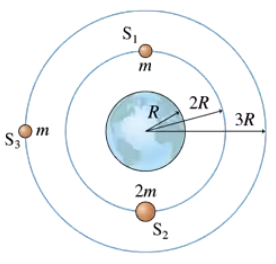
Three satellites orbit a planet of radius R, as shown in FIGURE EX13.24. Satellites S1 and S3 have mass m. Satellite S2 has mass 2m. Satellite S1 orbits in 250 minutes and the force on S1 is 10,000 N. What is the kinetic-energy ratio for K1 / K3 for S1 and S3?

검증된 단계별 안내
1
Step 1: Recall the formula for kinetic energy, which is given by \( K = \frac{1}{2} m v^2 \), where \( m \) is the mass of the satellite and \( v \) is its orbital velocity. To find the ratio \( \frac{K_1}{K_3} \), we need to compare the kinetic energies of satellites \( S_1 \) and \( S_3 \).
Step 2: The orbital velocity \( v \) of a satellite is determined by the gravitational force acting as the centripetal force. Using \( F = \frac{G M m}{r^2} \) and \( F = \frac{m v^2}{r} \), equate \( \frac{G M m}{r^2} = \frac{m v^2}{r} \) to solve for \( v \): \( v = \sqrt{\frac{G M}{r}} \).
Step 3: Note that the radius \( r \) of the orbit is proportional to the orbital period \( T \) squared, according to Kepler's third law: \( T^2 \propto r^3 \). Since \( S_1 \) and \( S_3 \) have different orbital periods, their orbital radii will differ. Use \( r \propto T^{2/3} \) to express the relationship between \( r_1 \) and \( r_3 \).
Step 4: Substitute \( r \) into the velocity formula \( v = \sqrt{\frac{G M}{r}} \) for both \( S_1 \) and \( S_3 \). Since \( r \propto T^{2/3} \), the velocities \( v_1 \) and \( v_3 \) will depend on the orbital periods \( T_1 \) and \( T_3 \).
Step 5: Finally, calculate the ratio \( \frac{K_1}{K_3} \) using \( \frac{K_1}{K_3} = \frac{\frac{1}{2} m v_1^2}{\frac{1}{2} m v_3^2} = \frac{v_1^2}{v_3^2} \). Substitute the expressions for \( v_1 \) and \( v_3 \) derived earlier to find the ratio in terms of \( T_1 \) and \( T_3 \).

비슷한 문제에 대한 검증된 영상 답변:

이 영상 해법은 위 문제에 도움이 된다고 튜터들이 추천한 것입니다.
영상 길이:
7m
도움이 되었나요?

주요 개념

질문에 올바르게 답하기 위해 반드시 이해해야 하는 핵심 개념들은 다음과 같습니다.

Gravitational Force

The gravitational force is the attractive force between two masses, described by Newton's law of universal gravitation. It is proportional to the product of the masses and inversely proportional to the square of the distance between their centers. In the context of satellites, this force provides the necessary centripetal force for circular motion.
추천 영상:
가이드 코스
05:41
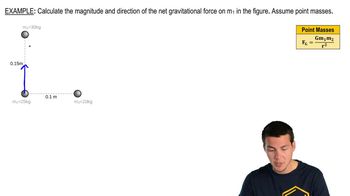
Gravitational Forces in 2D

Kinetic Energy in Orbital Motion

Kinetic energy (K) of an object in motion is given by the formula K = 1/2 mv², where m is the mass and v is the velocity. For satellites in orbit, their velocity is determined by the balance between gravitational force and centripetal force. The kinetic energy of each satellite can be compared to understand their motion and energy dynamics.
추천 영상:
가이드 코스
9:11
Energy of Circular Orbits

Orbital Period and Velocity Relationship

The orbital period (T) of a satellite is the time it takes to complete one full orbit around a planet. The relationship between the orbital period and the radius of the orbit is given by Kepler's third law, which states that T² is proportional to r³, where r is the radius of the orbit. This relationship helps determine the velocity of the satellites, which is crucial for calculating their kinetic energies.
추천 영상:
가이드 코스
04:45
Geosynchronous Orbits
관련 실천
교과서 질문

A satellite orbits the sun with a period of 1.0 day. What is the radius of its orbit?

1889
views

교과서 질문

The asteroid belt circles the sun between the orbits of Mars and Jupiter. One asteroid has a period of 5.0 earth years. What are the asteroid's orbital radius and speed?

1949
views
교과서 질문

A new planet is discovered orbiting the star Vega in a circular orbit. The planet takes 55 earth years to complete one orbit around the star. Vega's mass is 2.1 times the sun's mass. What is the radius of the planet's orbit? Give your answer as a multiple of the radius of the earth's orbit.

2043
views
교과서 질문

Nothing can escape the event horizon of a black hole, not even light. You can think of the event horizon as being the distance from a black hole at which the escape speed is the speed of light, 3.00 ✕ 10⁸ m/s, making all escape impossible. What is the radius of the event horizon for a black hole with a mass 5.0 times the mass of the sun? This distance is called the Schwarzschild radius.

3007
views
교과서 질문

A binary star system has two stars, each with the same mass as our sun, separated by 1.0 ✕ 1012 m. A comet is very far away and essentially at rest. Slowly but surely, gravity pulls the comet toward the stars. Suppose the comet travels along a trajectory that passes through the midpoint between the two stars. What is the comet's speed at the midpoint?

925
views
교과서 질문

You have been visiting a distant planet. Your measurements have determined that the planet's mass is twice that of earth but the free-fall acceleration at the surface is only one-fourth as large. To get back to earth, you need to escape the planet. What minimum speed does your rocket need?

1537
views