Ch 13: Newton's Theory of Gravity
Knight Calc - Physics for Scientists and Engineers 5th Edition
Knight Calc5th EditionPhysics for Scientists and EngineersISBN: 9780137344796당신이 사용하는 게 아니라요?교과서 변경
13장, 문제 37

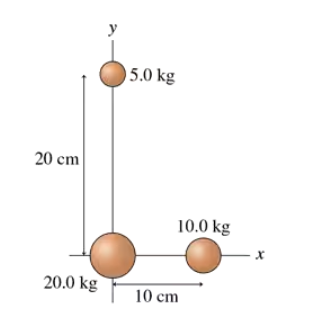
What is the total gravitational potential energy of the three masses in FIGURE P13.35?

검증된 단계별 안내
1
Step 1: Understand the concept of gravitational potential energy. Gravitational potential energy between two masses is given by the formula: U = -Gmmr, where G is the gravitational constant, m and m are the masses, and r is the distance between them.
Step 2: Identify the three masses and their positions from FIGURE P13.35. Determine the distances between each pair of masses. Label the masses as m1, m2, and m3, and calculate the distances r12, r13, and r23.
Step 3: Calculate the gravitational potential energy for each pair of masses using the formula U = -Gmmr. For example, calculate U12, U13, and U23.
Step 4: Add the gravitational potential energies of all pairs to find the total gravitational potential energy of the system. Use the equation: Utotal = U12 + U13 + U23.
Step 5: Ensure all values are substituted correctly, including the gravitational constant G, masses, and distances. Verify the units are consistent throughout the calculation.

비슷한 문제에 대한 검증된 영상 답변:

이 영상 해법은 위 문제에 도움이 된다고 튜터들이 추천한 것입니다.
영상 길이:
5m

주요 개념

질문에 올바르게 답하기 위해 반드시 이해해야 하는 핵심 개념들은 다음과 같습니다.

Gravitational Potential Energy

Gravitational potential energy (U) is the energy an object possesses due to its position in a gravitational field. It is calculated using the formula U = mgh, where m is the mass, g is the acceleration due to gravity, and h is the height above a reference point. This energy is crucial for understanding how the position of masses affects their potential energy in a gravitational system.
추천 영상:
가이드 코스
06:35
Gravitational Potential Energy

Superposition Principle

The superposition principle states that the total gravitational potential energy of a system of masses is the sum of the potential energies of each mass relative to a reference point. This means that when calculating the total gravitational potential energy for multiple masses, one must consider the individual contributions from each mass based on their respective heights and distances from the reference point.
추천 영상:
가이드 코스
03:32
Superposition of Sinusoidal Wave Functions

Reference Point in Gravitational Calculations

In gravitational calculations, the choice of a reference point is essential as it determines the height (h) used in the potential energy formula. The reference point can be any location, but it is often chosen to be the ground or the lowest point in the system. The potential energy is relative, meaning that it can vary based on the selected reference point, affecting the total energy calculation for the system.
추천 영상:
가이드 코스
14:10
Inertial Reference Frames