

Ch 15: Oscillations
Knight Calc - Physics for Scientists and Engineers 5th Edition
Knight Calc5th EditionPhysics for Scientists and EngineersISBN: 9780137344796당신이 사용하는 게 아니라요?교과서 변경
15장, 문제 56

A 1.00 kg block is attached to a horizontal spring with spring constant 2500 N/m. The block is at rest on a frictionless surface. A 10 g bullet is fired into the block, in the face opposite the spring, and sticks. What was the bullet's speed if the subsequent oscillations have an amplitude of 10.0 cm?

검증된 단계별 안내
1
Step 1: Understand the problem. The bullet embeds itself into the block, causing the block to oscillate on the spring. The amplitude of oscillation is given as 10.0 cm, and we need to find the bullet's speed. This involves concepts of conservation of momentum and energy in a spring-mass system.
Step 2: Apply the conservation of momentum principle. Before the collision, the bullet has momentum, and the block is stationary. After the collision, the bullet and block move together as a single system. Use the equation: m1v1=(m1+m2)vf, where m1 is the mass of the bullet, v1 is the bullet's speed, m2 is the mass of the block, and vf is the final velocity of the combined system.
Step 3: Relate the final velocity of the block-bullet system to the amplitude of oscillation. The kinetic energy of the system immediately after the collision is converted into potential energy in the spring at maximum compression or extension. Use the energy conservation equation: (1/2)kA2=(1/2)(m1+m2)vf2, where k is the spring constant, A is the amplitude, and vf is the final velocity.
Step 4: Solve for the final velocity vf using the energy conservation equation. Rearrange the equation to isolate vf: vf=kA2m1+m2. Substitute the given values for k, A, m1, and m2.
Step 5: Use the conservation of momentum equation to solve for the bullet's initial speed v1. Rearrange the momentum equation to isolate v1: v1=(m1+m2)vfm1. Substitute the values for m1, m2, and vf obtained from the previous step.

비슷한 문제에 대한 검증된 영상 답변:

이 영상 해법은 위 문제에 도움이 된다고 튜터들이 추천한 것입니다.
영상 길이:
14m
도움이 되었나요?

주요 개념

질문에 올바르게 답하기 위해 반드시 이해해야 하는 핵심 개념들은 다음과 같습니다.

Conservation of Momentum

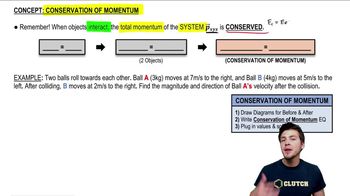
The principle of conservation of momentum states that in a closed system, the total momentum before an event must equal the total momentum after the event. In this scenario, the bullet and block system is isolated, so the momentum of the bullet before it hits the block must equal the combined momentum of the bullet-block system immediately after the collision.
추천 영상:
05:58
Conservation Of Momentum

Simple Harmonic Motion (SHM)

Simple Harmonic Motion refers to the oscillatory motion of an object where the restoring force is directly proportional to the displacement from its equilibrium position. In this case, after the bullet embeds into the block, the system undergoes SHM due to the spring's restoring force, and the amplitude of oscillation can be related to the energy in the system.
추천 영상:
07:52
Simple Harmonic Motion of Pendulums

Energy Conservation in Oscillations

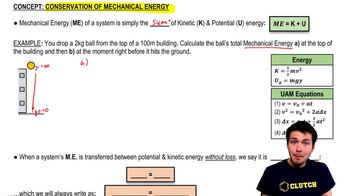
In oscillatory systems, mechanical energy is conserved, meaning the total energy (kinetic plus potential) remains constant. When the bullet embeds into the block, the kinetic energy of the bullet is converted into potential energy stored in the spring at maximum displacement (amplitude), allowing us to relate the bullet's speed to the amplitude of the oscillations.
추천 영상:
06:24
Conservation Of Mechanical Energy
관련 실천
교과서 질문

A mass hanging from a spring oscillates with a period of 0.35 s. Suppose the mass and spring are swung in a horizontal circle, with the free end of the spring at the pivot. What rotation frequency, in rpm, will cause the spring's length to stretch by 15%?

1485
views
교과서 질문

A uniform rod of mass M and length L swings as a pendulum on a pivot at distance L/4 from one end of the rod. Find an expression for the frequency f of small-angle oscillations.

2095
views
교과서 질문

It has recently become possible to 'weigh' DNA molecules by measuring the influence of their mass on a nano-oscillator. FIGURE P15.58 shows a thin rectangular cantilever etched out of silicon (density 2300 kg/m³) with a small gold dot (not visible) at the end. If pulled down and released, the end of the cantilever vibrates with SHM, moving up and down like a diving board after a jump. When bathed with DNA molecules whose ends have been modified to bind with gold, one or more molecules may attach to the gold dot. The addition of their mass causes a very slight—but measurable—decrease in the oscillation frequency. A vibrating cantilever of mass M can be modeled as a block of mass ⅓M attached to a spring. (The factor of ⅓ arises from the moment of inertia of a bar pivoted at one end.) Neither the mass nor the spring constant can be determined very accurately—perhaps to only two significant figures—but the oscillation frequency can be measured with very high precision simply by counting the oscillations. In one experiment, the cantilever was initially vibrating at exactly 12 MHz. Attachment of a DNA molecule caused the frequency to decrease by 50 Hz. What was the mass of the DNA?

1167
views
교과서 질문

Interestingly, there have been several studies using cadavers to determine the moments of inertia of human body parts, information that is important in biomechanics. In one study, the center of mass of a 5.0 kg lower leg was found to be 18 cm from the knee. When the leg was allowed to pivot at the knee and swing freely as a pendulum, the oscillation frequency was 1.6 Hz. What was the moment of inertia of the lower leg about the knee joint?

1503
views
교과서 질문

A compact car has a mass of 1200 kg. Assume that the car has one spring on each wheel, that the springs are identical, and that the mass is equally distributed over the four springs. What will be the car's oscillation frequency while carrying four 70 kg passengers?

1152
views
교과서 질문

Scientists are measuring the properties of a newly discovered elastic material. They create a 1.5-m-long, 1.6-mm-diameter cord, attach an 850 g mass to the lower end, then pull the mass down 2.5 mm and release it. Their high-speed video camera records 36 oscillations in 2.0 s. What is Young's modulus of the material?

903
views