Ch 15: Oscillations
Knight Calc - Physics for Scientists and Engineers 5th Edition
Knight Calc5th EditionPhysics for Scientists and EngineersISBN: 9780137344796당신이 사용하는 게 아니라요?교과서 변경
15장, 문제 46b

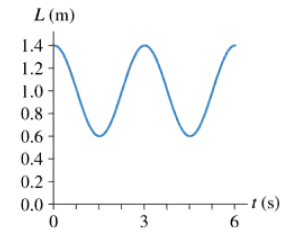
Astronauts in space cannot weigh themselves by standing on a bathroom scale. Instead, they determine their mass by oscillating on a large spring. Suppose an astronaut attaches one end of a large spring to her belt and the other end to a hook on the wall of the space capsule. A fellow astronaut then pulls her away from the wall and releases her. The spring's length as a function of time is shown in FIGURE P15.46. What is her speed when the spring's length is 1.2 m?

검증된 단계별 안내
1
Step 1: Analyze the graph provided. The graph shows the spring's length (L) as a function of time (t). The oscillation is periodic, with a maximum length of 1.8 m and a minimum length of 0.6 m. The period of oscillation is 4 seconds, as the pattern repeats every 4 seconds.
Step 2: Determine the equilibrium position of the spring. The equilibrium length is the average of the maximum and minimum lengths: \( L_{eq} = \frac{L_{max} + L_{min}}{2} \). Substitute \( L_{max} = 1.8 \ \text{m} \) and \( L_{min} = 0.6 \ \text{m} \) into the formula.
Step 3: Use the conservation of energy principle to relate the potential energy stored in the spring and the kinetic energy of the astronaut. The total mechanical energy in the system is constant and is given by \( E = \frac{1}{2} k A^2 \), where \( k \) is the spring constant and \( A \) is the amplitude of oscillation. The speed of the astronaut can be found using \( v = \sqrt{\frac{k}{m} (A^2 - (L - L_{eq})^2)} \), where \( m \) is the astronaut's mass, \( L \) is the spring's length at the given moment, and \( L_{eq} \) is the equilibrium length.
Step 4: Identify the amplitude \( A \) of oscillation from the graph. The amplitude is the difference between the maximum length and the equilibrium length: \( A = L_{max} - L_{eq} \). Substitute the values of \( L_{max} \) and \( L_{eq} \) to find \( A \).
Step 5: Substitute the given spring length \( L = 1.2 \ \text{m} \), the calculated equilibrium length \( L_{eq} \), the amplitude \( A \), and the spring constant \( k \) into the velocity formula \( v = \sqrt{\frac{k}{m} (A^2 - (L - L_{eq})^2)} \). This will give the astronaut's speed at the specified spring length.

비슷한 문제에 대한 검증된 영상 답변:

이 영상 해법은 위 문제에 도움이 된다고 튜터들이 추천한 것입니다.
영상 길이:
16m
도움이 되었나요?

주요 개념

질문에 올바르게 답하기 위해 반드시 이해해야 하는 핵심 개념들은 다음과 같습니다.

Simple Harmonic Motion (SHM)

Simple Harmonic Motion is a type of periodic motion where an object oscillates around an equilibrium position. In this case, the astronaut oscillates due to the restoring force of the spring, which is proportional to the displacement from the equilibrium position. The motion is characterized by a sinusoidal pattern, which can be described mathematically by sine or cosine functions.
추천 영상:
가이드 코스
07:52
Simple Harmonic Motion of Pendulums

Spring Constant (k)

The spring constant, denoted as 'k', is a measure of a spring's stiffness. It is defined by Hooke's Law, which states that the force exerted by a spring is proportional to its displacement from the equilibrium position (F = -kx). A higher spring constant indicates a stiffer spring, which affects the frequency and amplitude of the oscillation experienced by the astronaut.
추천 영상:
가이드 코스
08:59
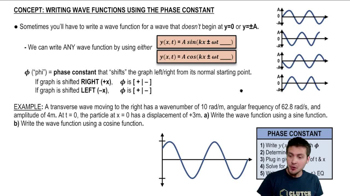
Phase Constant of a Wave Function

Velocity in Oscillatory Motion

In oscillatory motion, the velocity of an object varies with time and is maximum at the equilibrium position and zero at the maximum displacement. The velocity can be derived from the displacement function of the oscillation, which is often sinusoidal. To find the speed at a specific displacement, such as when the spring's length is 1.2 m, one can differentiate the displacement function with respect to time to obtain the velocity function.
추천 영상:
가이드 코스
04:27
Intro to Relative Motion (Relative Velocity)
관련 실천
교과서 질문

An ultrasonic transducer, of the type used in medical ultrasound imaging, is a very thin disk (m = 0.10 g) driven back and forth in SHM at 1.0 MHz by an electromagnetic coil. What is the disk's maximum speed at this amplitude?

1613
views

교과서 질문

A 200 g block hangs from a spring with spring constant 10 N/m. At t = 0 s the block is 20 cm below the equilibrium point and moving upward with a speed of 100 cm/s. What are the block's distance from equilibrium when the speed is 50 cm/s?

1578
views
교과서 질문

Your lab instructor has asked you to measure a spring constant using a dynamic method—letting it oscillate—rather than a static method of stretching it. You and your lab partner suspend the spring from a hook, hang different masses on the lower end, and start them oscillating. One of you uses a meter stick to measure the amplitude, the other uses a stopwatch to time 10 oscillations. Your data are as follows: Use the best-fit line of an appropriate graph to determine the spring constant.

1980
views
1
comments
교과서 질문

A 100 g block attached to a spring with spring constant 2.5 N/m oscillates horizontally on a frictionless table. Its velocity is 20 c/m when 𝓍 = -5.0 cm What is the block's position when the acceleration is maximum?

1341
views
교과서 질문

When the displacement of a mass on a spring is (½)A, what fraction of the energy is kinetic energy and what fraction is potential energy?

2301
views
교과서 질문

A 200 g block hangs from a spring with spring constant 10 N/m. At t = 0 s the block is 20 cm below the equilibrium point and moving upward with a speed of 100 cm/s. What are the block's a. Oscillation frequency?

1029
views