An air-track glider attached to a spring oscillates with a period of 1.5 s. At t = 0 s the glider is 5.00 cm left of the equilibrium position and moving to the right at 36.3 cm/s. What is the phase constant?
Ch 15: Oscillations
15장, 문제 7c
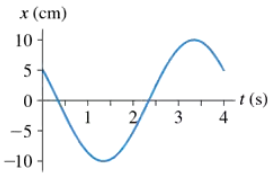
FIGURE EX15.7 is the position-versus-time graph of a particle in simple harmonic motion. What is vmax?

검증된 단계별 안내1
Identify the amplitude (A) of the motion from the graph. The amplitude is the maximum displacement from the equilibrium position. From the graph, the amplitude is 4 cm.
Determine the period (T) of the motion. The period is the time it takes for one complete cycle of motion. From the graph, the particle completes one cycle from t = 0 to t = 4 s, so T = 4 s.
Calculate the angular frequency (ω) using the formula: ω = 2π / T. Substitute the value of T = 4 s into the formula to find ω.
Use the formula for maximum velocity in simple harmonic motion: vₘₐₓ = Aω. Substitute the values of A (4 cm) and ω (calculated in the previous step) into this formula.
Ensure the units are consistent. If needed, convert the amplitude from cm to meters before calculating vₘₐₓ. The final expression for vₘₐₓ will be in meters per second (m/s).

비슷한 문제에 대한 검증된 영상 답변:
이 영상 해법은 위 문제에 도움이 된다고 튜터들이 추천한 것입니다.
영상 길이:
2m도움이 되었나요?
주요 개념
질문에 올바르게 답하기 위해 반드시 이해해야 하는 핵심 개념들은 다음과 같습니다.
Simple Harmonic Motion (SHM)
Simple Harmonic Motion is a type of periodic motion where an object oscillates around an equilibrium position. The motion is characterized by a restoring force proportional to the displacement from the equilibrium, leading to sinusoidal position, velocity, and acceleration graphs. In SHM, the maximum displacement from the equilibrium is known as the amplitude.
추천 영상:
Simple Harmonic Motion of Pendulums
Velocity in SHM
In Simple Harmonic Motion, the velocity of the oscillating object varies sinusoidally with time. The maximum velocity, denoted as vₘₐₓ, occurs as the object passes through the equilibrium position. It can be calculated using the formula vₘₐₓ = ωA, where ω is the angular frequency and A is the amplitude of the motion.
추천 영상:
Escape Velocity
Position-Time Graph
A position-time graph visually represents the position of an object as a function of time. In the context of SHM, this graph typically shows a sinusoidal wave, indicating periodic motion. The slope of the graph at any point gives the instantaneous velocity, and the maximum slope corresponds to the maximum velocity of the particle.
추천 영상:
Curved Position-Time Graphs & Acceleration
관련 실천
교과서 질문
2316
views
1
comments
교과서 질문
When a guitar string plays the note 'A,' the string vibrates at 440 Hz. What is the period of the vibration?
1746
views
교과서 질문
What are the (a) amplitude, (b) frequency, and (c) phase constant of the oscillation shown in FIGURE EX15.6?
3079
views
2
rank
교과서 질문
A 200 g air-track glider is attached to a spring. The glider is pushed in 10 cm and released. A student with a stopwatch finds that 10 oscillations take 12.0 s. What is the spring constant?
1191
views
교과서 질문
FIGURE EX15.7 is the position-versus-time graph of a particle in simple harmonic motion. What is the phase constant?
2724
views
교과서 질문
An object in simple harmonic motion has an amplitude of 8.0 cm, n angular frequency of 0.25 rad/s, and a phase constant of π rad. Draw a velocity graph showing two cycles of the motion.
2332
views