Ch 15: Oscillations
Knight Calc - Physics for Scientists and Engineers 5th Edition
Knight Calc5th EditionPhysics for Scientists and EngineersISBN: 9780137344796당신이 사용하는 게 아니라요?교과서 변경
15장, 문제 33

In a science museum, a 110 kg brass pendulum bob swings at the end of a 15.0-m-long wire. The pendulum is started at exactly 8:00 a.m. every morning by pulling it 1.5 m to the side and releasing it. Because of its compact shape and smooth surface, the pendulum's damping constant is only 0.010 kg/s. At exactly 12:00 noon, how many oscillations will the pendulum have completed and what is its amplitude?

검증된 단계별 안내
1
Step 1: Identify the key parameters of the problem. The mass of the pendulum bob is \( m = 110 \; \text{kg} \), the length of the pendulum is \( L = 15.0 \; \text{m} \), the initial displacement (amplitude) is \( A_0 = 1.5 \; \text{m} \), and the damping constant is \( b = 0.010 \; \text{kg/s} \). The time interval of interest is from 8:00 a.m. to 12:00 noon, which is \( t = 4 \; \text{hours} = 14400 \; \text{seconds} \).
Step 2: Calculate the natural frequency of the pendulum. For a simple pendulum, the angular frequency \( \omega_0 \) is given by \( \omega_0 = \sqrt{\frac{g}{L}} \), where \( g \) is the acceleration due to gravity (\( g = 9.8 \; \text{m/s}^2 \)). Substitute the values of \( g \) and \( L \) to find \( \omega_0 \).
Step 3: Determine the damped angular frequency \( \omega_d \). The damped angular frequency is given by \( \omega_d = \sqrt{\omega_0^2 - \left(\frac{b}{2m}\right)^2} \). Substitute the values of \( \omega_0 \), \( b \), and \( m \) to calculate \( \omega_d \).
Step 4: Calculate the number of oscillations completed in the given time. The period of the damped oscillation is \( T_d = \frac{2\pi}{\omega_d} \). The total number of oscillations is then \( N = \frac{t}{T_d} \). Substitute the values of \( t \) and \( T_d \) to find \( N \).
Step 5: Determine the amplitude at noon. The amplitude of a damped oscillator decreases exponentially with time according to \( A(t) = A_0 e^{-\frac{b}{2m}t} \). Substitute the values of \( A_0 \), \( b \), \( m \), and \( t \) to calculate the amplitude \( A(t) \) at \( t = 14400 \; \text{seconds} \).

비슷한 문제에 대한 검증된 영상 답변:

이 영상 해법은 위 문제에 도움이 된다고 튜터들이 추천한 것입니다.
영상 길이:
9m

주요 개념

질문에 올바르게 답하기 위해 반드시 이해해야 하는 핵심 개념들은 다음과 같습니다.

Simple Harmonic Motion (SHM)

Simple Harmonic Motion describes the oscillatory motion of an object where the restoring force is directly proportional to the displacement from its equilibrium position. In the case of a pendulum, this motion occurs when it swings back and forth around a central point. The period of oscillation depends on the length of the pendulum and the acceleration due to gravity, allowing us to predict the number of oscillations over a given time.
추천 영상:
가이드 코스
07:52
Simple Harmonic Motion of Pendulums

Damping

Damping refers to the gradual reduction in amplitude of oscillations due to energy loss, often from friction or air resistance. In this scenario, the damping constant quantifies how quickly the pendulum's motion decreases over time. A lower damping constant, like 0.010 kg/s, indicates that the pendulum will maintain its oscillations for a longer duration before coming to rest, affecting both the amplitude and the number of oscillations completed.
추천 영상:

Amplitude

Amplitude is the maximum extent of displacement from the equilibrium position in oscillatory motion. For the pendulum, the initial amplitude is determined by how far it is pulled to the side before release. Over time, due to damping, the amplitude will decrease, and understanding this change is crucial for calculating the pendulum's behavior at specific times, such as at noon after being released at 8:00 a.m.
추천 영상:
가이드 코스
04:24
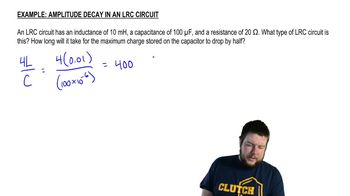
Amplitude Decay in an LRC Circuit