

Ch 16: Traveling Waves
Knight Calc - Physics for Scientists and Engineers 5th Edition
Knight Calc5th EditionPhysics for Scientists and EngineersISBN: 9780137344796당신이 사용하는 게 아니라요?교과서 변경
16장, 문제 82

A loudspeaker, mounted on a tall pole, is engineered to emit 75% of its sound energy into the forward hemisphere, 25% toward the back. You measure an 85 dB sound intensity level when standing 3.5 m in front of and 2.5 m below the speaker. What is the speaker's power output?

검증된 단계별 안내
1
Determine the sound intensity (I) at the measurement point using the given sound intensity level (L) of 85 dB. Use the formula: L = 10log(I/I0), where I0 is the reference intensity (1 × 10⁻¹² W/m²). Rearrange to solve for I: I = I0 × 10(L/10).
Calculate the total distance (r) from the speaker to the measurement point using the Pythagorean theorem. The horizontal distance is 3.5 m, and the vertical distance is 2.5 m. Use the formula: r = 3.52 + 2.52.
Relate the sound intensity (I) to the power output (P) of the speaker using the formula: I = P × f / (4πr2), where f is the fraction of the power directed into the forward hemisphere (0.75 in this case). Rearrange to solve for P: P = I × (4πr2) / f.
Substitute the calculated values of I, r, and f into the formula for P to find the speaker's power output.
Verify the units of the final result to ensure the power output is expressed in watts (W), and confirm that the assumptions (e.g., uniform sound distribution in the forward hemisphere) are consistent with the problem's conditions.

비슷한 문제에 대한 검증된 영상 답변:

이 영상 해법은 위 문제에 도움이 된다고 튜터들이 추천한 것입니다.
영상 길이:
8m
도움이 되었나요?

주요 개념

질문에 올바르게 답하기 위해 반드시 이해해야 하는 핵심 개념들은 다음과 같습니다.

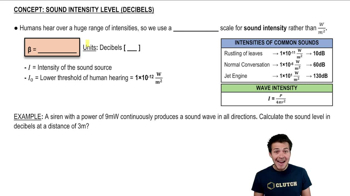
Sound Intensity Level

The sound intensity level, measured in decibels (dB), quantifies the power per unit area of sound waves. It is a logarithmic scale, meaning that an increase of 10 dB represents a tenfold increase in intensity. Understanding this concept is crucial for relating the measured sound level to the actual power output of the loudspeaker.
추천 영상:
가이드 코스
04:25
Sound Intensity Level and the Decibel Scale

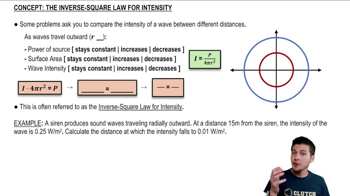
Inverse Square Law

The inverse square law states that the intensity of sound decreases with the square of the distance from the source. This principle is essential for calculating how sound intensity changes as you move away from the loudspeaker, allowing you to determine the effective power output based on the distance at which the sound level is measured.
추천 영상:
가이드 코스
05:26
The Inverse-Square Law for Intensity

Acoustic Power Output

Acoustic power output refers to the total sound energy emitted by the loudspeaker per unit time, typically measured in watts. To find the power output, one must consider the sound intensity level at a specific distance and the distribution of sound energy in different directions, as indicated by the speaker's design.
추천 영상:
가이드 코스
06:58
Power Output of a Gasoline Engine
관련 실천
교과서 질문

A communications truck with a 44-cm-diameter dish receiver on the roof starts out 10 km from its base station. It drives directly away from the base station at 50 km/h for 1.0 h, keeping the receiver pointed at the base station. The base station antenna broadcasts continuously with 2.5 kW of power, radiated uniformly in all directions. How much electromagnetic energy does the truck's dish receive during that 1.0 h?

179
views
교과서 질문

An avant-garde composer wants to use the Doppler effect in his new opera. As the soprano sings, he wants a large bat to fly toward her from the back of the stage. The bat will be outfitted with a microphone to pick up the singer's voice and a loudspeaker to rebroadcast the sound toward the audience. The composer wants the sound the audience hears from the bat to be, in musical terms, one half-step higher in frequency than the note they are hearing from the singer. Two notes a half-step apart have a frequency ratio of 21/12 = 1.059. With what speed must the bat fly toward the singer?

1632
views
교과서 질문

A physics professor demonstrates the Doppler effect by tying a 600 Hz sound generator to a 1.0-m-long rope and whirling it around her head in a horizontal circle at 100 rpm. What are the highest and lowest frequencies heard by a student in the classroom?

882
views
교과서 질문

Some modern optical devices are made with glass whose index of refraction changes with distance from the front surface. FIGURE P16.72 shows the index of refraction as a function of the distance into a slab of glass of thickness L. The index of refraction increases linearly from n1 at the front surface to n₂ at the rear surface. Evaluate your expression for a 1.0-cm-thick piece of glass for which n1 = 1.50 and n2 = 1.60.

1732
views