Ch 16: Traveling Waves
Knight Calc - Physics for Scientists and Engineers 5th Edition
Knight Calc5th EditionPhysics for Scientists and EngineersISBN: 9780137344796당신이 사용하는 게 아니라요?교과서 변경
16장, 문제 8

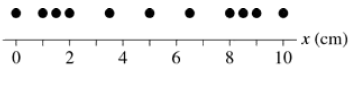
FIGURE EX16.8 is a picture at t = 0 s of the particles in a medium as a longitudinal wave is passing through. The equilibrium spacing between the particles is 1.0 cm. Draw the snapshot graph D(x, t = 0 s) of this wave at t = 0 s.

검증된 단계별 안내
1
Step 1: Observe the image provided. The red squares represent particles in a medium, and their positions indicate the compression and rarefaction regions of a longitudinal wave. The equilibrium spacing between particles is 1.0 cm.
Step 2: Identify the regions of compression and rarefaction. Compression occurs where particles are closer together than the equilibrium spacing, and rarefaction occurs where particles are farther apart than the equilibrium spacing.
Step 3: To draw the snapshot graph D(x, t = 0 s), plot the displacement of particles (D) as a function of position (x). Displacement is positive for particles displaced to the right of their equilibrium position and negative for particles displaced to the left.
Step 4: Analyze the positions of the particles in the image. For example, at x = 16 cm, particles are compressed, indicating a peak in the graph. At x = 10 cm, particles are rarefied, indicating a trough in the graph.
Step 5: Sketch the graph by connecting the peaks and troughs smoothly to represent the wave. Ensure the graph reflects the periodic nature of the wave, with alternating regions of compression and rarefaction.

비슷한 문제에 대한 검증된 영상 답변:

이 영상 해법은 위 문제에 도움이 된다고 튜터들이 추천한 것입니다.
영상 길이:
3m

주요 개념

질문에 올바르게 답하기 위해 반드시 이해해야 하는 핵심 개념들은 다음과 같습니다.

Longitudinal Waves

Longitudinal waves are a type of mechanical wave where the particle displacement is parallel to the direction of wave propagation. In these waves, particles in the medium oscillate back and forth along the same line as the wave travels, creating regions of compression and rarefaction. This is in contrast to transverse waves, where particle displacement is perpendicular to wave direction.
추천 영상:
가이드 코스
05:40
Speed of Longitudinal Waves (Fluids & Solids)

Equilibrium Spacing

Equilibrium spacing refers to the natural distance between particles in a medium when no wave is passing through. In the context of longitudinal waves, this spacing is crucial for understanding how particles compress and expand as the wave moves. The given equilibrium spacing of 1.0 cm indicates the distance between adjacent particles when they are at rest, which helps in visualizing the wave's effect on the medium.
추천 영상:
가이드 코스
10:13
Torque & Equilibrium

Snapshot Graph

A snapshot graph represents the position of particles in a medium at a specific moment in time, illustrating the wave's effect. For longitudinal waves, this graph typically shows the compressions and rarefactions of particles along the medium. At t = 0 s, the graph will depict the arrangement of particles based on their displacement from the equilibrium position, allowing for a visual understanding of the wave's characteristics.
추천 영상:
가이드 코스
07:32
Graphing Position, Velocity, and Acceleration Graphs