
Ch 17: Superposition
Knight Calc - Physics for Scientists and Engineers 5th Edition
Knight Calc5th EditionPhysics for Scientists and EngineersISBN: 9780137344796당신이 사용하는 게 아니라요?교과서 변경
17장, 문제 27b

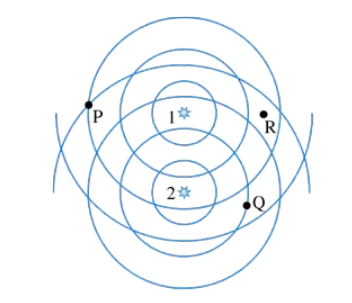
FIGURE EX17.27 shows the circular wave fronts emitted by two wave sources. Make a table with rows labeled P, Q, and R and columns labeled r1, r2, Δr, and C/D. Fill in the table for points P, Q, and R, giving the distances as multiples of λ and indicating, with a C or a D, whether the interference at that point is constructive or destructive.

검증된 단계별 안내
1
Step 1: Understand the problem. The goal is to analyze the interference pattern created by two wave sources at points P, Q, and R. The interference depends on the path difference (Δr) between the distances from the two sources (r1 and r2) to each point. Constructive interference occurs when Δr is an integer multiple of the wavelength (λ), while destructive interference occurs when Δr is a half-integer multiple of λ.
Step 2: Identify the distances r1 and r2 for each point (P, Q, and R) in terms of λ. Use the diagram provided in FIGURE EX17.27 to measure or deduce these distances. For example, if point P is equidistant from both sources, r1 and r2 will be equal, and Δr will be zero.
Step 3: Calculate the path difference Δr for each point using the formula Δr = |r1 - r2|. This gives the difference in distances traveled by the waves from the two sources to the point in question.
Step 4: Determine whether the interference is constructive (C) or destructive (D) at each point. If Δr is an integer multiple of λ (e.g., 0λ, 1λ, 2λ), the interference is constructive. If Δr is a half-integer multiple of λ (e.g., 0.5λ, 1.5λ, 2.5λ), the interference is destructive.
Step 5: Create the table with rows labeled P, Q, and R and columns labeled r1, r2, Δr, and C/D. Fill in the values for each point based on the calculations from the previous steps. Ensure the distances are expressed as multiples of λ and the interference type is indicated with a C or D.

비슷한 문제에 대한 검증된 영상 답변:

이 영상 해법은 위 문제에 도움이 된다고 튜터들이 추천한 것입니다.
영상 길이:
8m
도움이 되었나요?

주요 개념

질문에 올바르게 답하기 위해 반드시 이해해야 하는 핵심 개념들은 다음과 같습니다.

Wave Interference

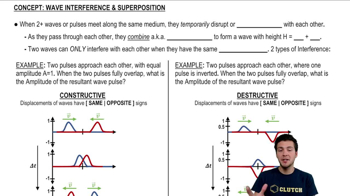
Wave interference occurs when two or more waves overlap and combine to form a new wave pattern. This can result in constructive interference, where wave amplitudes add together, or destructive interference, where they cancel each other out. Understanding this concept is crucial for analyzing how waves interact at points P, Q, and R in the given scenario.
추천 영상:
가이드 코스
03:47
Wave Interference & Superposition

Path Difference (Δr)

The path difference (Δr) refers to the difference in distance traveled by two waves from their sources to a specific point. It plays a key role in determining the type of interference at that point. If the path difference is a multiple of the wavelength (λ), constructive interference occurs; if it is an odd multiple of half the wavelength, destructive interference occurs.
추천 영상:

Wavelength (λ)

Wavelength (λ) is the distance between successive crests (or troughs) of a wave. It is a fundamental property of waves that influences their behavior during interference. In the context of the problem, expressing distances as multiples of λ helps in determining the nature of interference at points P, Q, and R, facilitating the completion of the required table.
추천 영상:
가이드 코스
05:42
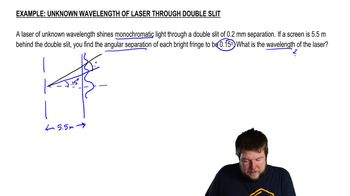
Unknown Wavelength of Laser through Double Slit
관련 실천
교과서 질문

Two loudspeakers emit sound waves along the x-axis. The sound has maximum intensity when the speakers are 20 cm apart. The sound intensity decreases as the distance between the speakers is increased, reaching zero at a separation of 60 cm. What is the wavelength of the sound?

2340
views
교과서 질문

Two strings are adjusted to vibrate at exactly 200 Hz. Then the tension in one string is increased slightly. Afterward, three beats per second are heard when the strings vibrate at the same time. What is the new frequency of the string that was tightened?

1616
views
교과서 질문

What is the thinnest film of MgF2 (n=1.39) on glass that produces a strong reflection for orange light with a wavelength of 600 nm?

420
views
교과서 질문

A flute player hears four beats per second when she compares her note to a 523 Hz tuning fork (the note C). She can match the frequency of the tuning fork by pulling out the 'tuning joint' to lengthen her flute slightly. What was her initial frequency?

1628
views
교과서 질문

Two loudspeakers in a 20°C room emit 686 Hz sound waves along the x-axis. If the speakers are out of phase, what is the smallest distance between the speakers for which the interference of the sound waves is maximum constructive?

1824
views
교과서 질문

Two out-of-phase radio antennas at x=±300 m on the x-axis are emitting 3.0 MHz radio waves. Is the point (x, y) =(300 m, 800 m) a point of maximum constructive interference, maximum destructive interference, or something in between?

274
views