
Ch 17: Superposition
Knight Calc - Physics for Scientists and Engineers 5th Edition
Knight Calc5th EditionPhysics for Scientists and EngineersISBN: 9780137344796당신이 사용하는 게 아니라요?교과서 변경
17장, 문제 71c

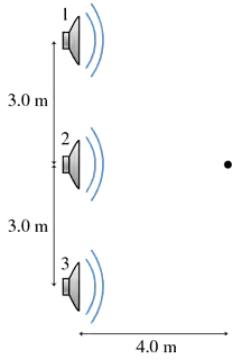
The three identical loudspeakers in FIGURE P17.71 play a 170 Hz tone in a room where the speed of sound is 340 m/s. You are standing 4.0 m in front of the middle speaker. At this point, the amplitude of the wave from each speaker is a. When the amplitude is maximum, by what factor is the sound intensity greater than the sound intensity from a single speaker?

검증된 단계별 안내
1
Step 1: Calculate the wavelength of the sound wave using the formula \( \lambda = \frac{v}{f} \), where \( v \) is the speed of sound (340 m/s) and \( f \) is the frequency (170 Hz).
Step 2: Determine the path difference between the waves from the side speakers and the middle speaker at the listener's position. Use the geometry of the setup to calculate the distances from the listener to each speaker.
Step 3: Analyze the interference pattern. If the path difference is an integer multiple of the wavelength, constructive interference occurs, leading to maximum amplitude.
Step 4: Recall that sound intensity is proportional to the square of the amplitude. When the amplitudes from all three speakers add constructively, the total amplitude is \( 3a \). The intensity is then proportional to \( (3a)^2 \), which is 9 times the intensity from a single speaker.
Step 5: Conclude that the sound intensity at the point of maximum amplitude is 9 times greater than the intensity from a single speaker.

비슷한 문제에 대한 검증된 영상 답변:

이 영상 해법은 위 문제에 도움이 된다고 튜터들이 추천한 것입니다.
영상 길이:
11m

주요 개념

질문에 올바르게 답하기 위해 반드시 이해해야 하는 핵심 개념들은 다음과 같습니다.

Wave Interference

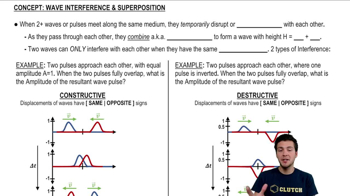
Wave interference occurs when two or more waves overlap and combine to form a new wave pattern. This can result in constructive interference, where the amplitudes of the waves add together, leading to a louder sound, or destructive interference, where the amplitudes cancel each other out, resulting in a quieter sound. In this scenario, the positioning of the speakers and the distance from the listener will determine the type of interference experienced.
추천 영상:
가이드 코스
03:47
Wave Interference & Superposition

Sound Intensity

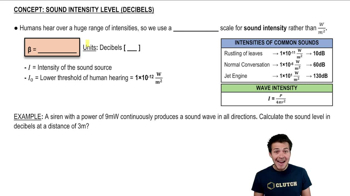
Sound intensity is defined as the power per unit area carried by a sound wave and is proportional to the square of the amplitude of the wave. When multiple sound sources are present, the total intensity at a point can be calculated by summing the intensities from each source. The intensity from a single speaker can be compared to the combined intensity from multiple speakers when they are in phase, leading to maximum amplitude.
추천 영상:
가이드 코스
04:25
Sound Intensity Level and the Decibel Scale

Amplitude and Sound Level

Amplitude refers to the maximum displacement of particles in a wave from their rest position, which directly affects the loudness of the sound produced. In acoustics, a higher amplitude results in a higher sound level, measured in decibels (dB). When multiple speakers produce sound waves in phase, the resultant amplitude increases, leading to a significant increase in sound intensity, which can be quantified as a factor greater than that of a single speaker.
추천 영상:
가이드 코스
04:25
Sound Intensity Level and the Decibel Scale
관련 실천
교과서 질문

The three identical loudspeakers in FIGURE P17.71 play a 170 Hz tone in a room where the speed of sound is 340 m/s. You are standing 4.0 m in front of the middle speaker. At this point, the amplitude of the wave from each speaker is a. How far must speaker 2 be moved to the left to produce a maximum amplitude at the point where you are standing?

1817
views
교과서 질문

Piano tuners tune pianos by listening to the beats between the harmonics of two different strings. When properly tuned, the note A should have a frequency of 440 Hz and the note E should be at 659 Hz. What is the frequency difference between the third harmonic of the A and the second harmonic of the E?

1163
views
교과서 질문

Piano tuners tune pianos by listening to the beats between the harmonics of two different strings. When properly tuned, the note A should have a frequency of 440 Hz and the note E should be at 659 Hz. The tuner starts with the tension in the E string a little low, then tightens it. What is the frequency of the E string when she hears four beats per second?

1481
views
교과서 질문

A flutist assembles her flute in a room where the speed of sound is 342 m/s. When she plays the note A, it is in perfect tune with a 440 Hz tuning fork. After a few minutes, the air inside her flute has warmed to where the speed of sound is 346 m/s. How far does she need to extend the 'tuning joint' of her flute to be in tune with the tuning fork?

1804
views
교과서 질문

Engineers are testing a new thin-film coating whose index of refraction is less than that of glass. They deposit a 560-nm-thick layer on glass, then shine lasers on it. A red laser with a wavelength of 640 nm has no reflection at all, but a violet laser with a wavelength of 400 nm has a maximum reflection. How the coating behaves at other wavelengths is unknown. What is the coating’s index of refraction?

1516
views
교과서 질문

Scientists are testing a transparent material whose index of refraction for visible light varies with wavelength as n = 30.0 nm1/21/2 , where λ is in nm. If a 295-nm-thick coating is placed on glass (n=1.50), for what visible wavelengths will the reflected light have maximum constructive interference?

1337
views