
Ch 17: Superposition
Knight Calc - Physics for Scientists and Engineers 5th Edition
Knight Calc5th EditionPhysics for Scientists and EngineersISBN: 9780137344796당신이 사용하는 게 아니라요?교과서 변경
17장, 문제 61c

Two loudspeakers emit sound waves of the same frequency along the x-axis. The amplitude of each wave is a. The sound intensity is minimum when speaker 2 is 10 cm behind speaker 1. The intensity increases as speaker 2 is moved forward and first reaches maximum, with amplitude 2a, when it is 30 cm in front of speaker 1. What is The amplitude of the sound (as a multiple of a) if the speakers are placed side by side?

검증된 단계별 안내
1
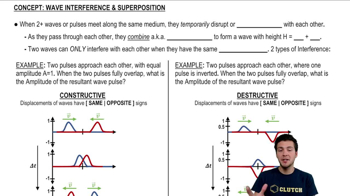
Step 1: Understand the concept of interference. When two sound waves of the same frequency overlap, their amplitudes combine. Constructive interference occurs when the waves are in phase, leading to maximum amplitude, while destructive interference occurs when the waves are out of phase, leading to minimum amplitude.
Step 2: Analyze the given information. The sound intensity is minimum when speaker 2 is 10 cm behind speaker 1, indicating destructive interference. This means the path difference corresponds to half a wavelength (λ/2). The intensity is maximum when speaker 2 is 30 cm in front of speaker 1, indicating constructive interference, where the path difference corresponds to a full wavelength (λ).
Step 3: Calculate the wavelength (λ) of the sound waves. The difference between the positions of destructive and constructive interference is 40 cm (30 cm in front minus 10 cm behind). Since this corresponds to half a wavelength (λ/2 to λ), the wavelength is λ = 40 cm.
Step 4: Consider the scenario where the speakers are placed side by side. In this case, the path difference is zero, meaning the waves are perfectly in phase. Constructive interference occurs, and the amplitudes of the waves add together.
Step 5: Determine the amplitude of the sound when the speakers are side by side. Since the amplitude of each wave is 'a' and they are in phase, the total amplitude is the sum of the individual amplitudes: 2a.

비슷한 문제에 대한 검증된 영상 답변:

이 영상 해법은 위 문제에 도움이 된다고 튜터들이 추천한 것입니다.
도움이 되었나요?

주요 개념

질문에 올바르게 답하기 위해 반드시 이해해야 하는 핵심 개념들은 다음과 같습니다.

Interference of Waves

Interference occurs when two or more waves overlap, resulting in a new wave pattern. Constructive interference happens when waves are in phase, leading to increased amplitude, while destructive interference occurs when waves are out of phase, reducing amplitude. The position of the speakers affects the phase relationship of the emitted sound waves, which is crucial for understanding the intensity variations described in the question.
추천 영상:
03:47
Wave Interference & Superposition

Amplitude and Intensity Relationship

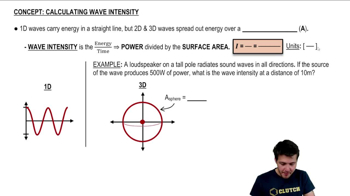
Amplitude refers to the maximum displacement of a wave from its rest position, while intensity is the power per unit area carried by the wave. The intensity of sound is proportional to the square of its amplitude. Therefore, when the amplitude of the sound waves from the speakers changes due to their positions, the resulting intensity also changes, which is key to solving the problem presented.
추천 영상:
02:32
Wave Intensity

Phase Difference

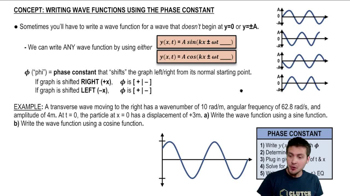
Phase difference is the difference in the phase of two waves at a given point in time. It is crucial in determining whether the interference is constructive or destructive. In this scenario, the phase difference between the sound waves from the two speakers changes as their positions are altered, affecting the resultant amplitude and intensity of the sound when they are side by side.
추천 영상:
08:59
Phase Constant of a Wave Function
관련 실천
교과서 질문

A 280 Hz sound wave is directed into one end of the trombone slide seen in FIGURE P17.55. A microphone is placed at the other end to record the intensity of sound waves that are transmitted through the tube. The straight sides of the slide are 80 cm in length and 10 cm apart with a semicircular bend at the end. For what slide extensions s will the microphone detect a maximum of sound intensity?

2051
views
교과서 질문

Microwaves with a frequency of 10.5 GHz are aimed downward into a flat-bottomed beaker that contains sunflower oil. A microwave detector above the beaker finds that there are strong reflections when the oil depth is 2.76 cm and 3.68 cm but at no depths in between. What is the index of refraction of sunflower oil at microwave frequencies?

1643
views
교과서 질문

An old mining tunnel disappears into a hillside. You would like to know how long the tunnel is, but it's too dangerous to go inside. Recalling your recent physics class, you decide to try setting up standing-wave resonances inside the tunnel. Using your subsonic amplifier and loudspeaker, you find resonances at 4.5 Hz and 6.3 Hz, and at no frequencies between these. It's rather chilly inside the tunnel, so you estimate the sound speed to be 335 m/s . Based on your measurements, how far is it to the end of the tunnel?

1408
views
교과서 질문

A 1.0-m-tall vertical tube is filled with 20°C water. A tuning fork vibrating at 580 Hz is held just over the top of the tube as the water is slowly drained from the bottom. At what water heights, measured from the bottom of the tube, will there be a standing wave in the tube above the water?

1988
views
교과서 질문

Engineers are testing a new thin-film coating whose index of refraction is less than that of glass. They deposit a 560-nm-thick layer on glass, then shine lasers on it. A red laser with a wavelength of 640 nm has no reflection at all, but a violet laser with a wavelength of 400 nm has a maximum reflection. How the coating behaves at other wavelengths is unknown. What is the coating’s index of refraction?

1516
views
교과서 질문

Scientists are testing a transparent material whose index of refraction for visible light varies with wavelength as n = 30.0 nm1/21/2 , where λ is in nm. If a 295-nm-thick coating is placed on glass (n=1.50), for what visible wavelengths will the reflected light have maximum constructive interference?

1337
views