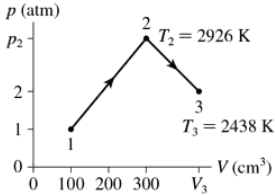
0.0050 mol of gas undergoes the process 1→2→3 shown in FIGURE EX18.37. What are temperature T1?
Ch 18: A Macroscopic Description of Matter
18장, 문제 37b
0.0050 mol of gas undergoes the process 1→2→3 shown in FIGURE EX18.37. What are pressure p2?

검증된 단계별 안내1
Step 1: Identify the given data for state B from the diagram: Volume (V_B = 4.00 L) and Temperature (T_B = 620 K). The number of moles of gas is also provided as n = 0.0050 mol.
Step 2: Use the Ideal Gas Law, which is expressed as: , where P is pressure, V is volume, n is the number of moles, R is the universal gas constant (R = 0.0821 L·atm/(mol·K)), and T is temperature.
Step 3: Rearrange the Ideal Gas Law to solve for pressure P_B: .
Step 4: Substitute the known values into the equation: n = 0.0050 mol, R = 0.0821 L·atm/(mol·K), T_B = 620 K, and V_B = 4.00 L.
Step 5: Perform the calculation using the substituted values to find P_B. Ensure units are consistent throughout the calculation (e.g., L, atm, mol, K).

비슷한 문제에 대한 검증된 영상 답변:
이 영상 해법은 위 문제에 도움이 된다고 튜터들이 추천한 것입니다.
영상 길이:
3m주요 개념
질문에 올바르게 답하기 위해 반드시 이해해야 하는 핵심 개념들은 다음과 같습니다.
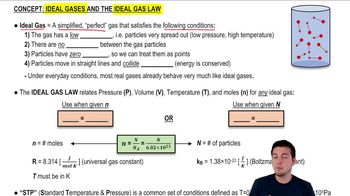
Ideal Gas Law
The Ideal Gas Law relates the pressure, volume, temperature, and number of moles of a gas through the equation PV = nRT. This law is fundamental in understanding the behavior of gases under various conditions and is essential for calculating properties like pressure in different states of a gas.
추천 영상:
가이드 코스
Ideal Gases and the Ideal Gas Law
Pressure-Volume Relationship
The pressure-volume relationship, often described by Boyle's Law, states that for a given amount of gas at constant temperature, the pressure of the gas is inversely proportional to its volume. This concept is crucial for analyzing processes in the provided graph, particularly when determining pressure at different volumes.
추천 영상:
가이드 코스
Pressure and Atmospheric Pressure
Thermodynamic Processes
Thermodynamic processes describe the changes in state variables of a system, such as pressure, volume, and temperature. Understanding the types of processes (isothermal, adiabatic, etc.) helps in analyzing the transitions between states A, B, and C in the graph, which is key to finding the pressure p₂.
추천 영상:
가이드 코스
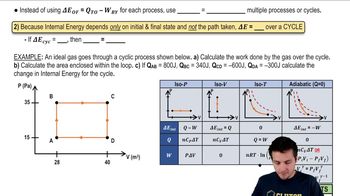
Properties of Cyclic Thermodynamic Processes
관련 실천
교과서 질문
1570
views
교과서 질문
A gas with an initial temperature of 900°C undergoes the process shown in FIGURE EX18.35. How many moles of gas are there?
2196
views
교과서 질문
The molecular mass of water (H₂O) is 18 u. How many protons are there in 1.0 L of liquid water?
2915
views
교과서 질문
A gas with an initial temperature of 900°C undergoes the process shown in FIGURE EX18.35. What type of process is this?
1734
views
교과서 질문
0.0050 mol of gas undergoes the process 1→2→3 shown in FIGURE EX18.37. What is the volume V3?
1832
views
교과서 질문
A sealed container holds 3.2 g of oxygen at 1 atm pressure and 20°C. The gas first undergoes an isobaric process that doubles the absolute temperature, then an isothermal process that halves the pressure. What is the final volume of the gas in L?
2423
views