By what factor does the rms speed of a molecule change if the temperature is increased from 10℃ to 1000℃?
Ch 20: The Micro/Macro Connection
20장, 문제 21
1.0 mol of argon has 3100 J of thermal energy. What is the gas temperature in °C?
검증된 단계별 안내1
Identify the relationship between thermal energy and temperature for an ideal gas. The thermal energy of a monatomic ideal gas is given by the formula: , where is the thermal energy, is the number of moles, is the ideal gas constant (8.314 J/(mol·K)), and is the temperature in kelvins.
Rearrange the formula to solve for temperature : .
Substitute the given values into the formula: J, mol, and J/(mol·K).
Perform the calculation to find the temperature in kelvins ().
Convert the temperature from kelvins to degrees Celsius using the formula: .

비슷한 문제에 대한 검증된 영상 답변:
이 영상 해법은 위 문제에 도움이 된다고 튜터들이 추천한 것입니다.
영상 길이:
3m주요 개념
질문에 올바르게 답하기 위해 반드시 이해해야 하는 핵심 개념들은 다음과 같습니다.
Thermal Energy
Thermal energy refers to the total kinetic energy of the particles in a substance due to their motion. In the context of gases, it is directly related to temperature, as higher thermal energy indicates greater particle movement. The relationship between thermal energy and temperature is crucial for understanding how energy is distributed among gas particles.
추천 영상:
가이드 코스
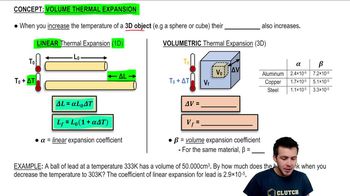
Volume Thermal Expansion
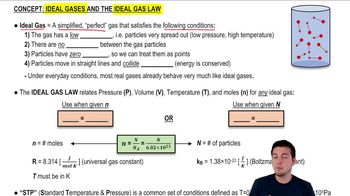
Ideal Gas Law
The Ideal Gas Law is a fundamental equation in thermodynamics that relates pressure, volume, temperature, and the number of moles of a gas. It is expressed as PV = nRT, where P is pressure, V is volume, n is the number of moles, R is the ideal gas constant, and T is temperature in Kelvin. This law helps in calculating the temperature of a gas when its thermal energy and amount are known.
추천 영상:
가이드 코스
Ideal Gases and the Ideal Gas Law
Temperature Conversion
Temperature conversion is the process of changing temperature values from one scale to another, such as from Kelvin to Celsius. The conversion from Kelvin to Celsius is done using the formula °C = K - 273.15. Understanding this conversion is essential for accurately interpreting temperature readings in different contexts, especially in thermodynamic calculations.
추천 영상:
가이드 코스
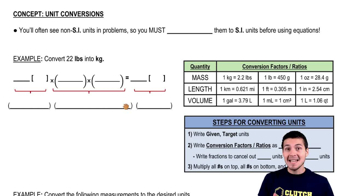
Unit Conversions
관련 실천
교과서 질문
1502
views
교과서 질문
A cylinder contains gas at a pressure of 2.0 atm and a number density of 4.2 x 1025 m-3. The rms speed of the atoms is 660 m/s. Identify the gas.
1402
views
교과서 질문
The rms speed of the atoms in a 2.0 g sample of helium gas is 700 m/s. What is the thermal energy of the gas?
1933
views
교과서 질문
A 6.0 m ✕ 8.0 m ✕ 3.0 m room contains air at 20℃. What is the room's thermal energy?
2083
views
교과서 질문
Liquid helium boils at 4.2 K. In a flask, the helium gas above the boiling liquid is at the same temperature. What are (a) the mean free path in the gas, (b) the rms speed of the atoms, and (c) the average energy per atom?
1786
views
교과서 질문
The rms speed of molecules in a gas is 600 m/s. What will be the rms speed if the gas pressure and volume are both halved?
1850
views