
Ch 20: The Micro/Macro Connection
Knight Calc - Physics for Scientists and Engineers 5th Edition
Knight Calc5th EditionPhysics for Scientists and EngineersISBN: 9780137344796당신이 사용하는 게 아니라요?교과서 변경
20장, 문제 65c

A monatomic gas is adiabatically compressed to 1/8 of its initial volume. Does each of the following quantities change? If so, does it increase or decrease, and by what factor? If not, why not? The thermal energy of the gas.

검증된 단계별 안내
1
Understand the context: In an adiabatic process, no heat is exchanged with the surroundings (Q = 0). For a monatomic ideal gas, the internal energy (thermal energy) is directly related to its temperature, and any change in thermal energy comes from work done on or by the gas.
Recall the first law of thermodynamics: ΔU = Q - W. Since Q = 0 in an adiabatic process, the change in internal energy (ΔU) is equal to the work done on the gas (W). This means the thermal energy of the gas changes as work is done during compression.
Use the adiabatic condition: For an adiabatic process, the relationship between pressure, volume, and temperature is governed by the equation P V^γ = constant, where γ (gamma) is the adiabatic index. For a monatomic gas, γ = 5/3.
Relate temperature to volume: The temperature of the gas changes according to the equation T₂/T₁ = (V₁/V₂)^(γ-1), where T₁ and T₂ are the initial and final temperatures, and V₁ and V₂ are the initial and final volumes. Substitute V₂ = V₁/8 and γ = 5/3 to find the factor by which the temperature changes.
Connect thermal energy to temperature: The thermal energy of a monatomic ideal gas is given by U = (3/2) nRT, where n is the number of moles and T is the temperature. Since U is proportional to T, the change in thermal energy is directly proportional to the change in temperature. Use the factor derived in the previous step to determine how much the thermal energy increases or decreases.

비슷한 문제에 대한 검증된 영상 답변:

이 영상 해법은 위 문제에 도움이 된다고 튜터들이 추천한 것입니다.
영상 길이:
7m
도움이 되었나요?

주요 개념

질문에 올바르게 답하기 위해 반드시 이해해야 하는 핵심 개념들은 다음과 같습니다.

Adiabatic Process

An adiabatic process is one in which no heat is exchanged with the surroundings. In the context of a gas, this means that any change in the internal energy of the gas is due solely to work done on or by the gas. During adiabatic compression, the gas's volume decreases, leading to an increase in pressure and temperature, while the thermal energy changes as a result of work input.
추천 영상:
가이드 코스
06:13
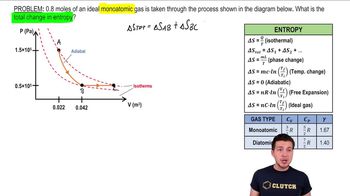
Entropy & Ideal Gas Processes

Thermal Energy

Thermal energy refers to the total kinetic energy of the particles in a substance, which is directly related to its temperature. For an ideal monatomic gas, thermal energy can be expressed as a function of temperature and the number of particles. In an adiabatic process, when the gas is compressed, its thermal energy increases due to the work done on it, resulting in a rise in temperature.
추천 영상:
가이드 코스
05:21
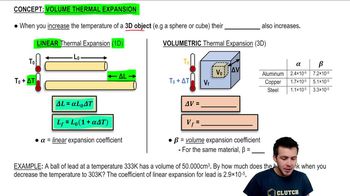
Volume Thermal Expansion

First Law of Thermodynamics

The First Law of Thermodynamics states that the change in internal energy of a system is equal to the heat added to the system minus the work done by the system. In an adiabatic process, since no heat is exchanged, the change in internal energy is equal to the work done on the gas. This principle helps to understand how the thermal energy of the gas changes during compression, as it directly correlates with the work input.
추천 영상:
가이드 코스
08:04
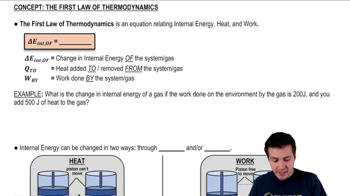
The First Law of Thermodynamics
관련 실천
교과서 질문

n moles of a diatomic gas with Cv = 5/2 R has initial pressure pi and volume Vi. The gas undergoes a process in which the pressure is directly proportional to the volume until the rms speed of the molecules has doubled. How much heat does this process require? Give your answer in terms of n, pi and Vi.

175
views
교과서 질문

A water molecule has its three atoms arranged in a 'V' shape, so it has rotational kinetic energy around any of three mutually perpendicular axes. However, like diatomic molecules, its vibrational modes are not active at temperatures below 1000 K. What is the thermal energy of 2.0 mol of steam at a temperature of 160°C?

1529
views
교과서 질문

A nitrogen molecule consists of two nitrogen atoms separated by 0.11 nm, the bond length. Treat the molecule as a rotating dumbbell and find the rms angular velocity at this temperature of a nitrogen molecule around the z-axis, as shown in Figure 20.10.

1600
views
교과서 질문

A monatomic gas is adiabatically compressed to 1/8 of its initial volume. Does each of the following quantities change? If so, does it increase or decrease, and by what factor? If not, why not? The mean free path.

1110
views
교과서 질문

The rms speed of the molecules in 1.0 g of hydrogen gas is 1800 m/s. 500 J of work are done to compress the gas while, in the same process, 1200 J of heat energy are transferred from the gas to the environment. Afterward, what is the rms speed of the molecules?

1873
views
교과서 질문

The 2010 Nobel Prize in Physics was awarded for the discovery of graphene, a two-dimensional form of carbon in which the atoms form a two-dimensional crystal-lattice sheet only one atom thick. Predict the molar specific heat of graphene. Give your answer as a multiple of R.

1582
views