
Ch 20: The Micro/Macro Connection
Knight Calc - Physics for Scientists and Engineers 5th Edition
Knight Calc5th EditionPhysics for Scientists and EngineersISBN: 9780137344796당신이 사용하는 게 아니라요?교과서 변경
20장, 문제 73b

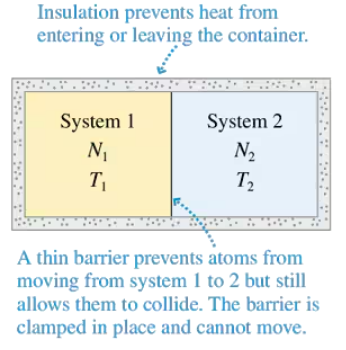
Consider a container like that shown in the Figure, with n1n_1 moles of a monatomic gas on one side and n2n_2 moles of a diatomic gas on the other. The monatomic gas has initial temperature T1iT_{1i}. The diatomic gas has initial temperature T2iT_{2i}. Show that the equilibrium temperature is


Tf=3n1T1i+5n2T2i3n1+5n2T_f = \(\frac{3n_1 T_{1i}\) + 5n_2 T_{2i}}{3n_1 + 5n_2}

검증된 단계별 안내
1
Step 1: Understand the problem. We are tasked with finding the equilibrium temperature when two gases, one monatomic and one diatomic, are allowed to exchange heat in a thermally insulated container. The system is isolated, so the total internal energy remains constant.
Step 2: Write the expression for the internal energy of each gas. For a monatomic gas, the internal energy is given by \( U_1 = \frac{3}{2} n_1 R T_1 \), where \( n_1 \) is the number of moles, \( R \) is the gas constant, and \( T_1 \) is the temperature. For a diatomic gas, the internal energy is \( U_2 = \frac{5}{2} n_2 R T_2 \), where \( n_2 \) is the number of moles and \( T_2 \) is the temperature.
Step 3: Apply the principle of conservation of energy. At equilibrium, the total internal energy of the system remains constant. This means the sum of the initial internal energies of the two gases equals the sum of their internal energies at equilibrium: \( \frac{3}{2} n_1 R T_{1i} + \frac{5}{2} n_2 R T_{2i} = \frac{3}{2} n_1 R T_{eq} + \frac{5}{2} n_2 R T_{eq} \).
Step 4: Simplify the equation to solve for the equilibrium temperature \( T_{eq} \). Factor out \( R \) and rearrange terms: \( T_{eq} = \frac{3 n_1 T_{1i} + 5 n_2 T_{2i}}{3 n_1 + 5 n_2} \).
Step 5: Interpret the result. The equilibrium temperature \( T_{eq} \) is a weighted average of the initial temperatures \( T_{1i} \) and \( T_{2i} \), with the weights determined by the number of moles and the degrees of freedom of each gas. This result reflects the distribution of energy according to the equipartition theorem.

비슷한 문제에 대한 검증된 영상 답변:

이 영상 해법은 위 문제에 도움이 된다고 튜터들이 추천한 것입니다.
영상 길이:
6m
도움이 되었나요?

주요 개념

질문에 올바르게 답하기 위해 반드시 이해해야 하는 핵심 개념들은 다음과 같습니다.

Thermodynamic Equilibrium

Thermodynamic equilibrium occurs when a system's macroscopic properties, such as temperature and pressure, become uniform throughout. In the context of gases, this means that after sufficient time, the temperatures of the monatomic and diatomic gases will equalize, leading to a single equilibrium temperature. This concept is crucial for understanding how energy is distributed between different types of gases in a closed system.
추천 영상:
가이드 코스
10:13
Torque & Equilibrium

Heat Capacity

Heat capacity is the amount of heat required to change a substance's temperature by a given amount. For gases, the heat capacity can vary depending on whether the gas is monatomic or diatomic. Monatomic gases typically have a lower heat capacity than diatomic gases due to their simpler molecular structure, which affects how they store thermal energy. This concept is essential for calculating the final equilibrium temperature when two gases with different heat capacities are mixed.
추천 영상:
가이드 코스
05:14
Overview of Heat Transfer

First Law of Thermodynamics

The First Law of Thermodynamics states that energy cannot be created or destroyed, only transformed from one form to another. In the context of the two gases, the heat lost by the hotter gas will equal the heat gained by the cooler gas, leading to the establishment of an equilibrium temperature. This principle is fundamental for analyzing energy exchanges in thermodynamic processes and is key to solving problems involving multiple gases.
추천 영상:
가이드 코스
08:04
The First Law of Thermodynamics
관련 실천
교과서 질문

Consider a container like that shown in Figure, with n1n_1 moles of a monatomic gas on one side and n2n_2 moles of a diatomic gas on the other. The monatomic gas has initial temperature T1iT_{1i}. The diatomic gas has initial temperature T2iT_{2i}. Show that the equilibrium thermal energies are

E1f=3n13n1+5n2(E1i+E2i)E2f=5n23n1+5n2(E1i+E2i)\(\begin{aligned}\) E_{1f} &= \(\frac{3n_1}{3n_1 + 5n_2}\) (E_{1i} + E_{2i}) \\ E_{2f} &= \(\frac{5n_2}{3n_1 + 5n_2}\) (E_{1i} + E_{2i}) \(\end{aligned}\)

1147
views
교과서 질문

A 2.0 mol sample of oxygen gas in a rigid, 15 L container is slowly cooled from 250℃ to 50℃ by being in thermal contact with a large bath of 50℃ water. What is the entropy change of (a) the gas and (b) the universe?

1688
views
교과서 질문

An experiment you're designing needs a gas with γ = 1.50. You recall from your physics class that no individual gas has this value, but it occurs to you that you could produce a gas with γ = 1.50 by mixing together a monatomic gas and a diatomic gas. What fraction of the molecules need to be monatomic?

133
views
교과서 질문

A thin partition divides a container of volume V into two parts. One side contains nA moles of gas A in a fraction fA of the container; that is, VA = fAV. The other side contains nB moles of a different gas B at the same temperature in a fraction fB of the container. The partition is removed, allowing the gases to mix. Find an expression for the change of entropy. This is called the entropy of mixing.

1718
views