Ch 20: The Micro/Macro Connection
Knight Calc - Physics for Scientists and Engineers 5th Edition
Knight Calc5th EditionPhysics for Scientists and EngineersISBN: 9780137344796당신이 사용하는 게 아니라요?교과서 변경
20장, 문제 48a

Interstellar space, far from any stars, is filled with a very low density of hydrogen atoms (H, not H₂). The number density is about 1 atom/cm³ and the temperature is about 3 K. Estimate the pressure in interstellar space. Give your answer in Pa and in atm.

검증된 단계별 안내
1
Start by recalling the ideal gas law, which is given by the equation: P=nkT, where P is the pressure, n is the number density (in particles per cubic meter), k is the Boltzmann constant (1.38×10²³ J/K), and T is the temperature in kelvins.
Convert the number density from atoms per cubic centimeter to atoms per cubic meter. Since there are 10 cubic centimeters in a cubic meter, multiply the given number density (1 atom/cm³) by 10 to get the number density in atoms/m³.
Substitute the values into the ideal gas law. Use n (number density in atoms/m³), k (Boltzmann constant), and T (temperature in kelvins) into the equation P=nkT to calculate the pressure in pascals (Pa).
Convert the pressure from pascals to atmospheres. Use the conversion factor 1 atm=1.013×10 Pa. Divide the pressure in pascals by this value to get the pressure in atmospheres.
Summarize the results: The pressure in interstellar space is calculated in both pascals (Pa) and atmospheres (atm) using the steps above. Ensure the units are consistent and the calculations are accurate.

비슷한 문제에 대한 검증된 영상 답변:

이 영상 해법은 위 문제에 도움이 된다고 튜터들이 추천한 것입니다.
영상 길이:
3m
도움이 되었나요?

주요 개념

질문에 올바르게 답하기 위해 반드시 이해해야 하는 핵심 개념들은 다음과 같습니다.

Ideal Gas Law

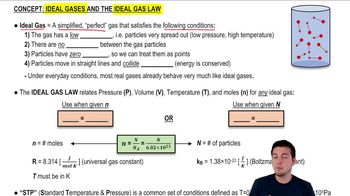
The Ideal Gas Law relates the pressure, volume, temperature, and number of moles of a gas through the equation PV = nRT. In this context, it can be simplified to P = nkT, where P is pressure, n is the number density of particles, k is the Boltzmann constant, and T is the temperature in Kelvin. This law is essential for estimating the pressure of gases in low-density environments like interstellar space.
추천 영상:
가이드 코스
07:21
Ideal Gases and the Ideal Gas Law

Number Density

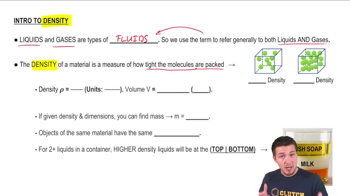
Number density refers to the number of particles per unit volume, typically expressed in particles per cubic centimeter (atoms/cm³). In the given scenario, the number density of hydrogen atoms is approximately 1 atom/cm³. This concept is crucial for calculating the pressure in interstellar space using the Ideal Gas Law, as it directly influences the resulting pressure value.
추천 영상:
가이드 코스
8:13
Intro to Density

Boltzmann Constant

The Boltzmann constant (k) is a fundamental physical constant that relates the average kinetic energy of particles in a gas with the temperature of the gas. Its value is approximately 1.38 x 10^-23 J/K. In the context of interstellar space, it is used in the Ideal Gas Law to convert temperature into energy, allowing for the calculation of pressure based on the thermal motion of hydrogen atoms at low temperatures.
추천 영상:
가이드 코스
08:59
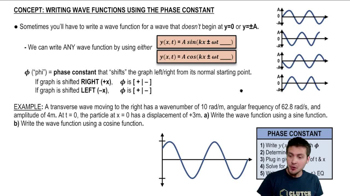
Phase Constant of a Wave Function
관련 실천
교과서 질문

The pressure inside a tank of neon is 150 atm. The temperature is 25℃. On average, how many atomic diameters does a neon atom move between collisions?

320
views

교과서 질문

Dust particles are ≈ 10 μm in diameter. They are pulverized rock, with ρ ≈ 2500 kg/m³. If you treat dust as an ideal gas, what is the rms speed of a dust particle at 20℃?

1377
views
교과서 질문

Interstellar space, far from any stars, is filled with a very low density of hydrogen atoms (H, not H₂). The number density is about 1 atom/cm³ and the temperature is about 3 K. What is the edge length L of an L ✕ L ✕ L cube of gas with 1.0 J of thermal energy?

260
views
교과서 질문

A mad engineer builds a cube, 2.5 m on a side, in which 6.2-cm-diameter rubber balls are constantly sent flying in random directions by vibrating walls. He will award a prize to anyone who can figure out how many balls are in the cube without entering it or taking out any of the balls. You decide to shoot 6.2-cm-diameter plastic balls into the cube, through a small hole, to see how far they get before colliding with a rubber ball. After many shots, you find they travel an average distance of 1.8 m. How many rubber balls do you think are in the cube?

1517
views
교과서 질문

Photons of light scatter off molecules, and the distance you can see through a gas is proportional to the mean free path of photons through the gas. Photons are not gas molecules, so the mean free path of a photon is not given by Equation 20.3, but its dependence on the number density of the gas and on the molecular radius is the same. Suppose you are in a smoggy city and can barely see buildings 500 m away. How far would you be able to see if all the molecules around you suddenly doubled in volume?

1624
views
교과서 질문

Photons of light scatter off molecules, and the distance you can see through a gas is proportional to the mean free path of photons through the gas. Photons are not gas molecules, so the mean free path of a photon is not given by Equation 20.3, but its dependence on the number density of the gas and on the molecular radius is the same. Suppose you are in a smoggy city and can barely see buildings 500 m away. How far would you be able to see if the temperature suddenly rose from 20°C to a blazing hot 1500°C with the pressure unchanged?

1424
views