Ch 21: Heat Engines and Refrigerators
Knight Calc - Physics for Scientists and Engineers 5th Edition
Knight Calc5th EditionPhysics for Scientists and EngineersISBN: 9780137344796당신이 사용하는 게 아니라요?교과서 변경
21장, 문제 3

A Boeing 777 jet engine, the world's largest, has a power output of 82 MW. It burns jet fuel with an energy density of 43 MJ /kg. What is the engine's fuel consumption rate, in kg/s, if its efficiency is 30%?

검증된 단계별 안내
1
Step 1: Understand the relationship between power, energy density, and efficiency. The power output of the engine is related to the rate of energy consumption and the efficiency of the engine. Efficiency is defined as the ratio of useful power output to the total energy input.
Step 2: Write the formula for efficiency: \( \text{Efficiency} = \frac{\text{Useful Power Output}}{\text{Total Energy Input Rate}} \). Rearrange this formula to find the total energy input rate: \( \text{Total Energy Input Rate} = \frac{\text{Useful Power Output}}{\text{Efficiency}} \).
Step 3: Substitute the given values into the formula. The useful power output is \( 82 \text{ MW} = 82 \times 10^6 \text{ W} \), and the efficiency is \( 30\% = 0.30 \). Calculate the total energy input rate using \( \text{Total Energy Input Rate} = \frac{82 \times 10^6}{0.30} \).
Step 4: Relate the total energy input rate to the fuel consumption rate. The energy density of the fuel is given as \( 43 \text{ MJ/kg} = 43 \times 10^6 \text{ J/kg} \). The fuel consumption rate can be calculated using \( \text{Fuel Consumption Rate} = \frac{\text{Total Energy Input Rate}}{\text{Energy Density}} \).
Step 5: Substitute the values for total energy input rate and energy density into the formula for fuel consumption rate: \( \text{Fuel Consumption Rate} = \frac{\text{Total Energy Input Rate}}{43 \times 10^6} \). This will give the fuel consumption rate in \( \text{kg/s} \).

비슷한 문제에 대한 검증된 영상 답변:

이 영상 해법은 위 문제에 도움이 된다고 튜터들이 추천한 것입니다.
영상 길이:
2m
도움이 되었나요?

주요 개념

질문에 올바르게 답하기 위해 반드시 이해해야 하는 핵심 개념들은 다음과 같습니다.

Power Output

Power output refers to the rate at which energy is produced or consumed. In this context, the Boeing 777 jet engine has a power output of 82 MW, which means it converts energy at a rate of 82 megajoules per second. Understanding power output is crucial for calculating fuel consumption, as it directly relates to how much energy the engine requires to operate efficiently.
추천 영상:
가이드 코스
06:58
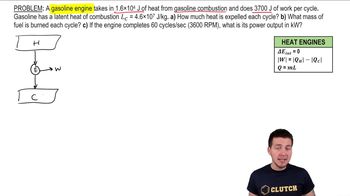
Power Output of a Gasoline Engine

Energy Density

Energy density is a measure of how much energy is stored in a given mass of fuel, expressed in joules per kilogram (J/kg). For jet fuel, the energy density is 43 MJ/kg, indicating that one kilogram of jet fuel can produce 43 megajoules of energy when burned. This concept is essential for determining how much fuel is needed to achieve the desired power output of the engine.
추천 영상:
가이드 코스
8:13
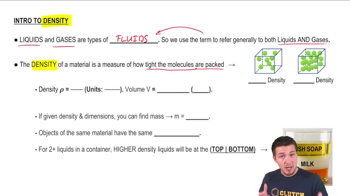
Intro to Density

Efficiency

Efficiency in this context refers to the ratio of useful power output to the total power input, expressed as a percentage. The engine's efficiency of 30% means that only 30% of the energy from the fuel is converted into useful work, while the rest is lost as waste energy. This concept is critical for calculating the actual fuel consumption rate, as it affects how much fuel is needed to produce the required power output.
추천 영상:
가이드 코스
03:55
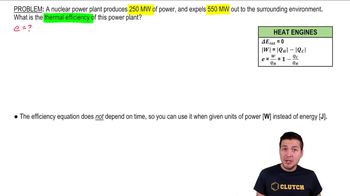
Efficiency of a Nuclear Power Plant