
Ch 21: Heat Engines and Refrigerators
Knight Calc - Physics for Scientists and Engineers 5th Edition
Knight Calc5th EditionPhysics for Scientists and EngineersISBN: 9780137344796당신이 사용하는 게 아니라요?교과서 변경
21장, 문제 44

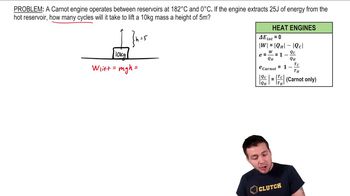
A Carnot heat engine operates between reservoirs at 182℃ and 0℃. If the engine extracts 25 J of energy from the hot reservoir per cycle, how many cycles will it take to lift a 10 kg mass a height of 10 m?

검증된 단계별 안내
1
Step 1: Convert the temperatures of the hot and cold reservoirs from Celsius to Kelvin. Use the formula T(K) = T(°C) + 273.15. For the hot reservoir, T_hot = 182 + 273.15, and for the cold reservoir, T_cold = 0 + 273.15.
Step 2: Calculate the efficiency of the Carnot engine using the formula η = 1 - (T_cold / T_hot), where η is the efficiency, T_cold is the temperature of the cold reservoir, and T_hot is the temperature of the hot reservoir.
Step 3: Determine the work output per cycle of the engine. The work output (W) is given by W = η × Q_hot, where Q_hot is the energy extracted from the hot reservoir per cycle (25 J).
Step 4: Calculate the work required to lift the 10 kg mass a height of 10 m. Use the formula W_lift = m × g × h, where m is the mass (10 kg), g is the acceleration due to gravity (approximately 9.8 m/s²), and h is the height (10 m).
Step 5: Divide the total work required to lift the mass (W_lift) by the work output per cycle (W) to determine the number of cycles needed. Use the formula cycles = W_lift / W.

비슷한 문제에 대한 검증된 영상 답변:

이 영상 해법은 위 문제에 도움이 된다고 튜터들이 추천한 것입니다.
영상 길이:
5m
도움이 되었나요?

주요 개념

질문에 올바르게 답하기 위해 반드시 이해해야 하는 핵심 개념들은 다음과 같습니다.

Carnot Heat Engine

A Carnot heat engine is an idealized thermodynamic cycle that provides the maximum possible efficiency for a heat engine operating between two thermal reservoirs. It operates on the principles of reversible processes and is defined by the temperatures of the hot and cold reservoirs. The efficiency of a Carnot engine is given by the formula η = 1 - (T_c / T_h), where T_c and T_h are the absolute temperatures of the cold and hot reservoirs, respectively.
추천 영상:
06:25
Lifting Mass with a Heat Engine

Work and Energy

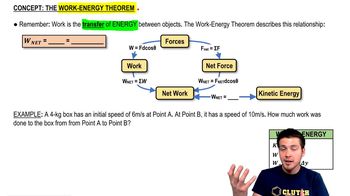
In physics, work is defined as the energy transferred when a force is applied over a distance. The work done on an object can be calculated using the formula W = F × d, where F is the force and d is the distance moved in the direction of the force. In the context of lifting a mass, the work done is equal to the gravitational potential energy gained, which can be calculated using W = m × g × h, where m is mass, g is the acceleration due to gravity, and h is the height.
추천 영상:
04:10
The Work-Energy Theorem

Efficiency and Energy Transfer

Efficiency in a heat engine is a measure of how well it converts the energy extracted from the hot reservoir into useful work. It is calculated as the ratio of the work output to the heat input from the hot reservoir. In this scenario, understanding the efficiency of the Carnot engine is crucial to determine how much work can be done per cycle, which directly influences how many cycles are needed to lift the specified mass.
추천 영상:
05:14
Overview of Heat Transfer
관련 실천
교과서 질문

A freezer with a coefficient of performance 30% that of a Carnot refrigerator keeps the inside temperature at -22℃ in a 25℃ room. 3.0 L of water at 20℃ are placed in the freezer. How long does it take for the water to freeze if the freezer's compressor does work at the rate of 200 W while the water is freezing?

1826
views
교과서 질문

Home air conditioners in the United States have their power specified in the truly obscure units of tons, where 1 ton is the power needed to melt 1 ton (2000 lb or 910 kg) of ice in 24 hours. A modest-size house typically has a 4.0 ton air conditioner. If a 4.0 ton air conditioner has a coefficient of performance of 2.5, a typical value, at what rate in kW is heat energy removed from the house?

1696
views
교과서 질문

An ideal refrigerator utilizes a Carnot cycle operating between 0℃ and 25℃. To turn 10 kg of liquid water at 0℃ into 10 kg of ice at 0℃, (a) how much heat is exhausted into the room and (b) how much energy must be supplied to the refrigerator?

1548
views
교과서 질문

FIGURE P21.46 shows a Carnot heat engine driving a Carnot refrigerator. Determine Q2, Q3 and Q4.

1796
views
교과서 질문

A Carnot refrigerator operates between energy reservoirs at 0℃ and 250℃. A 2.4-cm-diameter, 50-cm-long copper bar connects the two energy reservoirs. At what rate, in W, must work be done on the refrigerator to remove heat from the cold reservoir at the same rate that it arrives through the copper bar?

1715
views
교과서 질문

A Carnot engine operates between temperatures of 5℃ and 500℃. The output is used to run a Carnot refrigerator operating between -5℃ and 25℃. How many joules of heat energy does the refrigerator exhaust into the room for each joule of heat energy used by the heat engine?

1835
views