
교과서 질문
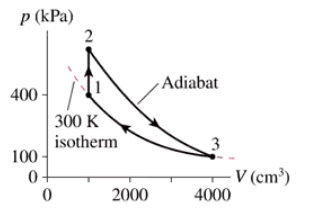
The heat engine shown in FIGURE P21.63 uses 0.020 mol of a diatomic gas as the working substance. Make a table that shows ∆Eth, Ws, and Q for each of the three processes.
195
views

 검증된 단계별 안내
 07:21
07:21
 10:59
10:59 06:13
06:13The heat engine shown in FIGURE P21.63 uses 0.020 mol of a diatomic gas as the working substance. Make a table that shows ∆Eth, Ws, and Q for each of the three processes.
A nuclear power plant generates 3000 MW of heat energy from nuclear reactions in the reactor's core. This energy is used to boil water and produce high-pressure steam at 300℃. The steam spins a turbine, which produces 1000 MW of electric power, then the steam is condensed and the water is cooled to 25℃ before starting the cycle again. What is the plant's actual efficiency?
FIGURE P21.57 shows the cycle for a heat engine that uses a gas having γ = 1.25. The initial temperature is T1 = 300 K, and this engine operates at 20 cycles per second. What is the power output of the engine?
The heat engine shown in FIGURE P21.62 uses 2.0 mol of a monatomic gas as the working substance. Determine T1, T2 and T3.
A heat engine using a diatomic gas follows the cycle shown in FIGURE P21.55. Its temperature at point 1 is 20℃. Determine Ws, Q, and ∆Eth for each of the three processes in this cycle. Display your results in a table.
The heat engine shown in FIGURE P21.62 uses 2.0 mol of a monatomic gas as the working substance. Make a table that shows ∆Eth, Ws, and Q for each of the three processes.