Ch 22: Electric Charges and Forces
Knight Calc - Physics for Scientists and Engineers 5th Edition
Knight Calc5th EditionPhysics for Scientists and EngineersISBN: 9780137344796당신이 사용하는 게 아니라요?교과서 변경
22장, 문제 22a

A 2.0 g plastic bead charged to −4.0 nC and a 4.0 g glass bead charged to +8.0 nC are 2.0 cm apart and free to move. What are the accelerations of the plastic bead?

검증된 단계별 안내
1
Identify the forces acting on the beads. The force between the two charged beads is given by Coulomb's law: F = k_e \(\frac{{|q_1 q_2|}\)}{{r^2}}, where k_e is the Coulomb constant (8.99 \(\times\) 10^9 \, \(\text{N·m}\)^2/\(\text{C}\)^2), q_1 and q_2 are the charges of the beads, and r is the distance between them.
Substitute the given values into Coulomb's law. Here, q_1 = -4.0 \, \(\text{nC}\) = -4.0 \(\times\) 10^{-9} \, \(\text{C}\), q_2 = +8.0 \, \(\text{nC}\) = 8.0 \(\times\) 10^{-9} \, \(\text{C}\), and r = 2.0 \, \(\text{cm}\) = 0.020 \, \(\text{m}\). Calculate the magnitude of the force F.
Determine the acceleration of the plastic bead using Newton's second law: a = \(\frac{F}{m}\). The mass of the plastic bead is m = 2.0 \, \(\text{g}\) = 0.002 \, \(\text{kg}\). Use the force calculated in the previous step to find the acceleration of the plastic bead.
Determine the acceleration of the glass bead using the same formula, a = \(\frac{F}{m}\). The mass of the glass bead is m = 4.0 \, \(\text{g}\) = 0.004 \, \(\text{kg}\). Use the same force (since the force is equal and opposite on both beads) to calculate the acceleration of the glass bead.
Summarize the results. The plastic bead and the glass bead experience equal and opposite forces due to Coulomb's law, but their accelerations differ because of their different masses. Ensure the directions of the accelerations are consistent with the attractive nature of the force (the plastic bead accelerates toward the glass bead, and vice versa).

비슷한 문제에 대한 검증된 영상 답변:

이 영상 해법은 위 문제에 도움이 된다고 튜터들이 추천한 것입니다.
영상 길이:
5m

주요 개념

질문에 올바르게 답하기 위해 반드시 이해해야 하는 핵심 개념들은 다음과 같습니다.

Coulomb's Law

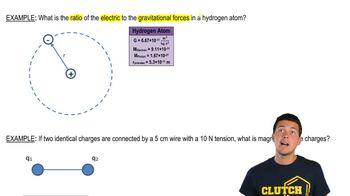
Coulomb's Law describes the electrostatic force between two charged objects. It states that the force is directly proportional to the product of the magnitudes of the charges and inversely proportional to the square of the distance between them. This law is fundamental in calculating the forces acting on charged particles, which is essential for determining their accelerations.
추천 영상:

Newton's Second Law of Motion

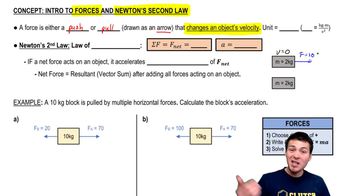
Newton's Second Law states that the acceleration of an object is directly proportional to the net force acting on it and inversely proportional to its mass. This relationship is expressed by the formula F = ma, where F is the net force, m is the mass, and a is the acceleration. Understanding this law is crucial for calculating how the forces from the charged beads affect their motion.
추천 영상:
가이드 코스
06:54
Intro to Forces & Newton's Second Law

Mass and Charge

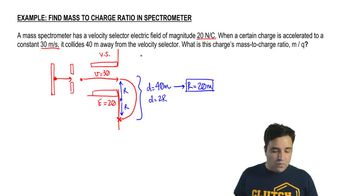
Mass and charge are fundamental properties of matter that influence how objects interact with forces. In this scenario, the mass of each bead affects how much they accelerate in response to the electrostatic forces calculated using Coulomb's Law. The charge determines the strength and direction of the forces acting on each bead, which is vital for solving the problem of their accelerations.
추천 영상:
가이드 코스
04:12
Find Mass-to-Charge Ratio in Spectrometer