Ch 23: The Electric Field
Knight Calc - Physics for Scientists and Engineers 5th Edition
Knight Calc5th EditionPhysics for Scientists and EngineersISBN: 9780137344796당신이 사용하는 게 아니라요?교과서 변경
23장, 문제 19

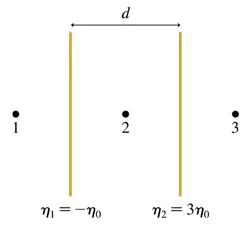
You’ve hung two very large sheets of plastic facing each other with distance d between them, as shown in FIGURE EX23.19. By rubbing them with wool and silk, you’ve managed to give one sheet a uniform surface charge density η1=η0η_1=−η_0 and the other a uniform surface charge density η2=+3η0η_2=+3η_0. What are the electric field vectors at points 1, 2, and 3?
Illustration of two charged sheets with points 1, 2, and 3 marked, showing electric field vectors and distance d between sheets.

검증된 단계별 안내
1
Understand the problem: Two large sheets of plastic are facing each other with a distance d between them. Each sheet has a uniform surface charge density: η₁ = -η₀ for one sheet and η₂ = +3η₀ for the other. We need to determine the electric field vectors at three points: 1 (to the left of the sheets), 2 (between the sheets), and 3 (to the right of the sheets).
Recall the formula for the electric field due to a uniformly charged infinite sheet: The electric field produced by a single sheet with surface charge density η is given by E = η / (2ε₀), where ε₀ is the permittivity of free space. The direction of the field depends on the sign of the charge: it points away from a positively charged sheet and toward a negatively charged sheet.
Analyze the electric field contributions at each point: At point 1 (to the left of both sheets), the field from the negatively charged sheet (η₁ = -η₀) points toward the sheet, while the field from the positively charged sheet (η₂ = +3η₀) points away from it. These fields are in opposite directions, so their magnitudes will subtract.
At point 2 (between the sheets), the field from the negatively charged sheet (η₁ = -η₀) points toward the sheet (to the right), and the field from the positively charged sheet (η₂ = +3η₀) also points away from it (to the right). These fields are in the same direction, so their magnitudes will add.
At point 3 (to the right of both sheets), the field from the negatively charged sheet (η₁ = -η₀) points toward the sheet (to the left), while the field from the positively charged sheet (η₂ = +3η₀) points away from it (to the right). These fields are in opposite directions, so their magnitudes will subtract. Use the formula E = η / (2ε₀) to calculate the individual contributions and combine them appropriately for each point.

비슷한 문제에 대한 검증된 영상 답변:

이 영상 해법은 위 문제에 도움이 된다고 튜터들이 추천한 것입니다.
영상 길이:
8m
도움이 되었나요?

주요 개념

질문에 올바르게 답하기 위해 반드시 이해해야 하는 핵심 개념들은 다음과 같습니다.

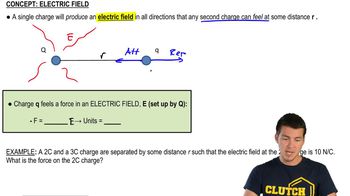
Electric Field

The electric field is a vector field that represents the force exerted by an electric charge on other charges in its vicinity. It is defined as the force per unit charge and is directed away from positive charges and toward negative charges. The strength and direction of the electric field can be calculated using Coulomb's law, which describes how charges interact with one another.
추천 영상:
가이드 코스
03:16
Intro to Electric Fields

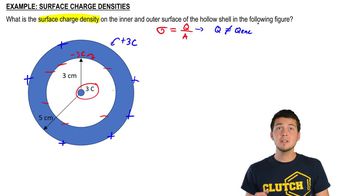
Surface Charge Density

Surface charge density (η) is a measure of the amount of electric charge per unit area on a surface. It is expressed in coulombs per square meter (C/m²). In this scenario, the two sheets have different surface charge densities, which will influence the resulting electric fields between and around them, as the distribution of charge affects the strength and direction of the electric field.
추천 영상:
가이드 코스
04:03
Surface Charge Density

Superposition Principle

The superposition principle states that the total electric field created by multiple charges is the vector sum of the electric fields produced by each charge individually. This principle is crucial for analyzing systems with multiple charge distributions, such as the two charged sheets in this problem, as it allows us to calculate the resultant electric field at various points by considering the contributions from each sheet separately.
추천 영상:
가이드 코스
03:32
Superposition of Sinusoidal Wave Functions
관련 실천
교과서 질문

FIGURE EX23.25 shows a 1.51.5 g ball hanging from a string inside a parallel-plate capacitor made with 12 cm × 12 cm electrodes. The electrodes are charged to±75 nC. What is the charge on the ball in nC?

2512
views
1
rank

교과서 질문

Two 10-cm-diameter charged rings face each other, 20 cm apart. The left ring is charged to −20 nC and the right ring is charged to +20 nC. What is the force on a proton at the midpoint?

301
views
교과서 질문

Air 'breaks down' when the electric field strength reaches 3.0×10⁶ N/C, causing a spark. A parallel-plate capacitor is made from two 4.0 cm×4.0 cm electrodes. How many electrons must be transferred from one electrode to the other to create a spark between the electrodes?

244
views
교과서 질문

Two 10-cm-diameter charged disks face each other, 20 cm apart. The left disk is charged to −50 nC and the right disk is charged to +50 nC. a. What is the electric field Ē, both magnitude and direction, at the midpoint between the two disks?

1491
views
교과서 질문

Two 2.0-cm-diameter disks face each other, 1.0 mm apart. They are charged to ±10 nC. A proton is shot from the negative disk toward the positive disk. What launch speed must the proton have to just barely reach the positive disk?

202
views
교과서 질문

Two 10-cm-diameter charged rings face each other, 20 cm apart. The left ring is charged to −20 nC and the right ring is charged to +20 nC. What is the electric field Ē, both magnitude and direction, at the midpoint between the two rings?

73
views