
An infinite cylinder of radius R has a linear charge density λ . The volume charge density (C/m³) within the cylinder (r ≤ R ) is p (r) = rp₀ / R, where p₀ is a constant to be determined. The charge within a small volume dV is dq = pdV. The integral of pdV over a cylinder of length L is the total charge Q = λL within the cylinder. Use this fact to show that p₀ = 3λ / 2πR² Hint: Let dV be a cylindrical shell of length L, radius r, and thickness dr. What is the volume of such a shell?
Ch 24: Gauss' Law
24장, 문제 61b
A spherical ball of charge has radius R and total charge Q. The electric field strength inside the ball (r ≤ R ) is . Find an expression for the volume charge density ρ(r) inside the ball as a function of r.
검증된 단계별 안내1
Step 1: Recall the relationship between the electric field and the charge density. Gauss's law in differential form states that the divergence of the electric field is proportional to the charge density: ∇·E = ρ/ε₀, where ρ is the volume charge density and ε₀ is the permittivity of free space.
Step 2: Write the expression for the electric field inside the ball, which is given as E(r) = (r⁴ Eₘₐₓ) / R⁴. Since the electric field is radially symmetric, we can use the spherical form of Gauss's law: (1/r²) ∂(r²E(r))/∂r = ρ(r)/ε₀.
Step 3: Compute the derivative of r²E(r) with respect to r. Start by multiplying the electric field E(r) by r²: r²E(r) = r² * (r⁴ Eₘₐₓ / R⁴) = r⁶ Eₘₐₓ / R⁴. Now, differentiate this expression with respect to r: ∂(r²E(r))/∂r = ∂(r⁶ Eₘₐₓ / R⁴)/∂r = 6r⁵ Eₘₐₓ / R⁴.
Step 4: Substitute the derivative into Gauss's law. Using (1/r²) ∂(r²E(r))/∂r = ρ(r)/ε₀, replace ∂(r²E(r))/∂r with 6r⁵ Eₘₐₓ / R⁴: (1/r²) * (6r⁵ Eₘₐₓ / R⁴) = ρ(r)/ε₀.
Step 5: Simplify the expression to find ρ(r). Combine terms: ρ(r) = ε₀ * (6r³ Eₘₐₓ / R⁴). This is the final expression for the volume charge density inside the ball as a function of r.

비슷한 문제에 대한 검증된 영상 답변:
이 영상 해법은 위 문제에 도움이 된다고 튜터들이 추천한 것입니다.
영상 길이:
7m주요 개념
질문에 올바르게 답하기 위해 반드시 이해해야 하는 핵심 개념들은 다음과 같습니다.
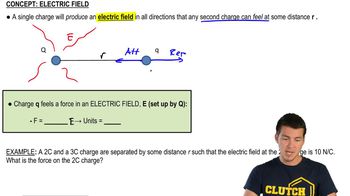
Electric Field
The electric field is a vector field that represents the force exerted by an electric charge on other charges in its vicinity. Inside a charged spherical object, the electric field varies with distance from the center, and in this case, it is given by E(r) = r⁴ Eₘₐₓ / R⁴, indicating that the field strength increases with the fourth power of the radius.
추천 영상:
가이드 코스
Intro to Electric Fields
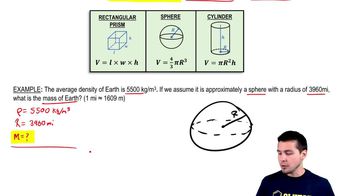
Volume Charge Density
Volume charge density (ρ) is defined as the amount of electric charge per unit volume within a specified region. It is crucial for understanding how charge is distributed within a volume, and can be derived from the electric field using Gauss's law, which relates the electric field to the charge enclosed within a Gaussian surface.
추천 영상:
가이드 코스
Problems with Mass, Volume, & Density
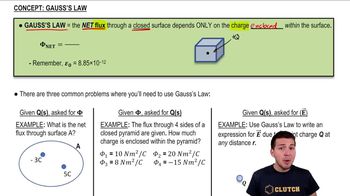
Gauss's Law
Gauss's Law states that the total electric flux through a closed surface is proportional to the enclosed electric charge. This principle is fundamental in electrostatics, allowing us to relate the electric field to charge distributions, particularly in symmetric situations like spherical charge distributions, which simplifies the calculation of electric fields and charge densities.
추천 영상:
가이드 코스
Gauss' Law
관련 실천
교과서 질문
2017
views
교과서 질문
An infinite cylinder of radius R has a linear charge density λ. The volume charge density (C/m3) within the cylinder (r ≤ R) is , where p₀ is a constant to be determined. Use Gauss’s law to find an expression for the electric field strength E inside the cylinder, r ≤ R, in terms of λ and R.
137
views
교과서 질문
A sphere of radius R has total charge Q. The volume charge density (C/m³) within the sphere is p(r) = C/r², where C is a constant to be determined. Use Gauss’s law to find an expression for the electric field strength E inside the sphere, r ≤ R, in terms of Q and R.
124
views
