Ch 24: Gauss' Law
Knight Calc - Physics for Scientists and Engineers 5th Edition
Knight Calc5th EditionPhysics for Scientists and EngineersISBN: 9780137344796당신이 사용하는 게 아니라요?교과서 변경
24장, 문제 25a

A thin, horizontal, 10-cm-diameter copper plate is charged to 3.5 nC. If the charge is uniformly distributed on the surface, what are the strength and direction of the electric field 0.1 mm above the center of the top surface of the plate?

검증된 단계별 안내
1
Determine the surface charge density (σ) of the copper plate. The surface charge density is given by the formula: σ=QA, where Q is the total charge (3.5 nC) and A is the area of the plate. The area of a circular plate is calculated as A=πr², with r being the radius of the plate (5 cm or 0.05 m).
Recognize that the plate is a thin, uniformly charged conductor. For a point very close to the surface of a conductor, the electric field strength is given by: E=σε, where ε is the permittivity of free space (ε=8.85×10¹² C²/N·m²). Substitute the value of σ from step 1 into this formula to calculate the electric field strength.
Since the point of interest is 0.1 mm (0.0001 m) above the center of the top surface of the plate, the electric field will be perpendicular to the surface of the plate. For a uniformly charged flat conductor, the electric field direction is always normal (perpendicular) to the surface, pointing away from the surface if the charge is positive.
Verify that the distance above the plate (0.1 mm) is negligible compared to the plate's dimensions. This ensures that the approximation of the electric field as uniform and perpendicular to the surface is valid.
Combine the results from the previous steps to express the electric field strength and direction. The electric field strength is given by the formula derived in step 2, and the direction is perpendicular to the plate's surface, pointing upward since the charge is positive.

비슷한 문제에 대한 검증된 영상 답변:

이 영상 해법은 위 문제에 도움이 된다고 튜터들이 추천한 것입니다.
영상 길이:
6m
도움이 되었나요?

주요 개념

질문에 올바르게 답하기 위해 반드시 이해해야 하는 핵심 개념들은 다음과 같습니다.

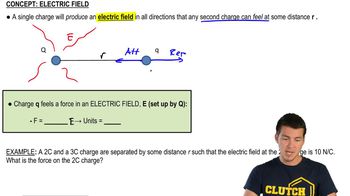
Electric Field

The electric field is a vector field that represents the force exerted by an electric charge on other charges in its vicinity. It is defined as the force per unit charge and is measured in newtons per coulomb (N/C). The direction of the electric field is away from positive charges and towards negative charges, indicating the direction a positive test charge would move.
추천 영상:
가이드 코스
03:16
Intro to Electric Fields

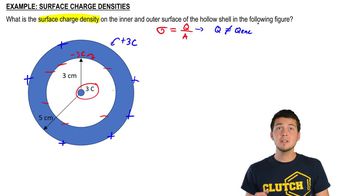
Surface Charge Density

Surface charge density is the amount of electric charge per unit area on a surface, typically denoted by the symbol σ (sigma). It is calculated by dividing the total charge by the area over which it is distributed. For a uniformly charged plate, this concept is crucial for determining the electric field above the surface, as it directly influences the field strength.
추천 영상:
가이드 코스
04:03
Surface Charge Density

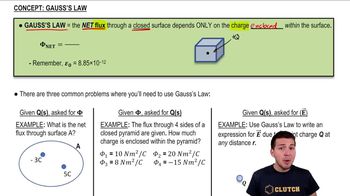
Gauss's Law

Gauss's Law relates the electric field to the charge enclosed within a closed surface. It states that the electric flux through a closed surface is proportional to the enclosed charge. This principle is particularly useful for calculating electric fields in symmetric charge distributions, such as a uniformly charged plate, allowing for straightforward determination of the field strength at specific points.
추천 영상: