Ch 24: Gauss' Law
Knight Calc - Physics for Scientists and Engineers 5th Edition
Knight Calc5th EditionPhysics for Scientists and EngineersISBN: 9780137344796당신이 사용하는 게 아니라요?교과서 변경
24장, 문제 2

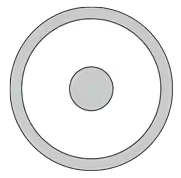
FIGURE EX24.2 shows a cross section of two concentric spheres. The inner sphere has a negative charge. The outer sphere has a positive charge larger in magnitude than the charge on the inner sphere. Draw this figure on your paper, then draw electric field vectors showing the shape of the electric field.
Cross section of two concentric spheres: inner sphere with negative charge, outer sphere with larger positive charge.

검증된 단계별 안내
1
Step 1: Begin by drawing the figure on your paper. The image shows two concentric spheres: a smaller inner sphere and a larger outer sphere. Label the inner sphere as negatively charged and the outer sphere as positively charged with a larger magnitude.
Step 2: Recall that electric field lines originate from positive charges and terminate at negative charges. The electric field vectors will point radially outward from the positively charged outer sphere and radially inward toward the negatively charged inner sphere.
Step 3: Between the two spheres, draw electric field lines pointing from the outer sphere toward the inner sphere. These lines should be evenly spaced and symmetric to represent the uniform radial field in this region.
Step 4: Inside the inner sphere, there will be no electric field because the charge distribution is uniform and the electric field cancels out within a conductor. Draw no field lines inside the inner sphere.
Step 5: Outside the outer sphere, the electric field vectors will point radially outward, as the net charge of the system is positive (the positive charge on the outer sphere is larger in magnitude than the negative charge on the inner sphere). Ensure the field lines are symmetric and extend outward from the outer sphere.

비슷한 문제에 대한 검증된 영상 답변:

이 영상 해법은 위 문제에 도움이 된다고 튜터들이 추천한 것입니다.
도움이 되었나요?

주요 개념

질문에 올바르게 답하기 위해 반드시 이해해야 하는 핵심 개념들은 다음과 같습니다.

Electric Field

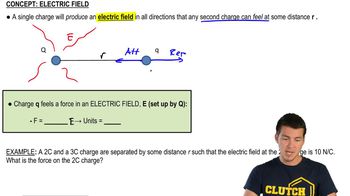
An electric field is a region around a charged object where other charged objects experience a force. The direction of the electric field is defined as the direction a positive test charge would move. In the case of concentric spheres, the electric field lines radiate outward from the positively charged outer sphere and inward toward the negatively charged inner sphere.
추천 영상:
가이드 코스
03:16
Intro to Electric Fields

Coulomb's Law

Coulomb's Law describes the force between two point charges. It states that the force is directly proportional to the product of the magnitudes of the charges and inversely proportional to the square of the distance between them. This law helps in understanding how the charges on the inner and outer spheres interact and influence the electric field configuration.
추천 영상:

Superposition Principle

The superposition principle states that the total electric field created by multiple charges is the vector sum of the electric fields produced by each charge independently. In this scenario, the electric field due to the inner negatively charged sphere and the outer positively charged sphere can be analyzed separately and then combined to understand the overall electric field pattern.
추천 영상:
가이드 코스
03:32
Superposition of Sinusoidal Wave Functions