Two small charged spheres are 5.0 cm apart. One is charged to +25 nC, the other to −15 nC. A proton is released from rest halfway between the spheres. What is the proton's speed after it has moved 1.0 cm?
Ch 25: The Electric Potential
25장, 문제 29b
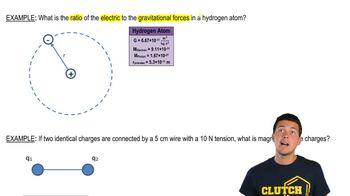
In a semiclassical model of the hydrogen atom, the electron orbits the proton at a distance of 0.053 nm. What is the electron's potential energy?
검증된 단계별 안내1
Step 1: Recall the formula for the potential energy of a system of two charges. The potential energy (U) is given by the equation: , where is Coulomb's constant, and are the charges of the proton and electron, and is the distance between them.
Step 2: Identify the values of the constants and variables. The charge of the electron and proton is C and C, respectively. Coulomb's constant is N·m²/C². The distance is given as , which needs to be converted to meters: m.
Step 3: Substitute the known values into the formula. Replace , , , and into the equation: .
Step 4: Simplify the numerator. Multiply the constants and charges in the numerator: . This will yield a negative value because the charges are opposite in sign.
Step 5: Divide the result of the numerator by the denominator. Use the value of in meters to complete the calculation. The final result will give the potential energy in joules (J).

비슷한 문제에 대한 검증된 영상 답변:
이 영상 해법은 위 문제에 도움이 된다고 튜터들이 추천한 것입니다.
영상 길이:
5m도움이 되었나요?
주요 개념
질문에 올바르게 답하기 위해 반드시 이해해야 하는 핵심 개념들은 다음과 같습니다.
Coulomb's Law
Coulomb's Law describes the electrostatic force between two charged particles. In the case of the hydrogen atom, it explains the attractive force between the negatively charged electron and the positively charged proton. The potential energy associated with this force can be calculated using the formula U = -k * (e^2 / r), where k is Coulomb's constant, e is the charge of the electron, and r is the distance between the charges.
추천 영상:
가이드 코스
Coulomb's Law
Potential Energy in Electric Fields
In the context of electric fields, potential energy represents the work done to move a charge from a reference point to a specific point in the field. For the hydrogen atom, the potential energy of the electron is negative, indicating that work must be done against the electric force to separate the electron from the proton. This negative value reflects the stability of the electron's orbit around the proton.
추천 영상:
가이드 코스
Electric Potential Energy
Quantum Mechanics and Energy Levels
Quantum mechanics introduces the concept of quantized energy levels for electrons in atoms. While the semiclassical model approximates the electron's orbit, it is important to recognize that in reality, electrons exist in probabilistic clouds rather than fixed orbits. The potential energy calculated in this model is a simplification, but it provides insight into the energy interactions within the atom, which are foundational for understanding atomic structure.
추천 영상:
가이드 코스
Conservation Of Mechanical Energy
관련 실천
교과서 질문
2118
views
교과서 질문
What are the potential differences ΔVₐᵦ=Vᵦ−Vₐ and ΔV𝒸ᵦ=Vᵦ−V𝒸?
48
views
교과서 질문
What is the electric potential at the point indicated with the dot in FIGURE EX25.31?
258
views
교과서 질문
A 1.0-mm-diameter ball bearing has 2.0×10⁹ excess electrons. What is the ball bearing's potential?
2369
views
교과서 질문
In a semiclassical model of the hydrogen atom, the electron orbits the proton at a distance of 0.053 nm. What is the electric potential of the proton at the position of the electron?
1421
views
교과서 질문
Four small spheres, each charged to +15 nC, form a square 2.0 cm on each side. From far away, a proton is shot toward the square along a line perpendicular to the square and passing through its center. What minimum initial speed does the proton need to pass through the square of charges?
1894
views