
Ch 25: The Electric Potential
Knight Calc - Physics for Scientists and Engineers 5th Edition
Knight Calc5th EditionPhysics for Scientists and EngineersISBN: 9780137344796당신이 사용하는 게 아니라요?교과서 변경
25장, 문제 53

Three electrons form an equilateral triangle 1.0 nm on each side. A proton is at the center of the triangle. What is the potential energy of this group of charges?

검증된 단계별 안내
1
Identify the charges involved: Each electron has a charge of \(-e = -1.6 \times 10^{-19} \; C\), and the proton has a charge of \(+e = 1.6 \times 10^{-19} \; C\). The system consists of three electrons and one proton.
Determine the distances between charges: The electrons form an equilateral triangle with side length \(1.0 \; \text{nm} = 1.0 \times 10^{-9} \; \text{m}\). The proton is located at the center of the triangle. The distance from the center to each vertex (electron) is the circumradius of the triangle, given by \(r = \frac{a}{\sqrt{3}}\), where \(a\) is the side length of the triangle.
Calculate the potential energy contributions: The total potential energy of the system is the sum of the potential energy between all pairs of charges. Use the formula for potential energy between two charges: \(U = \frac{k q_1 q_2}{r}\), where \(k = 8.99 \times 10^9 \; \text{N·m}^2/\text{C}^2\) is Coulomb's constant, \(q_1\) and \(q_2\) are the charges, and \(r\) is the distance between them.
Break the total potential energy into components: (1) The potential energy between each pair of electrons (three pairs in total), and (2) the potential energy between the proton and each electron (three interactions). For the electron-electron pairs, the distance is \(1.0 \; \text{nm}\). For the proton-electron interactions, the distance is \(\frac{1.0 \; \text{nm}}{\sqrt{3}}\).
Sum all contributions: Add the potential energy from the three electron-electron pairs and the three proton-electron interactions to find the total potential energy of the system. Be mindful of the signs of the charges (electron-electron interactions are repulsive, while proton-electron interactions are attractive).

비슷한 문제에 대한 검증된 영상 답변:

이 영상 해법은 위 문제에 도움이 된다고 튜터들이 추천한 것입니다.
도움이 되었나요?

주요 개념

질문에 올바르게 답하기 위해 반드시 이해해야 하는 핵심 개념들은 다음과 같습니다.

Coulomb's Law

Coulomb's Law describes the electrostatic force between two charged particles. It states that the force is directly proportional to the product of the magnitudes of the charges and inversely proportional to the square of the distance between them. This principle is essential for calculating the interactions between the electrons and the proton in the given configuration.
추천 영상:

Electric Potential Energy

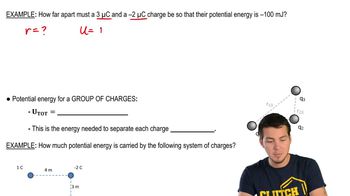
Electric potential energy is the energy a charged particle possesses due to its position in an electric field. It is calculated based on the configuration of charges and their distances from one another. In this scenario, the potential energy of the system can be determined by summing the potential energies between each pair of charges, considering both the electrons and the proton.
추천 영상:
가이드 코스
07:51
Electric Potential Energy

Equilateral Triangle Geometry

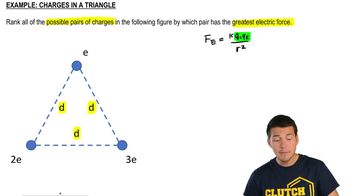
The geometry of an equilateral triangle is crucial for determining the distances between the charges. In this case, all sides are equal, and the angles are each 60 degrees. Understanding this geometry allows for accurate calculations of the distances between the electrons and the proton, which is necessary for applying Coulomb's Law and calculating the total potential energy of the system.
추천 영상:
가이드 코스
01:53
Charges In A Triangle (Rank Force Pairs)
관련 실천
교과서 질문

A 0.25 pg dust particle with 50 excess electrons is sitting at rest on top of a 5.0-cm-diameter metal sphere. Closing a switch charges the sphere almost instantaneously. To what potential must the sphere be charged to launch the dust particle to a height of 5.0 m? Ignore air resistance.

142
views
교과서 질문

The electric potential in a region of space is given by V=V₀[(x²+2y²)/(0.10 m)²], where V₀ is a constant. A proton released from rest at (x, y)=(20 cm, 0 cm) reaches the origin with a speed of 7.5×10⁵ m/s. At what value of y on the y-axis should a He+ ion (charge +e, mass 4 u) be released from rest to reach the origin with the same speed?

1584
views
교과서 질문

A proton is fired from far away toward the nucleus of an iron atom. Iron is element number 26, and the diameter of the nucleus is 9.0 fm. What initial speed does the proton need to just reach the surface of the nucleus? Assume the nucleus remains at rest.

110
views
교과서 질문

In the form of radioactive decay known as alpha decay, an unstable nucleus emits a helium-atom nucleus, which is called an alpha particle. An alpha particle contains two protons and two neutrons, thus having mass m=4 u and charge q=2e. Suppose a uranium nucleus with 92 protons decays into thorium, with 90 protons, and an alpha particle. The alpha particle is initially at rest at the surface of the thorium nucleus, which is 15 fm in diameter. What is the speed of the alpha particle when it is detected in the laboratory? Assume the thorium nucleus remains at rest.

112
views
교과서 질문

What is the escape speed of an electron launched from the surface of a 1.0-cm-diameter glass sphere that has been charged to 10 nC?

1882
views
교과서 질문

A 2.0-mm-diameter glass bead is positively charged. The potential difference between a point 2.0 mm from the bead and a point 4.0 mm from the bead is 500 V. What is the charge on the bead?

207
views