Ch 25: The Electric Potential
Knight Calc - Physics for Scientists and Engineers 5th Edition
Knight Calc5th EditionPhysics for Scientists and EngineersISBN: 9780137344796당신이 사용하는 게 아니라요?교과서 변경
25장, 문제 68

Two metal objects that are in contact must be at the same potential, an assertion we'll prove in the next chapter. Suppose a metal sphere of radius R is charged to 1000 V and a second metal sphere of radius 2R is charged to 2000 V. The two spheres are brought into contact and then separated. Afterward, what is the potential of each sphere?

검증된 단계별 안내
1
Step 1: Understand the concept of charge redistribution. When two conductors are brought into contact, charge redistributes between them until they reach the same electric potential. This is because charges move to minimize potential differences.
Step 2: Write the formula for the potential of a sphere. The potential of a charged sphere is given by \( V = \frac{Q}{4 \pi \epsilon_0 R} \), where \( Q \) is the charge, \( R \) is the radius, and \( \epsilon_0 \) is the permittivity of free space.
Step 3: Use the principle of charge conservation. The total charge before contact is equal to the total charge after contact. Let \( Q_1 \) and \( Q_2 \) be the initial charges on the spheres, and \( Q_1' \) and \( Q_2' \) be the charges after contact. Then, \( Q_1 + Q_2 = Q_1' + Q_2' \).
Step 4: Set the potentials equal after contact. Since the spheres are in contact, their potentials become equal: \( \frac{Q_1'}{4 \pi \epsilon_0 R} = \frac{Q_2'}{4 \pi \epsilon_0 (2R)} \). Simplify this equation to relate \( Q_1' \) and \( Q_2' \).
Step 5: Solve for the final potential. Use the charge conservation equation and the relationship between \( Q_1' \) and \( Q_2' \) to find the total charge and distribute it between the spheres. Substitute the charges into the potential formula to find the final potential of each sphere.

비슷한 문제에 대한 검증된 영상 답변:

이 영상 해법은 위 문제에 도움이 된다고 튜터들이 추천한 것입니다.
도움이 되었나요?

주요 개념

질문에 올바르게 답하기 위해 반드시 이해해야 하는 핵심 개념들은 다음과 같습니다.

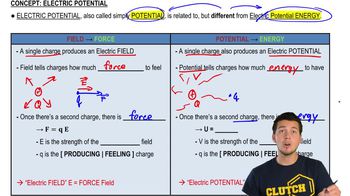
Electric Potential

Electric potential, measured in volts (V), is the amount of electric potential energy per unit charge at a point in an electric field. It indicates how much work would be done to move a charge from a reference point to a specific point within the field. In this scenario, the potentials of the two spheres before contact are crucial for understanding how they will equalize when brought into contact.
추천 영상:
가이드 코스
07:33
Electric Potential

Charge Distribution

When two conductive objects come into contact, charge redistributes between them until they reach the same electric potential. The total charge is conserved, meaning the sum of the charges on both spheres before contact equals the sum after they are separated. This principle is essential for determining the final potential of each sphere after they are disconnected.
추천 영상:
가이드 코스
04:03
Probability Distribution Graph

Capacitance

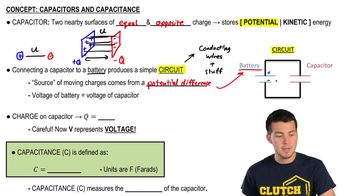
Capacitance is the ability of a system to store charge per unit potential difference and is influenced by the geometry of the conductors. For spheres, capacitance is proportional to their radius, meaning a larger sphere can hold more charge at the same potential. Understanding capacitance helps in calculating how the charges will distribute between the two spheres based on their sizes and initial potentials.
추천 영상:
가이드 코스
08:02
Capacitors & Capacitance (Intro)