An electric dipole at the origin consists of two charges ±q spaced distance s apart along the y-axis. What is the field Ē on the bisecting axis? Does your result agree with Equation 23.11?
Ch 26: Potential and Field
26장, 문제 81a
Find an expression for the capacitance of a spherical capacitor, consisting of concentric spherical shells of radii R1 (inner shell) and R2 (outer shell).
검증된 단계별 안내1
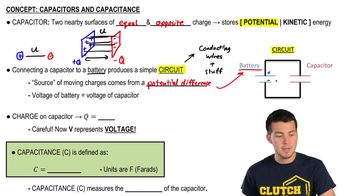
Start by recalling the formula for the capacitance of a capacitor: \( C = \frac{Q}{\Delta V} \), where \( Q \) is the charge on the capacitor and \( \Delta V \) is the potential difference between the two shells.
Determine the electric field \( E \) between the two spherical shells using Gauss's law: \( \oint \mathbf{E} \cdot d\mathbf{A} = \frac{Q}{\varepsilon_0} \). For a spherical shell, the electric field at a distance \( r \) from the center is \( E = \frac{Q}{4 \pi \varepsilon_0 r^2} \).
Find the potential difference \( \Delta V \) between the two shells by integrating the electric field from \( R_1 \) to \( R_2 \): \( \Delta V = \int_{R_1}^{R_2} E \, dr = \int_{R_1}^{R_2} \frac{Q}{4 \pi \varepsilon_0 r^2} \, dr \). Perform the integration to get \( \Delta V = \frac{Q}{4 \pi \varepsilon_0} \left( \frac{1}{R_1} - \frac{1}{R_2} \right) \).
Substitute \( \Delta V \) into the capacitance formula \( C = \frac{Q}{\Delta V} \): \( C = \frac{Q}{\frac{Q}{4 \pi \varepsilon_0} \left( \frac{1}{R_1} - \frac{1}{R_2} \right)} \). Simplify the expression to get \( C = 4 \pi \varepsilon_0 \left( \frac{1}{\frac{1}{R_1} - \frac{1}{R_2}} \right) \).
Simplify further to express the capacitance in terms of \( R_1 \) and \( R_2 \): \( C = \frac{4 \pi \varepsilon_0 R_1 R_2}{R_2 - R_1} \). This is the final expression for the capacitance of the spherical capacitor.

비슷한 문제에 대한 검증된 영상 답변:
이 영상 해법은 위 문제에 도움이 된다고 튜터들이 추천한 것입니다.
도움이 되었나요?
주요 개념
질문에 올바르게 답하기 위해 반드시 이해해야 하는 핵심 개념들은 다음과 같습니다.
Capacitance
Capacitance is a measure of a capacitor's ability to store charge per unit voltage. It is defined as the ratio of the electric charge (Q) stored on one conductor to the potential difference (V) between the conductors. The unit of capacitance is the farad (F), where 1 farad equals 1 coulomb per volt.
추천 영상:
가이드 코스
Capacitors & Capacitance (Intro)
Electric Field
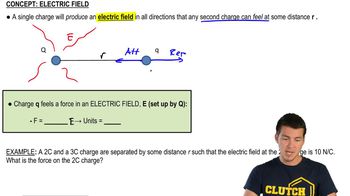
The electric field (E) is a vector field that represents the force per unit charge experienced by a positive test charge placed in the field. For a spherical capacitor, the electric field between the two shells can be derived from Gauss's law, which relates the electric field to the charge enclosed by a Gaussian surface. The electric field is crucial for understanding how the capacitor stores energy.
추천 영상:
가이드 코스
Intro to Electric Fields
Gauss's Law
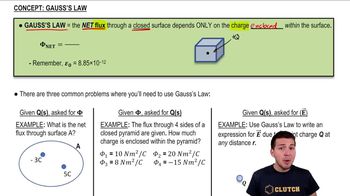
Gauss's Law states that the electric flux through a closed surface is proportional to the charge enclosed within that surface. It is mathematically expressed as ∮E·dA = Q_enc/ε₀, where E is the electric field, dA is the differential area, Q_enc is the enclosed charge, and ε₀ is the permittivity of free space. This law is essential for deriving the electric field in spherical capacitors and ultimately calculating their capacitance.
추천 영상:
가이드 코스
Gauss' Law
관련 실천
교과서 질문
125
views
교과서 질문
Consider a uniformly charged sphere of radius R and total charge Q. The electric field Eout outside the sphere (r≥R) is simply that of a point charge Q. In Chapter 24, we used Gauss’s law to find that the electric field Ein inside the sphere (r≤R) is radially outward with field strength . What is the ratio Vcenter/Vsurface?
1930
views
교과서 질문
Charge is uniformly distributed with charge density ρ inside a very long cylinder of radius R. Find the potential difference between the surface and the axis of the cylinder.
112
views
교과서 질문
Each capacitor in FIGURE CP26.83 has capacitance C. What is the equivalent capacitance between points a and b?
234
views
교과서 질문
A spherical capacitor with a 1.0 mm gap between the shells has a capacitance of 100 pF. What are the diameters of the two spheres?
78
views