Ch 26: Potential and Field
Knight Calc - Physics for Scientists and Engineers 5th Edition
Knight Calc5th EditionPhysics for Scientists and EngineersISBN: 9780137344796당신이 사용하는 게 아니라요?교과서 변경
26장, 문제 5b

What is the potential difference between A and B?

검증된 단계별 안내
1
Identify the type of circuit (series, parallel, or a combination) and the components involved between points A and B. This will help determine how the potential difference is distributed.
Use Ohm's Law, which states \( V = IR \), where \( V \) is the potential difference, \( I \) is the current, and \( R \) is the resistance. Determine if the current \( I \) and resistance \( R \) are given or need to be calculated.
If the circuit is a series circuit, calculate the total resistance between A and B by summing up the resistances: \( R_{total} = R_1 + R_2 + \dots \). If it is a parallel circuit, use the formula \( \frac{1}{R_{total}} = \frac{1}{R_1} + \frac{1}{R_2} + \dots \).
Determine the current \( I \) in the circuit. If the total voltage \( V_{total} \) and total resistance \( R_{total} \) are known, use \( I = \frac{V_{total}}{R_{total}} \).
Finally, calculate the potential difference between A and B using \( V = IR \), where \( R \) is the equivalent resistance between A and B, and \( I \) is the current through that portion of the circuit.

비슷한 문제에 대한 검증된 영상 답변:

이 영상 해법은 위 문제에 도움이 된다고 튜터들이 추천한 것입니다.
도움이 되었나요?

주요 개념

질문에 올바르게 답하기 위해 반드시 이해해야 하는 핵심 개념들은 다음과 같습니다.

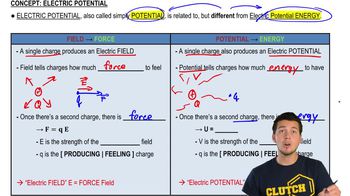
Electric Potential Difference

Electric potential difference, or voltage, is the work done per unit charge in moving a charge between two points in an electric field. It is measured in volts (V) and indicates how much energy is available to move charges from one point to another. Understanding this concept is crucial for analyzing circuits and electrical systems.
추천 영상:
가이드 코스
07:33
Electric Potential

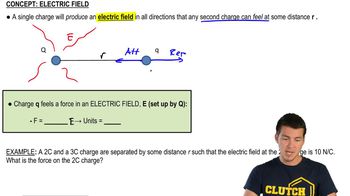
Electric Field

An electric field is a region around a charged object where other charged objects experience a force. The strength and direction of the electric field are determined by the charge and distance from the source charge. This concept is essential for understanding how charges interact and how potential differences arise between points A and B.
추천 영상:
가이드 코스
03:16
Intro to Electric Fields

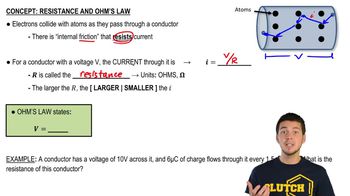
Ohm's Law

Ohm's Law states that the current (I) flowing through a conductor between two points is directly proportional to the voltage (V) across the two points and inversely proportional to the resistance (R) of the conductor. This relationship is fundamental in circuit analysis, allowing us to calculate potential differences when current and resistance are known.
추천 영상:
가이드 코스
03:07
Resistance and Ohm's Law