A small bar magnet experiences a 0.020 N m torque when the axis of the magnet is at 45° to a 0.10 T magnetic field. What is the magnitude of its magnetic dipole moment?
Ch 29: The Magnetic Field
29장, 문제 37
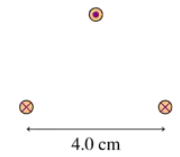
FIGURE EX29.37 is a cross section through three long wires with linear mass density 50 g/m. They each carry equal currents in the directions shown. The lower two wires are 4.0 cm apart and are attached to a table. What current I will allow the upper wire to 'float' so as to form an equilateral triangle with the lower wires?

검증된 단계별 안내1
Understand the problem: The goal is to determine the current \( I \) in the upper wire such that it 'floats' in equilibrium, forming an equilateral triangle with the two lower wires. This means the net force on the upper wire due to the magnetic forces from the lower wires and its weight must be zero.
Step 1: Recall the formula for the magnetic force per unit length between two parallel current-carrying wires. The force per unit length is given by \( F/L = \frac{\mu_0 I_1 I_2}{2 \pi d} \), where \( \mu_0 \) is the permeability of free space, \( I_1 \) and \( I_2 \) are the currents in the wires, and \( d \) is the distance between the wires.
Step 2: Analyze the forces acting on the upper wire. The magnetic forces from the two lower wires will act at an angle of 60° to each other (since the wires form an equilateral triangle). The weight of the upper wire, \( F_g = \lambda g \), where \( \lambda \) is the linear mass density and \( g \) is the acceleration due to gravity, acts vertically downward.
Step 3: Resolve the magnetic forces into components. The horizontal components of the magnetic forces from the two lower wires will cancel out due to symmetry. The vertical components will add up to balance the weight of the upper wire. Use trigonometry to express the vertical component of the magnetic force: \( F_{vertical} = 2 \cdot F_{magnetic} \cdot \sin(60°) \).
Step 4: Set up the equilibrium condition. For the upper wire to float, the total upward magnetic force must equal the downward gravitational force: \( 2 \cdot \frac{\mu_0 I^2}{2 \pi d} \cdot \sin(60°) = \lambda g \). Solve this equation for \( I \), the current in the wires.

비슷한 문제에 대한 검증된 영상 답변:
이 영상 해법은 위 문제에 도움이 된다고 튜터들이 추천한 것입니다.
영상 길이:
13m도움이 되었나요?
주요 개념
질문에 올바르게 답하기 위해 반드시 이해해야 하는 핵심 개념들은 다음과 같습니다.
Magnetic Force Between Current-Carrying Wires
When two parallel wires carry electric currents, they exert magnetic forces on each other. The direction of the force depends on the direction of the currents: if the currents are in the same direction, the wires attract; if they are in opposite directions, they repel. This principle is crucial for understanding how the upper wire can 'float' in equilibrium between the lower wires.
추천 영상:
가이드 코스
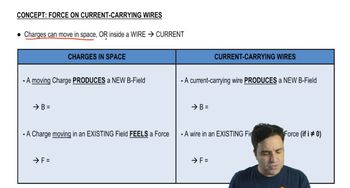
Magnetic Force on Current-Carrying Wire
Equilibrium of Forces
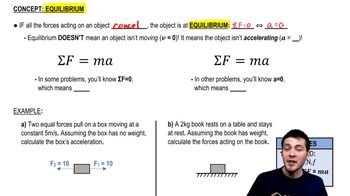
For the upper wire to float and form an equilateral triangle with the lower wires, the net force acting on it must be zero. This means that the magnetic forces exerted by the lower wires on the upper wire must balance out. Analyzing the forces involved allows us to determine the required current in the upper wire to achieve this balance.
추천 영상:
가이드 코스
Equilibrium
Linear Mass Density and Weight
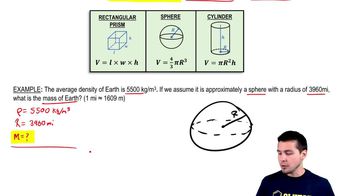
Linear mass density is defined as mass per unit length of an object, in this case, the wires. The weight of the upper wire, which acts downward due to gravity, is determined by its linear mass density and the length of the wire. This weight must be counteracted by the magnetic forces from the lower wires for the upper wire to remain suspended.
추천 영상:
가이드 코스
Problems with Mass, Volume, & Density
관련 실천
교과서 질문
441
views
교과서 질문
What is the loop's equilibrium orientation?
1606
views
교과서 질문
What is the magnitude of the torque on the current loop in FIGURE EX29.39?
656
views
교과서 질문
The two 10-cm-long parallel wires in FIGURE EX29.33 are separated by 5.0 mm. For what value of the resistor R will the force between the two wires be 5.4 x 10⁻⁵ N?
2054
views
1
rank
교과서 질문
The microwaves in a microwave oven are produced in a special tube called a magnetron. The electrons orbit the magnetic field at 2.4 GHz, and as they do so they emit 2.4 GHz electromagnetic waves. What is the magnetic field strength?
309
views
교과서 질문
The Hall voltage across a conductor in a 55 mT magnetic field is 1.9 μV. When used with the same current in a different magnetic field, the voltage across the conductor is 2.8 μV. What is the strength of the second field?
108
views