
Ch 29: The Magnetic Field
Knight Calc - Physics for Scientists and Engineers 5th Edition
Knight Calc5th EditionPhysics for Scientists and EngineersISBN: 9780137344796당신이 사용하는 게 아니라요?교과서 변경
29장, 문제 29

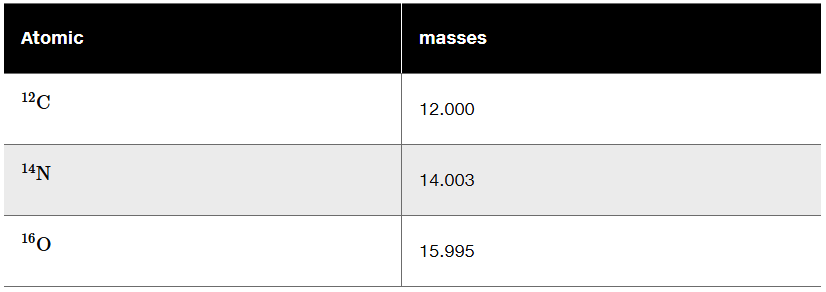
To five significant figures, what are the cyclotron frequencies in a 3.0000 T magnetic field of the ions (a) O₂⁺, (b) N₂⁺, and (c) CO⁺? The atomic masses are shown in the table; the mass of the missing electron is less than 0.001 u and is not relevant at this level of precision. Although N₂⁺ and CO⁺ both have a nominal molecular mass of 28, they are easily distinguished by virtue of their slightly different cyclotron frequencies. Use the following constants: 1 u = 1.6605 x 10⁻²⁷ kg, e = 1.6022 x 10⁻¹⁹ C.

검증된 단계별 안내
1
Step 1: Understand the cyclotron frequency formula. The cyclotron frequency (f) is given by the formula: f=qm⁢B, where q is the charge of the ion, m is the mass of the ion, and B is the magnetic field strength.
Step 2: Determine the charge of the ions. Since the ions are singly charged (O₂⁺, N₂⁺, CO⁺), the charge q is equal to the elementary charge, e=1.6022⁢×⁢10-19⁢C.
Step 3: Calculate the mass of each ion in kilograms. Use the atomic masses provided in the table and the conversion factor 1⁢u=1.6605⁢×⁢10-27⁢kg. For O₂⁺, the mass is 2⁢×⁢15.995⁢×⁢1.6605⁢×⁢10-27. Similarly, calculate for N₂⁺ and CO⁺ using their respective atomic masses.
Step 4: Substitute the values into the cyclotron frequency formula. For each ion, substitute q = 1.6022⁢×⁢10-19, m (calculated in Step 3), and B = 3.0000⁢T into the formula f=qm⁢B.
Step 5: Compare the cyclotron frequencies of N₂⁺ and CO⁺. Note that although both have a nominal molecular mass of 28 u, their slightly different atomic masses will result in distinct cyclotron frequencies, allowing them to be distinguished.

비슷한 문제에 대한 검증된 영상 답변:

이 영상 해법은 위 문제에 도움이 된다고 튜터들이 추천한 것입니다.

주요 개념

질문에 올바르게 답하기 위해 반드시 이해해야 하는 핵심 개념들은 다음과 같습니다.

Cyclotron Frequency

Cyclotron frequency is the frequency at which a charged particle orbits in a magnetic field. It is determined by the charge of the particle, the strength of the magnetic field, and the mass of the particle. The formula for cyclotron frequency (f) is f = (qB)/(2πm), where q is the charge, B is the magnetic field strength, and m is the mass of the particle. This concept is crucial for understanding the motion of ions in magnetic fields.
추천 영상:
가이드 코스
05:08
Circumference, Period, and Frequency in UCM

Atomic Mass Unit (u)

The atomic mass unit (u) is a standard unit of mass used to express atomic and molecular weights. One atomic mass unit is defined as one twelfth of the mass of a carbon-12 atom, approximately 1.6605 x 10⁻²⁷ kg. In this context, the atomic masses of ions like O₂⁺, N₂⁺, and CO⁺ are essential for calculating their cyclotron frequencies, as the mass directly influences the frequency of their motion in a magnetic field.
추천 영상:
가이드 코스
18:29
Pressure Gauges: U-Shaped Tube

Magnetic Field Strength

Magnetic field strength, denoted as B, is a measure of the intensity of a magnetic field at a given point in space. It is typically measured in teslas (T). In this problem, a magnetic field strength of 3.0000 T is provided, which is necessary for calculating the cyclotron frequencies of the ions. The strength of the magnetic field affects the radius and frequency of the charged particles' circular motion.
추천 영상:
가이드 코스
05:30
Magnetic Fields and Magnetic Dipoles