Ch 29: The Magnetic Field
Knight Calc - Physics for Scientists and Engineers 5th Edition
Knight Calc5th EditionPhysics for Scientists and EngineersISBN: 9780137344796당신이 사용하는 게 아니라요?교과서 변경
29장, 문제 19

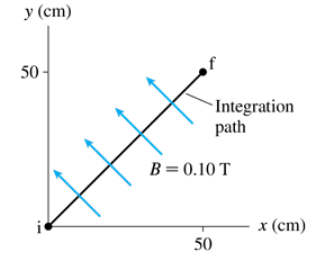
What is the line integral of Bds\(\overrightarrow{B}\[\cdot\]\overrightarrow{ds}\) between points i and f in FIGURE EX29.19?

검증된 단계별 안내
1
Step 1: Understand the problem. The line integral of \( \overrightarrow{B} \cdot \overrightarrow{ds} \) represents the work done by the magnetic field \( \overrightarrow{B} \) along the path of integration. Here, \( \overrightarrow{B} \) is constant with a magnitude of 0.10 T and points in the positive x-direction, while the path is a straight line from point i to point f.
Step 2: Express the line integral mathematically. The line integral is given by \( \int \overrightarrow{B} \cdot \overrightarrow{ds} \), where \( \overrightarrow{ds} \) is the infinitesimal displacement vector along the path. Since \( \overrightarrow{B} \) is constant and the path is straight, the integral simplifies to \( B \int \cos \theta \, ds \), where \( \theta \) is the angle between \( \overrightarrow{B} \) and \( \overrightarrow{ds} \).
Step 3: Determine the angle \( \theta \). From the diagram, \( \overrightarrow{B} \) points in the positive x-direction, and the path from i to f makes a 45° angle with the x-axis. Therefore, \( \theta = 0° \) because \( \overrightarrow{B} \) and the x-component of \( \overrightarrow{ds} \) are aligned.
Step 4: Calculate the path length \( s \). The path is a straight line from point i (0, 0) to point f (50 cm, 50 cm). Using the distance formula, \( s = \sqrt{(x_f - x_i)^2 + (y_f - y_i)^2} \). Substituting the coordinates, \( s = \sqrt{(50)^2 + (50)^2} \).
Step 5: Evaluate the integral. Since \( \cos \theta = 1 \) (as \( \theta = 0° \)), the integral becomes \( B \cdot s \). Substitute \( B = 0.10 \) T and the calculated path length \( s \) to find the result.

비슷한 문제에 대한 검증된 영상 답변:

이 영상 해법은 위 문제에 도움이 된다고 튜터들이 추천한 것입니다.

주요 개념

질문에 올바르게 답하기 위해 반드시 이해해야 하는 핵심 개념들은 다음과 같습니다.

Line Integral

A line integral is a type of integral that allows us to integrate a function along a curve. In physics, it is often used to calculate work done by a force field along a path or to evaluate the circulation of a vector field. The line integral of a vector field extbf{F} along a curve C is given by ∫C extbf{F} · d extbf{s}, where d extbf{s} is a differential element of the curve.
추천 영상:
가이드 코스
11:43
Finding Moment Of Inertia By Integrating

Magnetic Field (B)

The magnetic field, denoted as extbf{B}, is a vector field that describes the magnetic influence on moving electric charges, electric currents, and magnetic materials. It is measured in teslas (T) and can exert forces on charged particles moving through it. In this question, extbf{B} is given as 0.10 T, indicating the strength of the magnetic field along the integration path.
추천 영상:
가이드 코스
05:30
Magnetic Fields and Magnetic Dipoles

Vector Dot Product

The dot product of two vectors is a scalar quantity that measures the extent to which two vectors point in the same direction. It is calculated as extbf{A} · extbf{B} = |A||B|cos(θ), where θ is the angle between the vectors. In the context of the line integral, the dot product extbf{B} · d extbf{s} represents the component of the magnetic field along the path of integration, which is crucial for determining the work done by the magnetic field.
추천 영상:
가이드 코스
09:07
Introduction to Dot Product (Scalar Product)