Ch 30: Electromagnetic Induction
Knight Calc - Physics for Scientists and Engineers 5th Edition
Knight Calc5th EditionPhysics for Scientists and EngineersISBN: 9780137344796당신이 사용하는 게 아니라요?교과서 변경
30장, 문제 9b

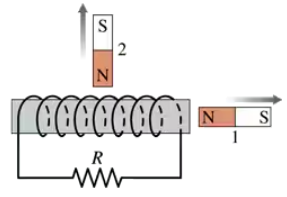
A solenoid is wound as shown in FIGURE EX30.9. Is there an induced current as magnet 2 is moved away from the solenoid? If so, what is the current direction through resistor R?

검증된 단계별 안내
1
Step 1: Analyze the situation using Faraday's Law of Induction, which states that a changing magnetic flux through a loop induces an electromotive force (EMF) in the loop. Magnet 2 is moving away from the solenoid, which changes the magnetic flux through the solenoid.
Step 2: Determine the direction of the change in magnetic flux. As magnet 2 moves away, the magnetic field it contributes to the solenoid decreases. This reduction in magnetic flux induces a current in the solenoid to oppose the change, according to Lenz's Law.
Step 3: Apply Lenz's Law to find the direction of the induced current. The solenoid will generate a magnetic field to counteract the decrease in flux caused by magnet 2 moving away. To do this, the solenoid's induced magnetic field must point in the same direction as the field of magnet 2 (upward).
Step 4: Use the right-hand rule to determine the direction of the induced current in the solenoid. Curl the fingers of your right hand around the solenoid in the direction of the induced magnetic field (upward). Your fingers will point in the direction of the induced current in the solenoid.
Step 5: Trace the current through the circuit to determine its direction through resistor R. Based on the solenoid's winding and the induced current direction, the current flows through resistor R from left to right.

비슷한 문제에 대한 검증된 영상 답변:

이 영상 해법은 위 문제에 도움이 된다고 튜터들이 추천한 것입니다.
도움이 되었나요?

주요 개념

질문에 올바르게 답하기 위해 반드시 이해해야 하는 핵심 개념들은 다음과 같습니다.

Electromagnetic Induction

Electromagnetic induction is the process by which a changing magnetic field within a closed loop induces an electromotive force (EMF) in the wire. This phenomenon is described by Faraday's Law, which states that the induced EMF is proportional to the rate of change of the magnetic flux through the loop. In this scenario, as magnet 2 moves away from the solenoid, the magnetic flux through the solenoid changes, potentially inducing a current.
추천 영상:
가이드 코스
05:42
Introduction to Induction

Lenz's Law

Lenz's Law states that the direction of the induced current will be such that it opposes the change in magnetic flux that produced it. This means that if the magnetic field through the solenoid decreases (as magnet 2 moves away), the induced current will flow in a direction that attempts to maintain the original magnetic field. Understanding Lenz's Law is crucial for determining the direction of the induced current through resistor R.
추천 영상:

Current Direction in a Circuit

The direction of current flow in a circuit is determined by the orientation of the induced EMF and the components within the circuit. In this case, once the induced current is established due to the movement of magnet 2, it will flow through the resistor R. By applying the right-hand rule and considering the effects of Lenz's Law, one can deduce the specific direction of the current in the circuit.
추천 영상:
09:49
Direction of Current in Loop Equations